





Call us
301-363-4651 (Available 9 a.m. to 5 p.m. CST from Monday to Friday)

The immune system is an important system for the body to defend itself against foreign pathogens and maintain internal stability. An immune disorder is a state in which the body's immune system is dysfunctional. This dysfunction may be caused by a variety of factors, including genetics, environment, and lifestyle, and may lead to a variety of diseases. Immune disorders can be divided into two main categories: immunodeficiencies and autoimmune diseases.
Immunodeficiencies and autoimmune diseases are two important groups of immune-related diseases that have seen significant progress in drug development in recent years:
In addition, cytokine analogs have an important role in the treatment of immunodeficiency and autoimmune diseases by modulating the immune response. Examples include NKTR-214, a drug that increases the half-life of IL-2 through PEGylation, and drugs that increase cytokine targeting specificity through fusion technology, such as ALT-803 (IL-15 "super agonist" complex). Antibody fusion cytokines, such as IL-2, TNF, IL-15, etc., are targeted for delivery to the site of disease through specific antibody-directed technologies to improve therapeutic efficacy and minimize side effects.

Measured by its binding ability in a functional ELISA. Immobilized human CD20 at 2 μg/ml can bind Anti-CD20 recombinant antibody (CSB-RA015007A1HU), the EC50 is 3.243-7.085 ng/mL

Human TNFSF13B protein Fc tag (CSB-MP897523HU1) captured on COOH chip can bind Human BCMA protein Fc tag (CSB-MP023974HU1) with an affinity constant of 39 nM as detected by LSPR Assay.
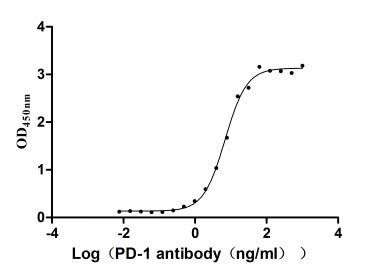
Measured by its binding ability in a functional ELISA. Immobilized PD-1 at 2 μg/ml can bind Anti-PD-1 recombinant antibody, the EC50 of human PD-1 protein is 6.087-7.854 ng/ml.

Measured by its binding ability in a functional ELISA. Immobilized CD22 at 2 μg/ml can bind Anti-CD22 rabbit monoclonal antibody, the EC50 of human CD22 protein is 4.034-4.800 ng/ml.

Measured by its binding ability in a functional ELISA. Immobilized PD-L1 at 2 μg/ml can bind Anti- PD-L1 mouse monoclonal antibody (CSB-MA878942A1m, antigen from E.coli), the EC50 of human PD-L1 protein is 1.252-1.653 ng/mL

Human SIRPA protein His/Myc tag (CSB-MP021334HU) captured on COOH chip can bind Human CD47 protein Fc tag (CSB-MP004940HU) with an affinity constant of 19.1 nM as detected by LSPR Assay.

Measured by its binding ability in a functional ELISA. Immobilized Human IL4 (CSB-MP011659HU) at 2μg/mL can bind biotinylated Human IL4R,the EC50 is 12.68-14.23 ng/mL.

Measured by its binding ability in a functional ELISA. Immobilized CD30 at 5 μg/ml can bind human CD30L(CSB-MP023996HU1c9), the EC50 is 14.96-20.25 ng/ml

CT26/Human ROR1 Stable Cell Line
CSB-SC020067HU
Untransfected CT26 cells (green line) and transfected Human ROR1 CT26 stable cells (red line) were stained with anti-ROR1 antibody (CSB-RA020067A1HU) (2µg/1*106 cells), washed and then followed by FITC-conjugated anti-Human IgG Fc antibody and analyzed with flow cytometry.
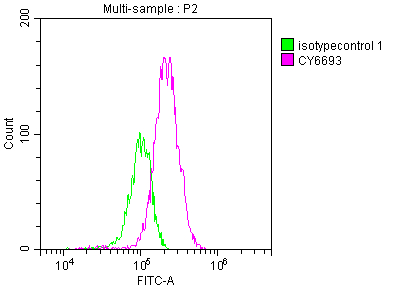
Overlay histogram showing HepG2 cells stained with CSB-RA303909A0HU (red line) at 1:50.

Overlay Peak curve showing Hela cells surface stained with CSB-RA878942MA1HU (red line) at 1:100.

Overlay Peak curve showing 3T3 cells stained with CSB-RA919940A0HU (red line) at 1:50.
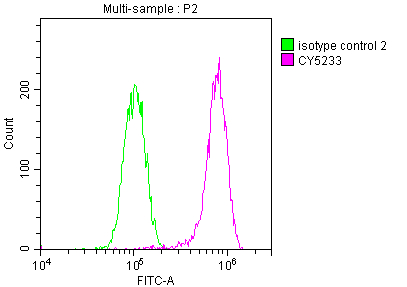
Overlay histogram showing Hela cells stained with CSB-RA983271A0HU (red line) at 1:50.
Tumour


