





Call us
301-363-4651 (Available 9 a.m. to 5 p.m. CST from Monday to Friday)

Prostate cancer is one of the most common malignant tumors of the male reproductive system, and is especially common in the group of men aged 65 and older. Prostate cancer usually grows slowly and many patients may not be affected by prostate cancer during their lifetime. However, for advanced or metastatic prostate cancer, treatment options are limited and the prognosis is poor.
Treatment options for prostate cancer include surgery, radiation therapy, chemotherapy, and hormone therapy. In recent years, significant progress has been made in the field of prostate cancer treatment, especially in targeted therapy and immunotherapy. For example, the development and application of androgen receptor inhibitors such as enzalutamide have provided new treatment options for patients with advanced prostate cancer. In addition, immune checkpoint blockade therapies targeting the programmed death receptor (PD-1) or programmed death ligand (PD-L1) signaling pathways have shown potential in the treatment of prostate cancer.
Recent studies have also revealed that the secreted protein Gremlin1, a novel ligand for FGFR1, regulates tumor cell plasticity through the FGFR1/MAPK signaling pathway and promotes the development of denervation-resistant prostate cancer (CRPC). This provides new candidates and therapeutic strategies for targeted therapy of CRPC.
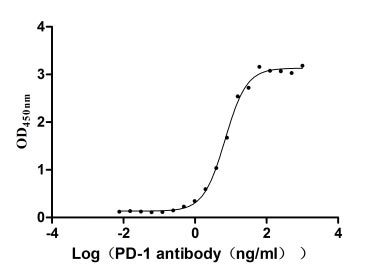
Measured by its binding ability in a functional ELISA. Immobilized PD-1 at 2 μg/ml can bind Anti-PD-1 recombinant antibody, the EC50 of human PD-1 protein is 6.087-7.854 ng/ml.

Measured by its binding ability in a functional ELISA. Immobilized HER2 at 2 μg/ml can bind Trastuzumab, the EC50 is 2.179-2.825 ng/ml.
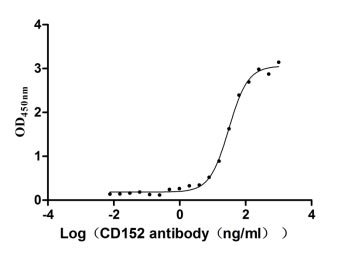
Measured by its binding ability in a functional ELISA. Immobilized CD152 at 2 μg/ml can bind Anti-CD152 rabbit monoclonal antibody (CSB-RA213310A0HU), the EC50 of human CD152 protein is 27.14-34.82 ng/ml.
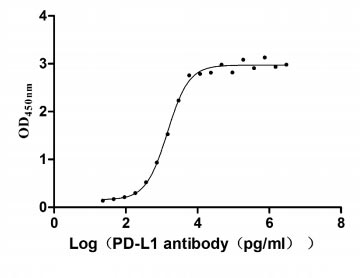
Measured by its binding ability in a functional ELISA. Immobilized PD-L1 at 2 μg/ml can bind Anti- PD-L1 mouse monoclonal antibody(CSB-MA878942A1m, antigen from E.coli), the EC50 of human PD-L1 protein is 1.252-1.653 ng/mL

Measured by its binding ability in a functional ELISA. Immobilized CD276 at 2 μg/ml can bind Anti-CD276 rabbit monoclonal antibody, the EC50 of human CD276 protein is 1.961-2.243 ng/ml.

Measured by its binding ability in a functional ELISA. Immobilized CD46 at 2 μg/ml can bind Anti-CD46 rabbit monoclonal antibody, the EC50 of human CD46 protein is 0.8333-1.054 ng/ml.

Measured by its binding ability in a functional ELISA. Immobilized DLL3 at 2 μg/ml can bind Anti-DLL3 Recombinant Antibody (CSB-RA882142A1HU), the EC50 is 1.102-1.707 ng/mL.

Measured by its binding ability in a functional ELISA. Immobilized DLL3 at 2 μg/ml can bind Anti-DLL3 Recombinant Antibody(CSB-RA882142A1HU), the EC50 is 1.102-1.707 ng/mL.

HEK293F/Human DLL3 Stable Cell Line
CSB-SC882142HU
Untransfected HEK293 cells (green line) and transfected Human DLL3 HEK293 stable cells (red line) were stained with anti-DLL3 antibody (rovalpituzumab-like) (2µg/1*106 cells), washed and then followed by FITC-conjugated anti-Human IgG1 Fc antibody and analyzed with flow cytometry.
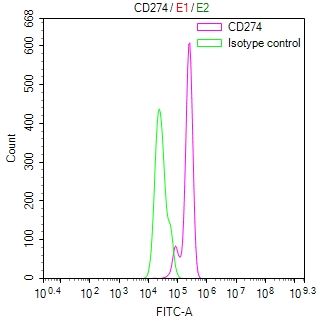
Overlay Peak curve showing Hela cells surface stained with CSB-RA878942MA1HU (red line) at 1:100.

Overlay Peak curve showing THP-1 cells surface stained with CSB-RA004936MA1HU (red line) at 1:100.
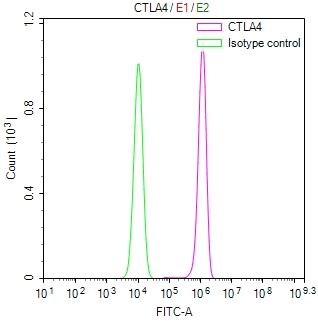
Overlay Peak curve showing JK cells surface stained with CSB-RA006163MA1HU (red line) at 1:50.
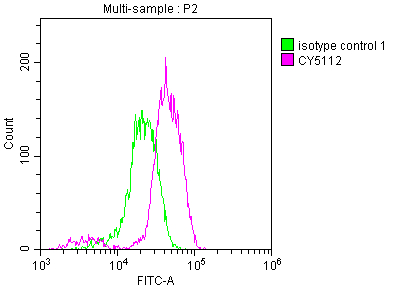
Overlay histogram showing Jurkat cells stained with CSB-RA159341A0HU (red line) at 1:50.
| Product Name | Code | Target | Species Reactivity | Tested Applications |
|---|---|---|---|---|
| CD247 Recombinant Monoclonal Antibody | CSB-RA244537A0HU | CD247 | Human | ELISA, FC |
| CD274 Recombinant Monoclonal Antibody | CSB-RA977797A0HU | CD274 | Human | ELISA, WB, IHC |
| CD274 Recombinant Monoclonal Antibody | CSB-RA878942MA1HU | CD274 | Human | ELISA, IHC, FC |
| CD40 Recombinant Monoclonal Antibody | CSB-RA004936MA1HU | CD40 | Human | ELISA, IF, FC |
| CD47 Recombinant Monoclonal Antibody | CSB-RA802124A0HU | CD47 | Human | ELISA, WB, IHC, IF |
| CDH6 Recombinant Monoclonal Antibody | CSB-RA005055MA1HU | CDH6 | Human | ELISA |
| CTLA4 Recombinant Monoclonal Antibody | CSB-RA213310A0HU | CTLA4 | Human | ELISA, IHC |
| CTLA4 Recombinant Monoclonal Antibody | CSB-RA006163MA1HU | CTLA4 | Human, Mouse | ELISA, WB, IF, FC |
| Phospho-EGFR (Y1092) Recombinant Monoclonal Antibody | CSB-RA007479A1092phHU | EGFR | Human | ELISA, WB |
| Phospho-EGFR (Y1068) Recombinant Monoclonal Antibody | CSB-RA007479A1068phHU | EGFR | Human | ELISA, WB |
| EGFR Recombinant Monoclonal Antibody | CSB-RA159341A0HU | EGFR | Human | ELISA, WB, IHC, IF, FC |
| EGFR Recombinant Monoclonal Antibody | CSB-RA794061A0HU | EGFR | Human | ELISA, WB, IHC |
| EGFR Recombinant Monoclonal Antibody | CSB-RA159341MA1HU | EGFR | Human | ELISA, IHC, FC |
| ERBB2 Recombinant Monoclonal Antibody | CSB-RA260392A0HU | ERBB2 | Human | ELISA, IHC, IF |
| ERBB2 Recombinant Monoclonal Antibody | CSB-RA007763MA1HU | ERBB2 | Human | ELISA |
| Phospho-ERBB2 (Y1139) Recombinant Monoclonal Antibody | CSB-RA588766A0HU | ERBB2 | Human | ELISA, IHC, IF |
| ERBB2 Recombinant Monoclonal Antibody | CSB-RA007763MA2HU | ERBB2 | Human | ELISA, IHC |
| FGFR3 Recombinant Monoclonal Antibody | CSB-RA555849A0HU | FGFR3 | Human | ELISA, IF |
| FGFR3 Recombinant Monoclonal Antibody | CSB-RA966627A0HU | FGFR3 | Human | ELISA, WB |
| IFNAR1 Recombinant Monoclonal Antibody | CSB-RA011046A0HU | IFNAR1 | Human | ELISA |
Tumour


