





Call us
301-363-4651 (Available 9 a.m. to 5 p.m. CST from Monday to Friday)

Leukemia is a malignant tumor affecting the blood and bone marrow, which causes the body to produce large numbers of immature or abnormal white blood cells. These abnormal cells may inhibit the production of normal blood cells, which can lead to a variety of symptoms and complications. Leukemia can be classified into two main categories: acute and chronic, which can be further divided into myeloid and lymphoid based on cell type. In acute leukemia, cell differentiation is stagnant at an early stage and the disease progresses rapidly, while in chronic leukemia, cell differentiation is better and development is slow.
Drug development for leukemia has made significant progress in recent years. For example, targeted therapeutic agents such as tyrosine kinase inhibitors (TKIs) have achieved great success in the treatment of chronic myeloid leukemia (CML), dramatically improving the prognosis of patients. In particular, the introduction of new third-generation TKIs has provided CML patients with more treatment options and better efficacy.
In addition, CAR-T cell therapy, an emerging immunotherapy approach, has shown breakthrough efficacy in the treatment of certain types of leukemia.CAR-T therapy works by modifying a patient's T-cells so that they can recognize and attack cancer cells.

Measured by its binding ability in a functional ELISA. Immobilized human CD20 at 2 μg/ml can bind Anti-CD20 recombinant antibody (CSB-RA015007A1HU), the EC50 is 3.243-7.085 ng/mL

Measured by its binding ability in a functional ELISA. Immobilized CD22 at 2 μg/ml can bind Anti-CD22 rabbit monoclonal antibody, the EC50 of human CD22 protein is 4.034-4.800 ng/ml.
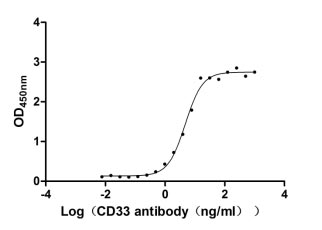
Measured by its binding ability in a functional ELISA. Immobilized CD33 at 2 μg/ml can bind Anti-CD33 rabbit monoclonal antibody, the EC50 of human CD33 protein is 4.289- 5.312 ng/ml.

Human SIRPA protein His/Myc tag (CSB-MP021334HU) captured on COOH chip can bind Human CD47 protein Fc tag (CSB-MP004940HU) with an affinity constant of 19.1 nM as detected by LSPR Assay.
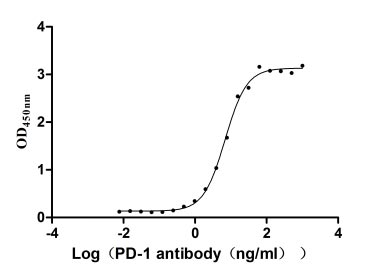
Measured by its binding ability in a functional ELISA. Immobilized PD-1 at 2 μg/ml can bind Anti-PD-1 recombinant antibody, the EC50 of human PD-1 protein is 6.087-7.854 ng/ml.

Measured by its binding ability in a functional ELISA. Immobilized PD-L1 at 2 μg/ml can bind Anti- PD-L1 mouse monoclonal antibody (CSB-MA878942A1m, antigen from E.coli), the EC50 of human PD-L1 protein is 1.252-1.653 ng/mL
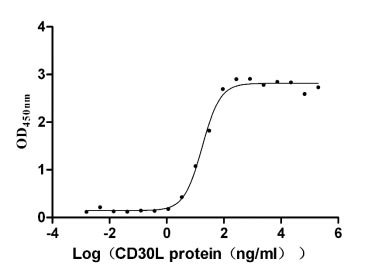
Measured by its binding ability in a functional ELISA. Immobilized CD30 at 5 μg/ml can bind human CD30L(CSB-MP023996HU1c9), the EC50 is 14.96-20.25 ng/ml
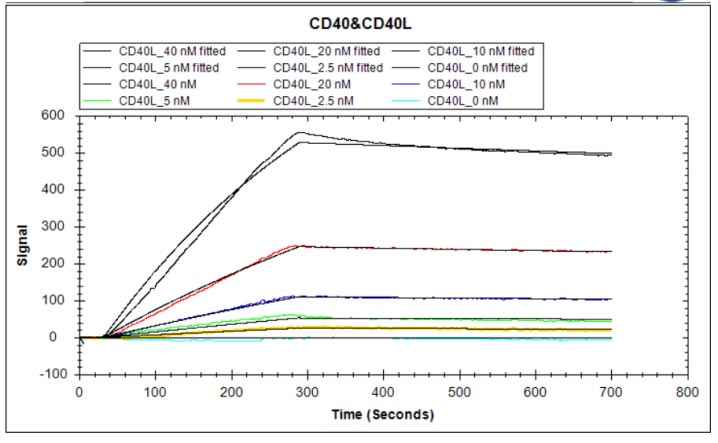
Human CD40 protein hFc tag (CSB-MP004936HU1) captured on COOH chip can bind Human CD40L protein hFc and Flag tag (CSB-MP004937HU3) with an affinity constant of 2.06 nM as detected by LSPR Assay
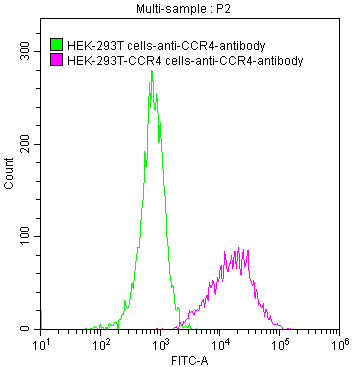
HEK293T/Human CCR4 Stable Cell Line
Untransfected HEK293T cells (green line) and transfected Human CCR4 HEK293T stable cells (red line) were stained with anti-CCR4 antibody (CSB-MA236376) (2µg/1*106), washed and then followed by FITC-conjugated anti-Human IgG Fc antibody and analyzed with flow cytometry.

CT26/Human ROR1 Stable Cell Line
Untransfected CT26 cells (green line) and transfected Human ROR1 CT26 stable cells (red line) were stained with anti-ROR1 antibody (CSB-RA020067A1HU) (2µg/1*106 cells), washed and then followed by FITC-conjugated anti-Human IgG Fc antibody and analyzed with flow cytometry.
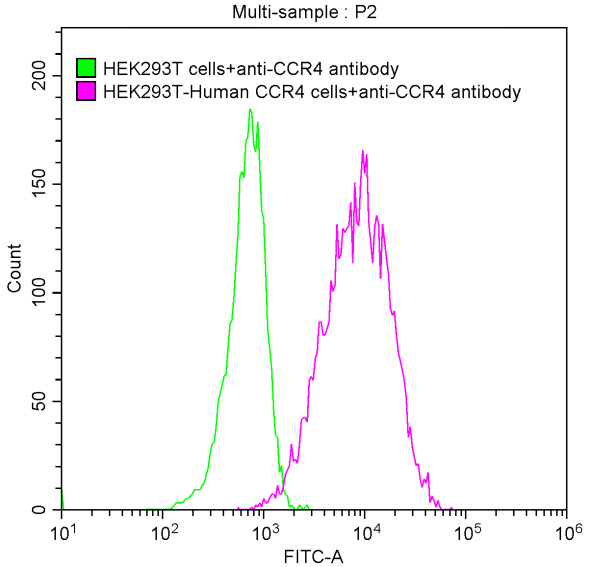
Untransfected HEK293 cells surface (green line) and transfected Human CCR4 HEK293 stable cells surface (red line) were stained with anti-CCR4 antibody (2µl/1*106 cells)
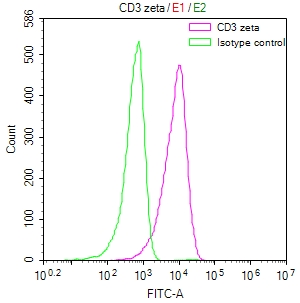
Overlay Peak curve showing Jurkat cells surface stained with CSB-RA244537A0HU (red line) at 1:50.
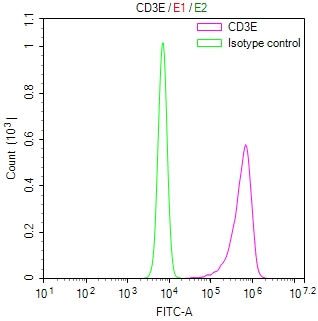
Overlay Peak curve showing JK cells surface stained with CSB-RA004931MA1HU (red line) at 1:100.

Overlay Peak curve showing Hela cells surface stained with CSB-RA004938MA1HU (red line) at 1:100.
Tumour


