* Sample kit cost can be deducted as a $30 credit for each 96-assay kit of the same analyte and brand you subsequently purchase within six months until depleted. More details >>
Interested in a trial size? Please leave a message below.


| Intra-assay Precision (Precision within an assay): CV%<8% | ||||||
| Three samples of known concentration were tested twenty times on one plate to assess. | ||||||
| Inter-assay Precision (Precision between assays): CV%<10% | ||||||
| Three samples of known concentration were tested in twenty assays to assess. | ||||||
| To assess the linearity of the assay, samples were spiked with high concentrations of pig VEGF in various matrices and diluted with the Sample Diluent to produce samples with values within the dynamic range of the assay. | ||||||
| Sample | Serum(n=4) | |||||
| 1:5 | Average % | 92 | ||||
| Range % | 85-98 | |||||
| 1:10 | Average % | 90 | ||||
| Range % | 85-97 | |||||
| 1:20 | Average % | 96 | ||||
| Range % | 89-103 | |||||
| 1:40 | Average % | 86 | ||||
| Range % | 81-92 | |||||
| The recovery of pig VEGF spiked to levels throughout the range of the assay in various matrices was evaluated. Samples were diluted prior to assay as directed in the Sample Preparation section. | ||||||
| Sample Type | Average % Recovery | Range | ||||
| Serum (n=5) | 94 | 89-99 | ||||
| EDTA plasma (n=4) | 96 | 90-102 | ||||
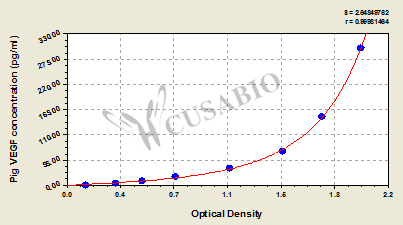
| These standard curves are provided for demonstration only. A standard curve should be generated for each set of samples assayed. | |||||||||||||||||||||||||||||||||||||||||||||||||||||||||||||||
| |||||||||||||||||||||||||||||||||||||||||||||||||||||||||||||||
Vascular endothelial growth factor A (VEGFA) is a key signaling protein that regulates angiogenesis, the formation of new blood vessels from existing vasculature. This growth factor binds to specific receptors on endothelial cells, promoting their proliferation, migration, and survival—processes that are essential in both physiological and pathological angiogenesis. VEGFA plays important roles in embryonic development, wound healing, and tissue repair. Its dysregulation is implicated in various diseases including cancer, diabetic retinopathy, and cardiovascular disorders. Research into VEGFA signaling pathways has provided valuable insights into therapeutic targets for anti-angiogenic treatments.
The Pig Vascular Endothelial cell Growth Factor VEGF ELISA KIT (CSB-E12053p) is designed for quantitative measurement of VEGFA in Sus scrofa samples. This sandwich ELISA works with serum, plasma, and tissue homogenates with a detection range of 4.69 pg/mL to 300 pg/mL and sensitivity of 1.17 pg/mL. The assay requires 50-100 μL sample volume and can be completed within 1-5 hours, with detection performed at 450 nm wavelength.
Application Examples
Note: The following application examples are drawn from a selection of publications citing this product. For additional applications, please refer to the full list of references in the "Citations" section.
This ELISA kit has been used in research studies to quantify vascular endothelial growth factor A levels in cell culture supernatants. The applications show its use in measuring secreted protein concentrations from cultured cells under various experimental conditions.
• Cell culture studies: Measurement of vascular endothelial growth factor A secretion from cultured cells to determine protein production and release
• Biomarker quantification: Analysis of culture media to determine concentrations of secreted growth factors in controlled experimental settings
• Protein expression research: Analysis of cellular responses through quantitative measurement of growth factor levels in culture supernatants





