KRT15 Monoclonal Antibody

CSB-MA785224
Size:
50μl
50μl100μl
US$166
Quantity:
Species Reactivity: Human
Raised in: Mouse
Application: ELISA, IHC
For inquiries on large quantities or another requirements
Send an Inquiry
Start an on-line Chat
Orders can only be placed from within the U.S.

Product Details

Uniprot NO.
Target Names
KRT15
Alternative Names
AI528832 antibody; CK 15 antibody; CK-15 antibody; CK15 antibody; Cytokeratin-15 antibody; Cytokeratin15 antibody; K15 antibody; K1C15_HUMAN antibody; K1CO antibody; Ka15 antibody; Keratin 15 antibody; Keratin 15 basic antibody; Keratin 15 beta antibody; Keratin antibody; Keratin complex 1 acidic gene 15 antibody; Keratin type I cytoskeletal 15 antibody; Keratin-15 antibody; Keratin15 antibody; KRT 15 antibody; Krt1-15 antibody; KRT15 antibody; KRTB antibody; KRTL15 antibody; Type I cytoskeletal 15 antibody; Type I keratin Ka15 antibody
Raised in
Mouse
Species Reactivity
Human
Immunogen
Synthesized peptide derived from human Cytokeratin 15
Immunogen Species
Homo sapiens (Human)
Conjugate
Non-conjugated
Clonality
Monoclonal
Isotype
IgG1, Kappa
Clone No.
17C5
Purification Method
The antibody was affinity-purified from mouse ascites by affinity-chromatography using specific immunogen.
Concentration
It differs from different batches. Please contact us to confirm it.
Buffer
Liquid in PBS containing 50% glycerol, 0.5% BSA and 0.02% sodium azide.
Form
Liquid
Tested Applications
ELISA, IHC
Recommended Dilution
ApplicationRecommended Dilution
IHC1:20-1:200
Storage
Upon receipt, store at -20°C or -80°C. Avoid repeated freeze.
Lead Time
Basically, we can dispatch the products out in 1-3 working days after receiving your orders. Delivery time maybe differs from different purchasing way or location, please kindly consult your local distributors for specific delivery time.
Usage
For Research Use Only. Not for use in diagnostic or therapeutic procedures.
Datasheet & COA
Images
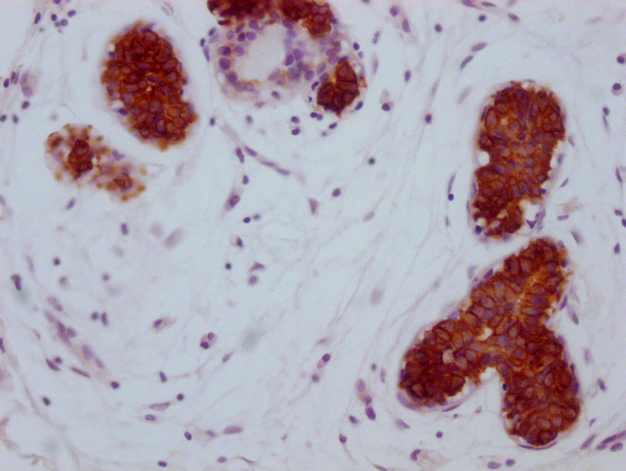
  • IHC image of CSB-MA785224 diluted at 1:100 and staining in paraffin-embedded human breast cancer performed on a Leica BondTM system. After dewaxing and hydration, antigen retrieval was mediated by high pressure in a citrate buffer (pH 6.0). Section was blocked with 10% normal goat serum 30min at RT. Then primary antibody (1% BSA) was incubated at 4°C overnight. The primary is detected by a Goat anti-mouse IgG polymer labeled by HRP and visualized using 0.05% DAB.
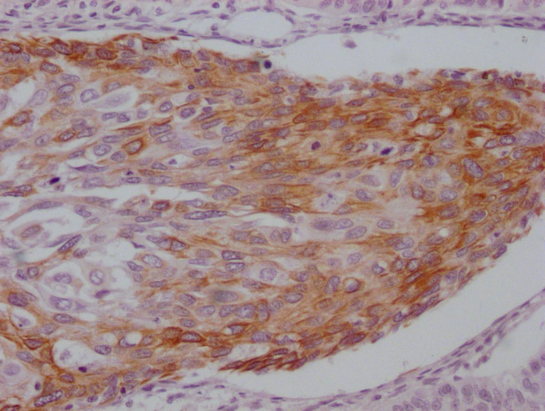
  • IHC image of CSB-MA785224 diluted at 1:100 and staining in paraffin-embedded human cervical cancer performed on a Leica BondTM system. After dewaxing and hydration, antigen retrieval was mediated by high pressure in a citrate buffer (pH 6.0). Section was blocked with 10% normal goat serum 30min at RT. Then primary antibody (1% BSA) was incubated at 4°C overnight. The primary is detected by a Goat anti-mouse IgG polymer labeled by HRP and visualized using 0.05% DAB.
Description

Immunization of mice with a synthesized peptide derived from the human KRT15 protein is the first step in the production of the KRT15 monoclonal antibody. B cells isolated from the mouse spleen are fused with myeloma cells to generate hybridomas. Hybridomas are screened to identify those that produce KRT15 antibodies. The chosen hybridomas are cultured in the mouse abdominal cavity, and the KRT15 monoclonal antibodies are purified using affinity chromatography with a specific immunogen. The resulting KRT15 monoclonal antibody is a mouse monoclonal antibody that binds specifically to human KRT15 protein and can be used for ELISA and IHC applications.

KRT15 is a type I intermediate filament protein that is mainly expressed in basal cells of the skin and other stratified epithelia. Its main function is to provide structural support to cells and tissues, and it plays a critical role in maintaining the integrity and strength of the skin. In addition, KRT15 has been implicated in the regulation of cell proliferation, differentiation, and migration, as well as wound healing and tissue repair processes. Mutations in the KRT15 gene have been linked to various skin disorders, including epidermolysis bullosa simplex and other keratinopathies.

Customer Reviews and Q&A

 Customer Reviews

Target Background

Gene References into Functions
  1. Underexpression of CK15 is associated with Esophageal Squamous Cell Carcinomas. PMID:27797221
  2. Cytokeratin 15 is upregulated in a subset of urothelial cell carcinomas. PMID:24260555
  3. K15 is expressed variably in both oral squamous cell carcinoma and squamous intraepithelial neoplasm PMID:22648550
  4. both expanded limbal NCs and HUVEC rejoined with LEPC to form spheres to upregulate expression of DeltaNp63alpha, CK15, and CEBPdelta, the former but not the latter abolished expression of CK12 keratin. PMID:22538425
  5. Stromal expression of KRT15, TCN1, and HOXB13 was significantly correlated with tumor grade, stromal hypercellularity, mitotic activity and microscopic borders. PMID:21574054
  6. CK15 highlights BZ cells in normal human follicles PMID:21251039
  7. Physiological concentrations of thyroid hormones T3 and T4 enhance keratin 15 promoter activity and expression in epithelial stem cells of adult human scalp hair follicles in situ and in vitro. PMID:20656376
  8. Report expression of stem-cell markers cytokeratin 15 and nestin in primary adnexal neoplasms. PMID:20700038
  9. Results identify the regulators of keratin 15 promoter activity and their binding sites. PMID:15060141
  10. Cytokeratin 15 expression pattern is useful in terms of distinguishing trichoepithelioma from basal cell carcinoma. PMID:18789069
  11. marker of the hair follicle stem cells; diminished during scarring in alopecia and discoid lupus erythematosus PMID:19162247
  12. Identification of a subset of breast carcinomas characterized by expression of CK15: relationship between CK15+ progenitor/amplified cells and pre-malignant lesions and invasive disease is reported. PMID:19383306
  13. KRT15 is a Gli1-responsive gene in human skin keratinocytes PMID:20050020
  14. KRT15 mRNA is selectively expressed in human hair follicle stem cells, while KRT15 protein is not. PMID:20050020

Show More

Hide All

Protein Families
Intermediate filament family
Tissue Specificity
Expressed in a discontinuous manner in the basal cell layer of adult skin epidermis, but continuously in the basal layer of fetal skin epidermis and nail. Also expressed in the outer root sheath above the hair bulb in hair follicle (at protein level). Exp
Database Links

HGNC: 6421

UNIGENE: Hs.654570

KEGG: hsa:3866

STRING: 9606.ENSP00000254043

OMIM: 148030

icon of phone
Call us
301-363-4651 (Available 9 a.m. to 5 p.m. CST from Monday to Friday)

icon of address
Address
7505 Fannin St., Ste 610, Room 7 (CUBIO Innovation Center), Houston, TX 77054, USA
icon of social media
Join us with

Subscribe newsletter

Leave a message

* To protect against spam, please pass the CAPTCHA test below.
CAPTCHA verification
© 2007-2025 CUSABIO TECHNOLOGY LLC All rights reserved. 鄂ICP备15011166号-1
Select 0 Products