Tag-Free
The tag type will be determined during production process. If you have specified tag type, please tell us and we will develop the specified tag preferentially.
Buffer
35% FBS + 55% F-12K + 10% DMSO
Storage
Frozen in liquid nitrogen or stored at -80°C
Lead Time
Basically, we can dispatch the products out in 1-3 working days after receiving your orders. Delivery time maybe differs from different purchasing way or location, please kindly consult your local distributors for specific delivery time.
Note: All of our proteins are default shipped with normal blue ice packs, if you request to ship with dry ice, please communicate with us in advance and extra fees will be charged.
Images
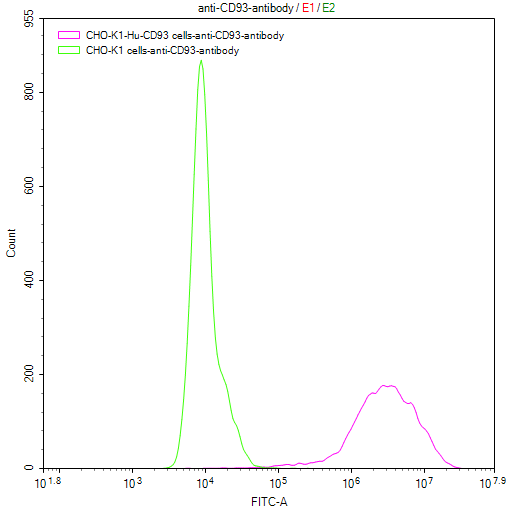
Untransfected CHO-K1 cells (green line) and transfected Human CD93 CHOK1 Stable cells (red line) were stained with anti-CD93 antibody(CSB-RA865099MA1HU) (2µg/1*106cells), washed and then followed by FITC-conjugated anti-Human IgG Fc antibody and analyzed with flow cytometry.
Receptor (or element of a larger receptor complex) for C1q, mannose-binding lectin (MBL2) and pulmonary surfactant protein A (SPA). May mediate the enhancement of phagocytosis in monocytes and macrophages upon interaction with soluble defense collagens. May play a role in intercellular adhesion.
Gene References into Functions
Report increased CD93 expression in patients with chronic plaque psoriasis and propose the C allele of rs2749817 as a new risk allele for psoriasis.PMID:28421233
Results show that CD93 and MMRN2 are co-expressed in the blood vessels of various tumors and their interaction modulates the angiogenic process.PMID:28912033
These findings identify novel protein interactions involving CLEC14A, CD93 and CD248 with MMRN2 as targetable components of vessel formationPMID:28671670
CD93 and Other Plasma Cell Survival Factor Genes Associated with Measles-Specific Antibody Response after VaccinationPMID:27529750
Soluble expression of disulfide-bonded C-type lectin like domain of human CD93 in the cytoplasm of Escherichia coli. The recombinant protein could alter LPS pro-inflammatory activity on THP1 cells.PMID:27742562
Vascular CD93 expression is elevated in nasopharyngeal carcinoma and is correlated with T classification, N classification, distant metastasis, clinical stage and poor prognosis (all P < 0.05). In addition, overexpression of CD93 promoted angiogenesis in vitro.PMID:27255994
both transmembrane and soluble CD93 are overexpressed in patients with neovascular Age-Related Macular Degeneration.PMID:27859225
Elevated serum sCD93 levels reflected exacerbated status of allergic diseases, including CSU [chronic spontaneous urticaria ], AR[allergic rhinitis], and asthma. ICS [inhaled corticosteroid] use significantly diminished serum sCD93 levels in steroid-naive patients with BA[Bronchial asthma]. This result may suggest sCD93 in serum as a therapeutic marker for allergic inflammation.PMID:28332366
Data show that CD93 antigen proved to be phosphorylated on tyrosine 628 and 644 following cell adhesion on laminin through dystroglycan.PMID:26848865
CD93 expression identifies a predominantly cycling, non-quiescent leukemia-initiating cell population in MLL-rearranged AML, providing opportunities for selective targeting and eradication of LSCs.PMID:26387756
The T/T genotype of SNP rs2749817 of CD93 is associated with disseminated cancer.PMID:26008729
CD93 is a key regulator of glioma angiogenesis and vascular function, acting via cytoskeletal rearrangements required for cell-cell and cell-matrix adhesion.PMID:26363010
These data support a mechanism whereby gC1qR plays an important role in HPV-16 E2-induced human cervical squamous carcinoma cell apoptosis via a mitochondria-dependent pathway.PMID:25288439
The data indicate that gC1qR inhibits viability, migration and proliferation of cervical squamous cells carcinoma via the p38 MAPK signalling pathway.PMID:23052251
Antibody-dependent enhancement of parvovirus B19 involves an alternative mechanism mediated by the heat-sensitive complement factor C1q and its receptor, CD93.PMID:24807719
Expression of CD93 on the lymphocyte population of peripheral blood cells from infants at 1 month after birth was also significantly decreased, compared with that for neonatal umbilical cord blood.PMID:24033555
HPV 16 E2 induces apoptosis by silencing the gC1qR gene or inhibiting p38 MAPK/JNK signalling in cervical squamous cell carcinomaPMID:23651874
These data support a mechanism whereby gC1qR induces apoptosis through the mitochondrial and p53-dependent pathways in cervical squamous cell carcinoma.PMID:23268996
soluble EGF-like domain containing CD93 protein is a novel angiogenic factor acting on the endotheliumPMID:23272129
[review] Following a comprehensive summary of CD93 expression patterns, this review focuses on recent findings that address the putative function of CD93 in inflammation and innate immunity.PMID:22206251
Data show that Pic, a class 2 SPATE protein produced by Shigella flexneri 2a targets a broad range of human leukocyte glycoproteins including CD43, CD44, CD45, CD93, CD162 and the surface-attached chemokine fractalkine.PMID:21768350
Results suggest that the plasma concentration of soluble CD93 is a potential novel biomarker for Coronary Artery Disease (CAD), including MI.PMID:21332844
expression on naive T lymphocytes (CD4(+)CD45RA (+) cells) in human neonatal umbilical cord bloodPMID:20512406
both B1 receptor and gC1q receptor are involved in the vascular leakage induced by hereditary and acquired angioedema plasma.PMID:19796797
To clarify the cellular and molecular properties of C1qRp it has been demonstrated that C1q does not show enhanced binding to C1qRp-transfected cells, is not a receptor for C1q, and is identical to CD93 with functions relevant to intercellular adhesion.PMID:11994479
C1qRp defines a new human stem cell population with hematopoietic and hepatic potentialPMID:12140365
O-glycosylation is important in the stable cell surface expression of C1qRP/CD93PMID:12891708
Taken together, these findings indicate that the expression of the CD93 molecule identified by CD93 mAb (mNI-11) is dramatically decreased on U937 cells with apoptotic propertiesPMID:18094537
RNAi-mediated suppression of gC1qR/p32 markedly reduced HTNV binding and infection in human lung epithelial A549 cellsPMID:18834607
Show
More
Hide
All
Subcellular Location
Membrane; Single-pass type I membrane protein.
Tissue Specificity
Highly expressed in endothelial cells, platelets, cells of myeloid origin, such as monocytes and neutrophils. Not expressed in cells of lymphoid origin.