Recombinant Rat GTPase HRas (Hras)

Code: CSB-RP155374r
Size:
20μg
20μg100μg1mg(1mg*1 or 500ug*2)
US$306
Quantity:
Express system: E.coli
Species: Rattus norvegicus (Rat)
Tag Info: N-terminal 6xHis-tagged
For inquiries on large quantities or another requirements
Send an Inquiry
Start an on-line Chat
Online ordering is currently available for U.S. customers only. For orders outside the U.S., please kindly submit an inquiry or start a chat with us.

Product Details

Purity
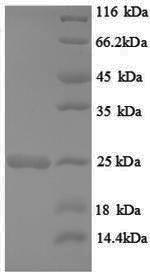
Greater than 90% as determined by SDS-PAGE.
Target Names
Hras
Uniprot NO.
Research Area
Others
Alternative Names
H-Ras-1Transforming protein p21c-H-rasp21ras
Species
Rattus norvegicus (Rat)
Source
E.coli
Expression Region
2-186aa
Target Protein Sequence
TEYKLVVVGAGGVGKSALTIQLIQNHFVDEYDPTIEDSYRKQVVIDGETCLLDILDTAGQEEYSAMRDQYMRTGEGFLCVFAINNTKSFEDIHQYREQIKRVKDSDDVPMVLVGNKCDLAARTVESRQAQDLARSYGIPYIETSAKTRQGVEDAFYTLVREIRQHKLRKLNPPDESGPGCMSCKC
Note: The complete sequence may include tag sequence, target protein sequence, linker sequence and extra sequence that is translated with the protein sequence for the purpose(s) of secretion, stability, solubility, etc.
If the exact amino acid sequence of this recombinant protein is critical to your application, please explicitly request the full and complete sequence of this protein before ordering.
Mol. Weight
24.9kDa
Protein Length
Full Length of Mature Protein
Tag Info
N-terminal 6xHis-tagged
The tag type will be determined during production process. If you have specified tag type, please tell us and we will develop the specified tag preferentially.
Reconstitution
We recommend that this vial be briefly centrifuged prior to opening to bring the contents to the bottom. Please reconstitute protein in deionized sterile water to a concentration of 0.1-1.0 mg/mL.We recommend to add 5-50% of glycerol (final concentration) and aliquot for long-term storage at -20°C/-80°C. Our default final concentration of glycerol is 50%. Customers could use it as reference.
Storage
The shelf life is related to many factors, storage state, buffer ingredients, storage temperature and the stability of the protein itself. Generally, the shelf life of liquid form is 6 months at -20°C/-80°C. The shelf life of lyophilized form is 12 months at -20°C/-80°C.
Shelf Life
The shelf life is related to many factors, storage state, buffer ingredients, storage temperature and the stability of the protein itself.
Generally, the shelf life of liquid form is 6 months at -20°C/-80°C. The shelf life of lyophilized form is 12 months at -20°C/-80°C.
Lead Time
Delivery time may differ from different purchasing way or location, please kindly consult your local distributors for specific delivery time.
Note: All of our proteins are default shipped with normal blue ice packs, if you request to ship with dry ice, please communicate with us in advance and extra fees will be charged.
Notes
Repeated freezing and thawing is not recommended. Store working aliquots at 4°C for up to one week.
Troubleshooting and FAQs
Datasheet & COA
Please contact us to get it.
Images
  • (Tris-Glycine gel) Discontinuous SDS-PAGE (reduced) with 5% enrichment gel and 15% separation gel.

Customer Reviews and Q&A

 Customer Reviews

Target Background

Function(From Uniprot)
Ras proteins bind GDP/GTP and possess intrinsic GTPase activity.
Gene References into Functions
  1. Together, these results suggest a novel mechanism regulating PATZ1 expression based on the upregulation of miR-29b expression induced by Ras oncogene. PMID:27125250
  2. H-ras isoform mediates protection against pressure overload-induced cardiac dysfunction in part through activation of AKT/PI3K signaling pathway. PMID:28193718
  3. Phenotypic Screening Identifies Protein Synthesis Inhibitors as H-Ras-Nanocluster-Increasing Tumor Growth Inducers. PMID:26568031
  4. H-Ras mediates the inhibitory effect of epidermal growth factor on the epithelial Na+ channel PMID:25774517
  5. Data indicate that numerous proteins that are up-regulated in H-ras(G12V) transgenic rat pancreatic ductal adenocarcinoma (PDAC) are also up-regulated in human PDAC; therefore, this rat model can be used for diagnostic biomarkers for this disease. PMID:23648844
  6. Fe(2+)-generated O(2) mediates p21(ras) and TAK1 activation via PTP inhibition and Lys(63)-polyUb of TRAF6 in caveosomes for proinflammatory M1 activation in hepatic macrophages PMID:22829592
  7. The proto-oncogenic H-Ras is directly involved in the promotion of muscle differentiation via PI3K and its downstream signaling pathways. PMID:20603646
  8. Data show that Myc repressed Ras-induced senescence, and that Cdk2 interacted with Myc at promoters, where it affected Myc-dependent regulation of genes, including those of proteins known to control senescence. PMID:19966300
  9. We examined if H-Ras and K-Ras proteins, which are distributed across different plasma membrane microdomains, have equal access to the endocytic compartment and whether this access is necessary for downstream signaling. PMID:12077341
  10. A positive regulatory role of Ras is observed in AMPA receptor-mediated synaptic transmission in hippocampal pyramidal neurons. PMID:12824760
  11. Functional activation of H-Ras might be one of the signaling steps involved in glucose-induced capillary cell apoptosis. PMID:14988264
  12. Silencing of individual genes by DNA methylation is controlled by HRAS oncogenic signalling pathways, yet the mechanisms responsible for initial target gene suppression are variable. PMID:16568090
  13. H-ras suppresses integrin affinity via independent Raf and phospholipase C epsilon signaling pathways. PMID:16895916
  14. analysis of tumor induction with expression plasmids for activated H-ras and c-myc PMID:18218323
  15. Infection with M. arginini made rat and mouse embryo fibroblasts susceptible to transformation with oncogenic H-Ras PMID:18408766
  16. induction of long-term potentiation triggered robust Ca2+-dependent Ras activation in single spines that decayed in approximately 5 minutes; Ras activity spread over approximately 10 micrometers of dendrite and invaded neighboring spines by diffusion PMID:18556515
  17. trend of increased H-ras expression was observed in diabetic compared to normal rats during oncogenesis PMID:19283661

Show More

Hide All

Subcellular Location
Cell membrane. Cell membrane; Lipid-anchor; Cytoplasmic side. Golgi apparatus. Golgi apparatus membrane; Lipid-anchor.
Protein Families
Small GTPase superfamily, Ras family
Database Links

  Email: support@cusabio.com
  Distributors Worldwide

CUSABIO guaranteed quality
icon of phone
Call us
301-363-4651 (Available 9 a.m. to 5 p.m. CST from Monday to Friday)
icon of address
Address
No. 269, Shendun 5th Road, Donghu Hi-Tech Development Area, Hubei Province, 430206, P.R.China
icon of social media
Join us with

Subscribe newsletter

Leave a message

* To protect against spam, please pass the CAPTCHA test below.
CAPTCHA verification
© 2007-2025 CUSABIO TECHNOLOGY LLC All rights reserved. 鄂ICP备15011166号-1
Select 0 Products