Recombinant Human C-C motif chemokine 8 (CCL8)

Code: CSB-EP004802HU
Size:
20ug
20ug100ug1mg(1mg*1 or 500ug*2)
US$224
Quantity:
Express system: E.coli
Species: Homo sapiens (Human)
Tag Info: N-terminal GST-tagged
For inquiries on large quantities or another requirements
Send an Inquiry
Start an on-line Chat
Online ordering is currently available for U.S. customers only. For orders outside the U.S., please kindly submit an inquiry or start a chat with us.

Product Details

Purity
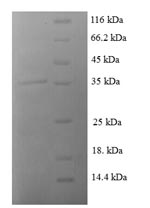
Greater than 90% as determined by SDS-PAGE.
Target Names
CCL8
Uniprot NO.
Research Area
Immunology
Alternative Names
HC14;Monocyte chemoattractant protein 2;Monocyte chemotactic protein 2 ;MCP-2;Small-inducible cytokine A8
Species
Homo sapiens (Human)
Source
E.coli
Expression Region
24-99aa
Target Protein Sequence
QPDSVSIPITCCFNVINRKIPIQRLESYTRITNIQCPKEAVIFKTKRGKEVCADPKERWVRDSMKHLDQIFQNLKP
Note: The complete sequence may include tag sequence, target protein sequence, linker sequence and extra sequence that is translated with the protein sequence for the purpose(s) of secretion, stability, solubility, etc.
If the exact amino acid sequence of this recombinant protein is critical to your application, please explicitly request the full and complete sequence of this protein before ordering.
Mol. Weight
35.9kDa
Protein Length
Full Length of Mature Protein
Tag Info
N-terminal GST-tagged
The tag type will be determined during production process. If you have specified tag type, please tell us and we will develop the specified tag preferentially.
Reconstitution
We recommend that this vial be briefly centrifuged prior to opening to bring the contents to the bottom. Please reconstitute protein in deionized sterile water to a concentration of 0.1-1.0 mg/mL.We recommend to add 5-50% of glycerol (final concentration) and aliquot for long-term storage at -20°C/-80°C. Our default final concentration of glycerol is 50%. Customers could use it as reference.
Storage
The shelf life is related to many factors, storage state, buffer ingredients, storage temperature and the stability of the protein itself. Generally, the shelf life of liquid form is 6 months at -20°C/-80°C. The shelf life of lyophilized form is 12 months at -20°C/-80°C.
Shelf Life
The shelf life is related to many factors, storage state, buffer ingredients, storage temperature and the stability of the protein itself.
Generally, the shelf life of liquid form is 6 months at -20°C/-80°C. The shelf life of lyophilized form is 12 months at -20°C/-80°C.
Lead Time
Delivery time may differ from different purchasing way or location, please kindly consult your local distributors for specific delivery time.
Note: All of our proteins are default shipped with normal blue ice packs, if you request to ship with dry ice, please communicate with us in advance and extra fees will be charged.
Notes
Repeated freezing and thawing is not recommended. Store working aliquots at 4°C for up to one week.
Troubleshooting and FAQs
Datasheet & COA
Please contact us to get it.
Images
  • (Tris-Glycine gel) Discontinuous SDS-PAGE (reduced) with 5% enrichment gel and 15% separation gel.

Customer Reviews and Q&A

 Customer Reviews
 Q&A
Q:

Do you happen to have LAL testing done on your CCL8 protein, expressed in Yeast, catalog number CSB-EP004802HU ? We are interested in using this on cells, but we are worried about endotoxin levels. If not, is that something that your company is easily able to run and find out?

A:
Very nice to receive your inquiry. If you would perform cell relevant experiment, we could provide Endotoxin Removal Service and Aseptic Manufacture Processing free of charge. The details are as below.
Please kindly remark "Endotoxin Removal Service & Aseptic Manufacture Processing" in your PO.
Endotoxin Removal Service
a.If customer plans to use a protein in cell culture, please check with us if it has been endotoxin tested and if it is suitable for this purpose.
b.If customer has requirement for endotoxin level, please remark this information when placing the order and we could offer endotoxin removal service free of charge.
c.We use conjugated PMB affinity filler adsorption to remove endotoxin and guarantee endotoxin level within 0.1ng / ug (1EU / ug).
d.Generally, the delivery time will be extended for 2-3 working days.
e.Endotoxin removal result will be shown in COA as follows “<1.0 EU per 1μg of the protein by the LAL method.”
Aseptic Manufacture Processing
a.If customer plans to use a protein in cell culture, please check with them if aseptic manufacture processing is required. If customer has demand for aseptic manufacture processing, then please remark this
information when placing the order.
b.We could offer aseptic manufacture processing service free of charge.
c.The delivery time won’t be extended.
d.We've performed Aseptic processing for liquid protein, before lyophilization, but there may exist contamination during lyophilization process, so we can't say bacteria free for the whole process.
e.Aseptic manufacture processing will be shown in both of datasheet & COA as follows “0.2 μm sterile filtered 20 mM Tris-HCl, 0.5 M NaCl, pH 8.0, 50% glycerol”.

Target Background

Function(From Uniprot)
Chemotactic factor that attracts monocytes, lymphocytes, basophils and eosinophils. May play a role in neoplasia and inflammatory host responses. This protein can bind heparin. The processed form MCP-2(6-76) does not show monocyte chemotactic activity, but inhibits the chemotactic effect most predominantly of CCL7, and also of CCL2 and CCL5 and CCL8.
Gene References into Functions
  1. It was shown that MCP2 was able to activate the NF-kappaB signaling pathway inducing the epithelial-mesenchymal transition (EMT) and promoting the migration and invasion of ESCC cells in vitro. PMID:29148603
  2. Transcriptome analysis identified several novel IPF-related genes. Among them, CCL8 is a candidate molecule for the differential diagnosis and prediction of survival. PMID:28057004
  3. Findings exemplify how gradients of chemoattractive factors such as CCL8, drive metastasis and suggest that interference with their operation may provide means for breast cancer management. PMID:27181207
  4. Detecting expression changes in TLR4 and MCP2 in the peripheral blood is a feasible method for predicting the occurrence of abortion in women of child-bearing age PMID:27173235
  5. Dermal fibroblast CCL8 promotes melanoma metastasis. PMID:26320180
  6. Authors show that the previously observed downregulation of hsa-miR-92a and upregulation of CCL8 during human cytomegalovirus latent infection of myeloid cells are intimately linked via the latency-associated expression of cytomegalovirus UL111A. PMID:25253336
  7. CCL8 is an antimicrobial protein with bacteriocidal activity against E. coli. PMID:12949249
  8. Results indicate that the induction of MCP-2/CCL8 by mycobacteria is dependent on the activation of TLR2/PI3K/Akt signaling pathway. PMID:23418602
  9. Macrophage Colony Stimulating Factor and Monocyte Chemoattractant Protein are elevated in sera of intrinsic asthmatics compared to normal controls. PMID:21945122
  10. genetic polymorphhism is associated with a risk of death for non-small cell lung cancer in Chinese PMID:21514686
  11. Cytokine treatment increases mRNA stability only for chemokines CCL2 and CCL8 in airway epithelium, and transient silencing and overexpression of human antigen R affects only chemokine CCL2 and CCL8 expression in primary and transformed epithelial cells. PMID:21220697
  12. CCL8/MCP-2 is a target for mir-146a in HIV-1 infected microglia, as overexpression of mir-146a prevented HIV-induced secretion of MCP-2 chemokine PMID:20181935
  13. TRAIL pretreatment of endothelial cells down-modulated mRNA steady-state levels of several TNF-alpha-induced chemokines, and it abrogated the TNF-alpha-mediated up-regulation of CCL8 and CXCL10, modulating leukocyte/endothelial cell adhesion PMID:15644410
  14. Angiotensin II directly stimulates MCP-2 expression through AT1-receptors in activated macrophages PMID:17487826
  15. CCL8 is a promising specific serum marker for the early and accurate diagnosis of graft-versus-host disease. PMID:18256320
  16. A new finding is the differential distribution of CCL8 marker alleles and a haplotype in extreme severity subgroups of MS. PMID:18602166
  17. IP-10 and MCP-2 are expressed in tuberculosis patients PMID:18684849
  18. 5-Amino-4-imidazole carboxamide riboside (AICAR) markedly increases UCP-2 expression and reduced both reactive oxygen species and prostacyclin synthase nitration. PMID:18835932
  19. These data indicate that optimal induction and delivery of MCP-2/CCL8 is counteracted by converting this chemokine into a receptor antagonist, thereby losing its anti-tumoral potential. PMID:19224633
  20. CCL8/MCP rs1133763 SNP, or other variants in linkage disequilibrium with this variant, likely do not influence the susceptibility to AD or FTLD in Caucasians. PMID:19415413

Show More

Hide All

Subcellular Location
Secreted.
Protein Families
Intercrine beta (chemokine CC) family
Tissue Specificity
Highest expression found in the small intestine and peripheral blood cells. Intermediate levels seen in the heart, placenta, lung, skeletal muscle, thymus, colon, ovary, spinal cord and pancreas. Low levels seen in the brain, liver, spleen and prostate.
Database Links

HGNC: 10635

UNIGENE: Hs.271387

KEGG: hsa:6355

STRING: 9606.ENSP00000378118

OMIM: 602283

icon of phone
Call us
301-363-4651 (Available 9 a.m. to 5 p.m. CST from Monday to Friday)

icon of address
Address
No. 269, Shendun 5th Road, Donghu Hi-Tech Development Area, Hubei Province, 430206, P.R.China
icon of social media
Join us with

Subscribe newsletter

Leave a message

* To protect against spam, please pass the CAPTCHA test below.
CAPTCHA verification
© 2007-2025 CUSABIO TECHNOLOGY LLC All rights reserved. 鄂ICP备15011166号-1
Select 0 Products