Recombinant Human C-C motif chemokine 24 (CCL24)

Code: CSB-EP004788HU
Size:
20ug
20ug100ug1mg(1mg*1 or 500ug*2)
US$224
Quantity:
Express system: E.coli
Species: Homo sapiens (Human)
Tag Info: N-terminal 6xHis-tagged
For inquiries on large quantities or another requirements
Send an Inquiry
Start an on-line Chat
Online ordering is currently available for U.S. customers only. For orders outside the U.S., please kindly submit an inquiry or start a chat with us.

Product Details

Purity
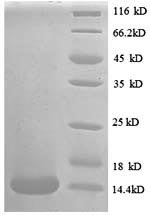
Greater than 90% as determined by SDS-PAGE.
Target Names
CCL24
Uniprot NO.
Research Area
Immunology
Alternative Names
CK-beta-6Eosinophil chemotactic protein 2Eotaxin-2Myeloid progenitor inhibitory factor 2 ;MPIF-2Small-inducible cytokine A24
Species
Homo sapiens (Human)
Source
E.coli
Expression Region
27-119aa
Target Protein Sequence
VVIPSPCCMFFVSKRIPENRVVSYQLSSRSTCLKAGVIFTTKKGQQFCGDPKQEWVQRYMKNLDAKQKKASPRARAVAVKGPVQRYPGNQTTC
Note: The complete sequence may include tag sequence, target protein sequence, linker sequence and extra sequence that is translated with the protein sequence for the purpose(s) of secretion, stability, solubility, etc.
If the exact amino acid sequence of this recombinant protein is critical to your application, please explicitly request the full and complete sequence of this protein before ordering.
Mol. Weight
14.5kDa
Protein Length
Full Length of Mature Protein
Tag Info
N-terminal 6xHis-tagged
The tag type will be determined during production process. If you have specified tag type, please tell us and we will develop the specified tag preferentially.
Reconstitution
We recommend that this vial be briefly centrifuged prior to opening to bring the contents to the bottom. Please reconstitute protein in deionized sterile water to a concentration of 0.1-1.0 mg/mL.We recommend to add 5-50% of glycerol (final concentration) and aliquot for long-term storage at -20°C/-80°C. Our default final concentration of glycerol is 50%. Customers could use it as reference.
Storage
The shelf life is related to many factors, storage state, buffer ingredients, storage temperature and the stability of the protein itself. Generally, the shelf life of liquid form is 6 months at -20°C/-80°C. The shelf life of lyophilized form is 12 months at -20°C/-80°C.
Shelf Life
The shelf life is related to many factors, storage state, buffer ingredients, storage temperature and the stability of the protein itself.
Generally, the shelf life of liquid form is 6 months at -20°C/-80°C. The shelf life of lyophilized form is 12 months at -20°C/-80°C.
Lead Time
Delivery time may differ from different purchasing way or location, please kindly consult your local distributors for specific delivery time.
Note: All of our proteins are default shipped with normal blue ice packs, if you request to ship with dry ice, please communicate with us in advance and extra fees will be charged.
Notes
Repeated freezing and thawing is not recommended. Store working aliquots at 4°C for up to one week.
Troubleshooting and FAQs
Datasheet & COA
Please contact us to get it.
Images
  • (Tris-Glycine gel) Discontinuous SDS-PAGE (reduced) with 5% enrichment gel and 15% separation gel.

Customer Reviews and Q&A

 Customer Reviews

Target Background

Function(From Uniprot)
Chemotactic for resting T-lymphocytes, and eosinophils. Has lower chemotactic activity for neutrophils but none for monocytes and activated lymphocytes. Is a strong suppressor of colony formation by a multipotential hematopoietic progenitor cell line. Binds to CCR3.
Gene References into Functions
  1. Study showed that CCL24 was upregulated in hepatocellular carcinoma (HCC) tissues and correlated with poor prognosis in HCC patients . Also, CCL24 was associated with the metastatic potential of HCC cell lines and promoted proliferation, migration, and invasion. PMID:28042950
  2. Mean eotaxin 2 concentrations in nasal fluid in patients with perennial allergic rhinitis and nonallergic and allergic chronic rhinosinusitis with nasal polyps patients were significantly higher in comparison to control subjects. PMID:28587510
  3. HMGB1 did not elicit chemotaxis of human eosinophils alone and had no effect in combination with the eosinophil chemotactic agent, eotaxin-2 (CCL24). PMID:25774667
  4. these data suggest that CCL26 and CCL24 are likely involved in the pathogenesis of chronic nasal hypereosinophilia, with a complex cooperation and different involvement of the various members of eotaxin family. PMID:24989688
  5. Pregnancy associated environments increased local CCL24/CCR3, supporting the process of decidualization in human early pregnancy. PMID:23696919
  6. Phosphodiesterase 4 inhibitors, rolipram and RO-20-1724 have no effect on CCL24 expression in human primary bronchial epithelial cells. PMID:22946025
  7. Study shows that CCL24 levels were significantly increased in age-related macular degeneration (AMD) patients despite Avastin treatment as compared with normal controls and those without Avastin. PMID:23025269
  8. CCR3 is differentially expressed on inflammatory cells in rheumatoid arthritis, while eotaxin-2, a potent CCR3 agonist, is differentially expressed in active disease. PMID:20659406
  9. stimulates lung fibroblast proliferation and collagen synthesis PMID:20143648
  10. alters eosinophil integrin function via mitogen-activated protein kinases PMID:12034562
  11. Intradermal injection of CCL24 induces recruitment of eosinophils, basophils, neutrophils, and macrophages as well as features of early- and late-phase allergic reactions in atopic and nonatopic volunteers. PMID:12193745
  12. Plasma eotaxin-2 concentrations differed in asthmatic patients with respect to aspirin intolerance and tolerance, indicating that eotaxin-2 may be differentially up-regulated according to aspirin intolerance. PMID:16304252
  13. Our results suggest that Eo2 +179T>C and Eo2 +275C>T of eotaxin-2 might be associated with the susceptibility of ulcerative colitis. PMID:16391516
  14. These data support the idea that CCL24/eotaxin-2 is part of the mechanism of CD4 lymphocyte activation paracrinally induced by Nef. PMID:17630924
  15. eotaxin-2 is a chemokine strongly associated with primary and metastatic tumors of colorectal origin PMID:17908961
  16. the ability to produce eotaxin-2/CCL24 is acquired during the differentiation into eosinophilic lineage which is dependent on GATA-1 expression PMID:17917245
  17. This protein is an eosinophil chemoattractant that is up-regulated by human rhinovirus infection in cultured bronchial epithelial cells. PMID:11467997

Show More

Hide All

Subcellular Location
Secreted.
Protein Families
Intercrine beta (chemokine CC) family
Tissue Specificity
Activated monocytes and activated T lymphocytes.
Database Links

HGNC: 10623

UNIGENE: Hs.247838

KEGG: hsa:6369

STRING: 9606.ENSP00000222902

OMIM: 602495

icon of phone
Call us
301-363-4651 (Available 9 a.m. to 5 p.m. CST from Monday to Friday)
icon of address
Address
No. 269, Shendun 5th Road, Donghu Hi-Tech Development Area, Hubei Province, 430206, P.R.China
icon of social media
Join us with

Subscribe newsletter

Leave a message

* To protect against spam, please pass the CAPTCHA test below.
CAPTCHA verification
© 2007-2025 CUSABIO TECHNOLOGY LLC All rights reserved. 鄂ICP备15011166号-1
Select 0 Products