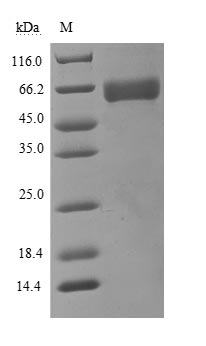
Purity
Greater than 85% as determined by SDS-PAGE.
Alternative Names
5A11 antigen; 5F7; BASI_HUMAN; Basigin (Ok blood group); Basigin; Blood brain barrier HT7 antigen; Bsg; CD 147; CD147; CD147 antigen; Collagenase stimulatory factor; EMMPRIN; Extracellular matrix metalloproteinase inducer; Leukocyte activation antigen M6; M 6; M6; M6 leukocyte activation antigen; Neurothelin; OK; OK blood group; OK blood group antigen; TCSF; Tumor cell derived collagenase stimulatory factor; Tumor cell-derived collagenase stimulatory factor
Species
Homo sapiens (Human)
Expression Region
138-323aa
Target Protein Sequence
EPGTVFTTVEDLGSKILLTCSLNDSATEVTGHRWLKGGVVLKEDALPGQKTEFKVDSDDQWGEYSCVFLPEPMGTANIQLHGPPRVKAVKSSEHINEGETAMLVCKSESVPPVTDWAWYKITDSEDKALMNGSESRFFVSSSQGRSELHIENLNMEADPGQYRCNGTSSKGSDQAIITLRVRSHLA
Note: The complete
sequence may include tag sequence, target protein sequence, linker sequence and extra sequence that is
translated with the protein sequence for the purpose(s) of secretion, stability, solubility, etc.
If the exact amino acid sequence of this recombinant protein is critical to your application,
please explicitly request the full and complete sequence of this protein before ordering.
Tag Info
C-terminal hFc-tagged
The tag type will be determined during production process. If you have specified tag type, please tell us and we will develop the specified tag preferentially.
Buffer
Tris-based buffer,50% glycerol
Storage Condition
The shelf life is related to many factors, storage state, buffer ingredients, storage temperature and the stability of the protein itself. Generally, the shelf life of liquid form is 6 months at -20°C/-80°C. The shelf life of lyophilized form is 12 months at -20°C/-80°C.
Shelf Life
The shelf life is related to many factors, storage state, buffer ingredients, storage temperature and the stability of the protein itself.
Generally, the shelf life of liquid form is 6 months at -20°C/-80°C. The shelf life of lyophilized form is 12 months at -20°C/-80°C.
Lead Time
3-7 business days
Note: All of our proteins are default shipped with normal blue ice packs, if you request to ship with dry ice, please communicate with us in advance and extra fees will be charged.
Notes
Repeated freezing and thawing is not recommended. Store working aliquots at 4°C for up to one week.
Datasheet & COA
Please contact us to get it.
Description
The gene fragment corresponding to the 138-323aa of the human BSG protein was synthesized, with appropriate restriction sites suitable for in-frame cloning into an expression vector, with C-terminal hFc tag. The Mammalian cell was transformed with the expression vector, and the clone was expressed upon certain induction. After the induced cell centrifugation, the recombinant protein was purified from the cell extract and presented as C-terminal hFc-tagged fusion. This recombinant human BSG protein's purity is greater than 85% assayed by SDS-PAGE. The BSG protein ran to a band of about 5 kDa molecular weight on the gel.
BSG also named CD147, a highly glycosylated transmembrane protein belonging to the immunoglobulin superfamily, is widely expressed in hematopoietic cells, endothelial cells, and epithelial cells in a variety of organs, particularly in the liver and kidneys. A wide range of BSG binding partners have been described to date, including caveolin, cyclophilin, MCTs, and BSG itself. Basigin is a multifunctional transmembrane glycoprotein with various binding partners. Among the most prominent claims for an alternate SARS-CoV-2 host receptor comes from a report identifying BSG as a binding partner for the SARS-CoV-2 spike protein with functional significance in viral invasion. Notably, the original finding that basigin is a possible alternative SARS-CoV-2 receptor has already translated into an open-label clinical trial of a humanized therapeutic monoclonal antibody against basigin, meplazumab, which reported striking improvements in COVID-19 patients treated with antibody.