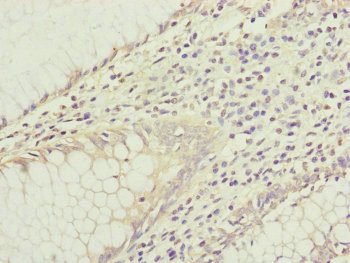
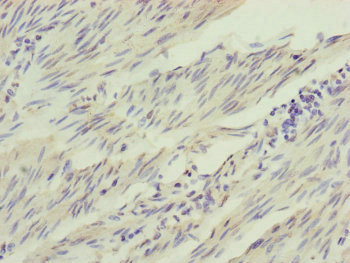
IL 1 epsilon antibody; IL 1 related protein 2 antibody; IL 1(EPSILON) antibody; IL 1F9 antibody; IL 1H1 antibody; IL 1RP2 antibody; IL-1 epsilon antibody; IL-1-related protein 2 antibody; IL-1F9 antibody; IL-1H1 antibody; IL-1RP2 antibody; IL1E antibody; Il1f9 antibody; IL1F9_HUMAN antibody; IL1H1 antibody; IL1RP2 antibody; IL36 gamma antibody; IL36G antibody; Interleukin 1 epsilon antibody; Interleukin 1 family member 9 antibody; Interleukin 1 homolog 1 antibody; Interleukin 1 related protein 2 antibody; Interleukin 36 gamma antibody; Interleukin-1 epsilon antibody; Interleukin-1 family member 9 antibody; Interleukin-1 homolog 1 antibody
Raised in
Rabbit
Species Reactivity
Human
Immunogen
Recombinant Human Interleukin-36 gamma protein (1-169AA)
Immunogen Species
Homo sapiens (Human)
Conjugate
Non-conjugated
Isotype
IgG
Purification Method
Antigen Affinity Purified
Concentration
It differs from different batches. Please contact us to confirm it.
Buffer
PBS with 0.02% sodium azide, 50% glycerol, pH7.3.
Tested Applications
ELISA, IHC
Recommended Dilution
Application
Recommended Dilution
IHC
1:20-1:200
Storage
Upon receipt, store at -20°C or -80°C. Avoid repeated freeze.
Lead Time
Basically, we can dispatch the products out in 1-3 working days after receiving your orders. Delivery time maybe differs from different purchasing way or location, please kindly consult your local distributors for specific delivery time.
Note: All of our proteins are default shipped with normal blue ice packs, if you request to ship with dry ice, please communicate with us in advance and extra fees will be charged.
Usage
For Research Use Only. Not for use in diagnostic or therapeutic procedures.
Cytokine that binds to and signals through the IL1RL2/IL-36R receptor which in turn activates NF-kappa-B and MAPK signaling pathways in target cells. Part of the IL-36 signaling system that is thought to be present in epithelial barriers and to take part in local inflammatory response; similar to the IL-1 system with which it shares the coreceptor IL1RAP. Seems to be involved in skin inflammatory response by acting on keratinocytes, dendritic cells and indirectly on T-cells to drive tissue infiltration, cell maturation and cell proliferation. In cultured keratinocytes induces the expression of macrophage, T-cell, and neutrophil chemokines, such as CCL3, CCL4, CCL5, CCL2, CCL17, CCL22, CL20, CCL5, CCL2, CCL17, CCL22, CXCL8, CCL20 and CXCL1; also stimulates its own expression and that of the prototypic cutaneous proinflammatory parameters TNF-alpha, S100A7/psoriasin and inducible NOS. May play a role in proinflammatory responses during particular neutrophilic airway inflammation: activates mitogen-activated protein kinases and NF-kappa B in primary lung fibroblasts, and stimulates the expression of IL-8 and CXCL3 and Th17 chemokine CCL20 in lung fibroblasts. May be involved in the innate immune response to fungal pathogens, such as Aspergillus fumigatus.
Gene References into Functions
serum IL-36gamma levels were higher in active systemic lupus erythematosus patients and correlated with disease activity and arthritisPMID:29571080
Cathepsin S was identified as the major IL-36gamma-activating protease expressed in epithelial cells.PMID:28289191
enhanced expression of IL-36gamma was observed in plasma and bronchoalveolar lavage fluid of patients with acute respiratory distress syndrome because of bacterial pneumoniaPMID:28176791
IL-36-mediated IL-6 and CXCL8 production in human lung fibroblasts and bronchial epithelial cells may be involved in pulmonary inflammation especially caused by bacterial or viral infections.PMID:28869889
With a focus on the skin as a target for microbial and viral invasion, the current knowledge of IL-36: IL-36alpha, IL-36beta and IL-36gamma, functions is reviewed. One physiological function of the IL-36smay be to counteract microbial immune evasion. [Review]PMID:28811383
IL-36gamma inhibits differentiation and induces inflammation of keratinocyte via Wnt signaling pathway in psoriasis.PMID:28924372
IL-36gamma-stimulated endothelial cells secrete the proinflammatory chemokines IL-8, CCL2 and CCL20.PMID:27673278
skin injury increases IL-36gamma via the activation of TLR3-SLUG-VDR axis and IL-36gamma induces REG3A to promote wound healingPMID:28774595
Autocrine and Paracrine Regulation of Keratinocyte Proliferation through a Novel Nrf2-IL-36gamma PathwayPMID:27183581
Here the authors show that Mycobacterium tuberculosis infection of macrophages induces IL-36gamma production in a 2-stage-regulated fashion.PMID:27389350
IL-36gamma, a member of the IL-1 superfamily, is involved in host defense and contributes to proinflammatory responses and development of inflammatory diseases.PMID:27853811
IL-36gamma is significantly more strongly expressed in the epidermis of patients with psoriasis-based erythroderma than in other inflammatory skin diseases.PMID:26524325
Study shows that plasma concentrations of IL-36alpha and IL-36gamma are overexpressed in active systemic lupus erythematosus patients and that IL-36alpha has a substantial pro-inflammatory effect through regulation of IL-6 and CXCL8 production.PMID:26516833
IRF6 is likely to promote inflammation to P. gingivalis through its regulation of IL-36gamma.PMID:26819203
Findings indicate that Interleukin (IL)-1beta-induced interleukin 36 gamma (IL-36gamma) expression is mediated by the activation of transcriptional factors, NF-kappaB p65 and AP-1 (c-jun).PMID:26562662
IL36G was identified as strong regulators of skin pathology in both lesional and non-lesional skin samples.PMID:25897967
Decreased Langerhans cell responses to IL36G: altered innate immunity in patients with recurrent respiratory papillomatosisPMID:24950037
IL-36gamma expression inversely correlated with the progression of human melanoma and lung cancer.PMID:26321222
IL-36gamma is a valuable biomarker in psoriasis patients, both for diagnostic purposes and measurement of disease activity during the clinical coursePMID:25525775
CAMP induces IL-36gamma expression leading to initiation of skin inflammation and occasional exacerbations of psoriasis.PMID:25305315
IL-36 promotes myeloid cell infiltration, activation, and inflammatory activity in skinPMID:24829417
This is the first report of extracellular release of endogenous IL-36gamma through pyroptosis suggesting a function of IL-36gamma as an alarmin.PMID:22318382
Data presented herein shed further light on involvement of T-bet in innate immunity and suggest that IL-36gamma, besides IFNgamma, may contribute to functions of this transcription factor in immunopathology.PMID:23095752
Interleukin-36 (IL-36) ligands require processing for full agonist (IL-36alpha, IL-36beta, and IL-36gamma) or antagonist (IL-36Ra) activityPMID:21965679
Regulation and function of the IL-1 family cytokine IL-1F9 in human bronchial epithelial cells.PMID:20870894
Expression of IL-1F9 is increased in human plaque psoriasis skin and is overexpressed in a transgenic mouse psoriasis model.PMID:21242515
IL-1F6 and IL-1F8, in addition to IL-1F9, activate the pathway leading to NF-kappaB in an IL-1Rrp2-dependent manner in Jurkat cellsPMID:14734551
This is the first report of IL-1 genotype association with the inflammation of skeletal muscle following acute resistance exercise that may potentially affect the adaptations to chronic resistance exercise.PMID:15331687
This report demonstrates expression of IL1F9 by bronchial epithelial cells induced by pro-inflammatory stimuli, suggesting a function of this molecule in airway inflammation.PMID:15701729
Show
More
Hide
All
Subcellular Location
Cytoplasm. Secreted.
Protein Families
IL-1 family
Tissue Specificity
Highly expressed in tissues containing epithelial cells: skin, lung, stomach and esophagus. Expressed in bronchial epithelial. In skin is expressed only in keratinocytes but not in fibroblasts, endothelial cells or melanocytes. Up-regulated in lesional ps