MPAENKKVRFENTTSDKGKIPSKVIKSYYGTMDIKKINEGLLDSKILSAFNTVIALLGSIVIIVMNIMIIQNYTRSTDNQAVIKDALQGIQQQIKGLADKIGTEIGPKVSLIDTSSTITIPANIGLLGSKISQSTASINENVNEKCKFTLPPLKIHECNISCPNPLPFREYRPQTEGVSNLVGLPNNICLQKTSNQILKPKLISYTLPVVGQSGTCITDPLLAMDEGYFAYSHLERIGSCSRGVSKQRIIGVGEVLDRGDEVPSLFMTNVWTPPNPNTVYHCSAVYNNEFYYVLCAVSTVGDPILNSTYWSGSLMMTRLAVKPKSNGGGYNQHQLALRSIEKGRYDKVMPYGPSGIKQGDTLYFPAVGFLVRTEFKYNDSNCPITKCQYSKPENCRLSMGIRPNSHYILRSGLLKYNLSDGENPKVVFIEISDQRLSIGSPSKIYDSLGQPVFYQASFSWDTMIKFGDVLTVNPLVVNWRNNTVISRPGQSQCPRFNTCPEICWEGVYNDAFLIDRINWISAGVFLDSNQTAENPVFTVFKDNEILYRAQLASEDTNAQKTITNCFLLKNKIWCISLVEIYDTGDNVIRPKLFAVKIPEQCT
Note: The complete
sequence may include tag sequence, target protein sequence, linker sequence and extra sequence that is
translated with the protein sequence for the purpose(s) of secretion, stability, solubility, etc.
If the exact amino acid sequence of this recombinant protein is critical to your application,
please explicitly request the full and complete sequence of this protein before ordering.
Mol. Weight
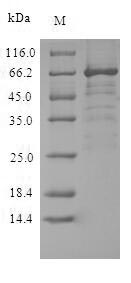
72.0kDa
Protein Length
Full Length
Tag Info
N-terminal 10xHis-tagged and C-terminal Myc-tagged
The tag type will be determined during production process. If you have specified tag type, please tell us and we will develop the specified tag preferentially.
Reconstitution
We recommend that this vial be briefly centrifuged prior to opening to bring the contents to the bottom. Please reconstitute protein in deionized sterile water to a concentration of 0.1-1.0 mg/mL.We recommend to add 5-50% of glycerol (final concentration) and aliquot for long-term storage at -20°C/-80°C. Our default final concentration of glycerol is 50%. Customers could use it as reference.
Interacts with host ephrinB2/EFNB2 or ephrin B3/EFNB3 to provide virion attachment to target cell. This attachment induces virion internalization predominantly through clathrin-mediated endocytosis.
Gene References into Functions
G and the fusion protein F are both crucial glycoproteins located on the surface of the virus envelope. [review]PMID:29963835
the binding of the viral attachment protein G to its host receptor ephrinB2 was studied and showed monomeric and dimeric receptors activate distinct conformational changes in G.PMID:28974687
Data suggest that fusion of Nipah viruses with host cells is facilitated by two of viral membrane proteins, the G protein and the F protein; G head domain binds to human ephrins B2 and B3 altering conformational density of entire G head domain.PMID:24615845
Authors identified a G stalk C-terminal region (amino acids 159 to 163) that is important for multiple G functions, including G tetramerization, conformational integrity, G-F interactions, receptor-induced conformational changes in G, and F triggering.PMID:25428863
Cysteine cluster in the G protein is involved in stabilizing a unique microdomain critical for triggering fusion.PMID:22496210
Results indicated that the G-H loop of ephrin-B2 was indeed critical for the interaction between ephrin-B2 and Nipah virus-G.PMID:21632558
the G protein appeared to be constitutively internalized with the bulk flow during membrane turnoverPMID:15731282
sNiV-G binds to ephrinB3 with a 30-fold higher affinity than that of sHeV-G.PMID:17652392
report the crystal structures of the NiV-G both in its receptor-unbound state and in complex with ephrin-B3, providing, to our knowledge, the first view of a paramyxovirus attachment complex in which a cellular protein is used as the virus receptorPMID:18632560
Show
More
Hide
All
Subcellular Location
Virion membrane; Single-pass type II membrane protein. Host cell membrane; Single-pass type II membrane protein.
Protein Families
Paramyxoviruses hemagglutinin-neuraminidase family