Recombinant Human Diacylglycerol kinase epsilon (DGKE)

Code: CSB-CF006835HU
Size:
20ug
20ug100ug
US$1620
Quantity:
Express system: in vitro E.coli expression system
Species: Homo sapiens (Human)
Tag Info: N-terminal 10xHis-SUMO-tagged and C-terminal Myc-tagged
For inquiries on large quantities or another requirements
Send an Inquiry
Start an on-line Chat
Online ordering is currently available for U.S. customers only. For orders outside the U.S., please kindly submit an inquiry or start a chat with us.

Product Details

Purity
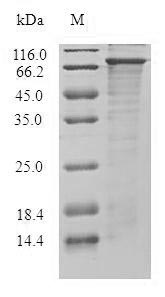
Greater than 85% as determined by SDS-PAGE.
Target Names
DGKE
Uniprot NO.
Research Area
Signal Transduction
Species
Homo sapiens (Human)
Source
in vitro E.coli expression system
Expression Region
1-567aa
Target Protein Sequence
MEAERRPAPGSPSEGLFADGHLILWTLCSVLLPVFITFWCSLQRSRRQLHRRDIFRKSKHGWRDTDLFSQPTYCCVCAQHILQGAFCDCCGLRVDEGCLRKADKRFQCKEIMLKNDTKVLDAMPHHWIRGNVPLCSYCMVCKQQCGCQPKLCDYRCIWCQKTVHDECMKNSLKNEKCDFGEFKNLIIPPSYLTSINQMRKDKKTDYEVLASKLGKQWTPLIILANSRSGTNMGEGLLGEFRILLNPVQVFDVTKTPPIKALQLCTLLPYYSARVLVCGGDGTVGWVLDAVDDMKIKGQEKYIPQVAVLPLGTGNDLSNTLGWGTGYAGEIPVAQVLRNVMEADGIKLDRWKVQVTNKGYYNLRKPKEFTMNNYFSVGPDALMALNFHAHREKAPSLFSSRILNKAVYLFYGTKDCLVQECKDLNKKVELELDGERVALPSLEGIIVLNIGYWGGGCRLWEGMGDETYPLARHDDGLLEVVGVYGSFHCAQIQVKLANPFRIGQAHTVRLILKCSMMPMQVDGEPWAQGPCTVTITHKTHAMMLYFSGEQTDDDISSTSDQEDIKATE
Note: The complete sequence may include tag sequence, target protein sequence, linker sequence and extra sequence that is translated with the protein sequence for the purpose(s) of secretion, stability, solubility, etc.
If the exact amino acid sequence of this recombinant protein is critical to your application, please explicitly request the full and complete sequence of this protein before ordering.
Mol. Weight
83.9kDa
Protein Length
Full Length
Tag Info
N-terminal 10xHis-SUMO-tagged and C-terminal Myc-tagged
The tag type will be determined during production process. If you have specified tag type, please tell us and we will develop the specified tag preferentially.
Reconstitution
We recommend that this vial be briefly centrifuged prior to opening to bring the contents to the bottom. Please reconstitute protein in deionized sterile water to a concentration of 0.1-1.0 mg/mL.We recommend to add 5-50% of glycerol (final concentration) and aliquot for long-term storage at -20°C/-80°C. Our default final concentration of glycerol is 50%. Customers could use it as reference.
Troubleshooting and FAQs
Datasheet & COA
Please contact us to get it.
Images
  • (Tris-Glycine gel) Discontinuous SDS-PAGE (reduced) with 5% enrichment gel and 15% separation gel.


Customer Reviews and Q&A

 Customer Reviews

Target Background

Function(From Uniprot)
Membrane-bound diacylglycerol kinase that converts diacylglycerol/DAG into phosphatidic acid/phosphatidate/PA and regulates the respective levels of these two bioactive lipids. Thereby, acts as a central switch between the signaling pathways activated by these second messengers with different cellular targets and opposite effects in numerous biological processes. Also plays an important role in the biosynthesis of complex lipids. Displays specificity for diacylglycerol substrates with an arachidonoyl acyl chain at the sn-2 position, with the highest activity toward 1-octadecanoyl-2-(5Z,8Z,11Z,14Z-eicosatetraenoyl)-sn-glycerol the main diacylglycerol intermediate within the phosphatidylinositol turnover cycle. Can also phosphorylate diacylglycerol substrates with a linoleoyl acyl chain at the sn-2 position but much less efficiently.
Gene References into Functions
  1. mutations can lead to atypical hemolytic uremic syndrome or membranoproliferative glomerulonephritis PMID:28526779
  2. Letter/Case Report: atypical haemolytic uraemic syndrome in a Japanese patient with DGKE genetic mutations. PMID:26018111
  3. Report DGKE intronic mutations located beyond the exon-intron boundaries in familial hemolytic uremic syndrome. PMID:25854283
  4. Data suggest that complement dysregulation influences the onset and disease severity in carriers of diacylglycerol kinase-epsilon mutations PMID:25135762
  5. DGKE silencing in resting endothelial cells does not affect complement activation at their surface. PMID:25498910
  6. Our study expands the clinical phenotypes associated with mutations in DGKE and challenges the benefits of complement blockade treatment in such patients PMID:24511134
  7. DGKzeta localizes to the nucleus and is considered to regulate nuclear diacylglycerol signaling.[review] PMID:24119575
  8. Fully activating high-density transfected muscarinic receptors (M1Rs) by oxotremorine-M (Oxo-M) leads to similar calcium, DAG, and PKC signals, but PIP2 is depleted. PMID:23630338
  9. Recessive mutations in DGKE cause atypical hemolytic-uremic syndrome. PMID:23542698
  10. Substrate specificity of DGKE is not a consequence of competition with hydrolysis of ATP. PMID:23261795
  11. performed homozygosity mapping and whole exome sequencing in a Turkish consanguineous family and identified DGKE gene variants as the cause of a membranoproliferative-like glomerular microangiopathy PMID:23274426
  12. Inhibition of lipid signaling enzyme diacylglycerol kinase epsilon attenuates mutant huntingtin toxicity. PMID:22511757
  13. A role for diacylglycerol kinase (DGK) and its downstream product phosphatidic acid (PA) in ANCA-induced neutrophil exocytosis, is reported. PMID:21833457
  14. The region responsible for this arachidonoyl specificity is the lipoxygenase (LOX)-like motif found in the accessory domain, adjacent to DGKvarepsilon's catalytic site. PMID:22266092
  15. diacylglycerol kinase-epsilon (DGKepsilon) has less preference for the acyl chain at the sn-1 position of diacylglycerol (DAG) than the one at the sn-2 position PMID:22108654
  16. DGK activity is reduced by oxidative stress in human mesangial cells cultured under high glucose conditions. PMID:21725595
  17. The hydrophobic domain of diacylglycerol kinase epsilon does not contribute to substrate specificity but plays a role in permanently sequestering the enzyme to a membrane. PMID:17455907
  18. The alpha and zeta isoforms of diacylglycerol kinase are inhibited by 2,3-dioleoylglycerol, but not the more substrate-selective epsilon isoform PMID:18004883
  19. Substrate specificity of diacylglycerol kinase epsilon is determined by selectivity of the sn-1 and sn-2 acyl chains phosphatidic acid or diacylglycerol. PMID:19744926

Show More

Hide All

Subcellular Location
Membrane; Single-pass membrane protein. Cytoplasm.
Protein Families
Eukaryotic diacylglycerol kinase family
Tissue Specificity
Expressed predominantly in testis. Expressed in endothelium, platelets and podocytes (at protein level).
Database Links

HGNC: 2852

UNIGENE: Hs.239514

KEGG: hsa:8526

STRING: 9606.ENSP00000284061

OMIM: 601440

icon of phone
Call us
301-363-4651 (Available 9 a.m. to 5 p.m. CST from Monday to Friday)
icon of address
Address
No. 269, Shendun 5th Road, Donghu Hi-Tech Development Area, Hubei Province, 430206, P.R.China
icon of social media
Join us with

Subscribe newsletter

Leave a message

* To protect against spam, please pass the CAPTCHA test below.
CAPTCHA verification
© 2007-2025 CUSABIO TECHNOLOGY LLC All rights reserved. 鄂ICP备15011166号-1
Select 0 Products