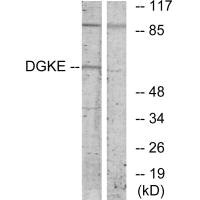
Synthesized peptide derived from internal of Human DGKE.
Immunogen Species
Homo sapiens (Human)
Purification Method
The antibody was affinity-purified from rabbit antiserum by affinity-chromatography using epitope-specific immunogen.
Concentration
It differs from different batches. Please contact us to confirm it.
Tested Applications
ELISA,WB
Storage
Upon receipt, store at -20°C or -80°C. Avoid repeated freeze.
Lead Time
Basically, we can dispatch the products out in 1-3 working days after receiving your orders. Delivery time maybe differs from different purchasing way or location, please kindly consult your local distributors for specific delivery time.
Note: All of our proteins are default shipped with normal blue ice packs, if you request to ship with dry ice, please communicate with us in advance and extra fees will be charged.
Usage
For Research Use Only. Not for use in diagnostic or therapeutic procedures.
Membrane-bound diacylglycerol kinase that converts diacylglycerol/DAG into phosphatidic acid/phosphatidate/PA and regulates the respective levels of these two bioactive lipids. Thereby, acts as a central switch between the signaling pathways activated by these second messengers with different cellular targets and opposite effects in numerous biological processes. Also plays an important role in the biosynthesis of complex lipids. Displays specificity for diacylglycerol substrates with an arachidonoyl acyl chain at the sn-2 position, with the highest activity toward 1-octadecanoyl-2-(5Z,8Z,11Z,14Z-eicosatetraenoyl)-sn-glycerol the main diacylglycerol intermediate within the phosphatidylinositol turnover cycle. Can also phosphorylate diacylglycerol substrates with a linoleoyl acyl chain at the sn-2 position but much less efficiently.
Gene References into Functions
mutations can lead to atypical hemolytic uremic syndrome or membranoproliferative glomerulonephritisPMID:28526779
Letter/Case Report: atypical haemolytic uraemic syndrome in a Japanese patient with DGKE genetic mutations.PMID:26018111
Report DGKE intronic mutations located beyond the exon-intron boundaries in familial hemolytic uremic syndrome.PMID:25854283
Data suggest that complement dysregulation influences the onset and disease severity in carriers of diacylglycerol kinase-epsilon mutationsPMID:25135762
DGKE silencing in resting endothelial cells does not affect complement activation at their surface.PMID:25498910
Our study expands the clinical phenotypes associated with mutations in DGKE and challenges the benefits of complement blockade treatment in such patientsPMID:24511134
DGKzeta localizes to the nucleus and is considered to regulate nuclear diacylglycerol signaling.[review]PMID:24119575
Fully activating high-density transfected muscarinic receptors (M1Rs) by oxotremorine-M (Oxo-M) leads to similar calcium, DAG, and PKC signals, but PIP2 is depleted.PMID:23630338
Recessive mutations in DGKE cause atypical hemolytic-uremic syndrome.PMID:23542698
Substrate specificity of DGKE is not a consequence of competition with hydrolysis of ATP.PMID:23261795
performed homozygosity mapping and whole exome sequencing in a Turkish consanguineous family and identified DGKE gene variants as the cause of a membranoproliferative-like glomerular microangiopathyPMID:23274426
A role for diacylglycerol kinase (DGK) and its downstream product phosphatidic acid (PA) in ANCA-induced neutrophil exocytosis, is reported.PMID:21833457
The region responsible for this arachidonoyl specificity is the lipoxygenase (LOX)-like motif found in the accessory domain, adjacent to DGKvarepsilon's catalytic site.PMID:22266092
diacylglycerol kinase-epsilon (DGKepsilon) has less preference for the acyl chain at the sn-1 position of diacylglycerol (DAG) than the one at the sn-2 positionPMID:22108654
DGK activity is reduced by oxidative stress in human mesangial cells cultured under high glucose conditions.PMID:21725595
The hydrophobic domain of diacylglycerol kinase epsilon does not contribute to substrate specificity but plays a role in permanently sequestering the enzyme to a membrane.PMID:17455907
The alpha and zeta isoforms of diacylglycerol kinase are inhibited by 2,3-dioleoylglycerol, but not the more substrate-selective epsilon isoformPMID:18004883
Substrate specificity of diacylglycerol kinase epsilon is determined by selectivity of the sn-1 and sn-2 acyl chains phosphatidic acid or diacylglycerol.PMID:19744926