N-terminal Flag-tagged
The tag type will be determined during production process. If you have specified tag type, please tell us and we will develop the specified tag preferentially.
Buffer
35% FBS + 55% DMEM + 10% DMSO
Storage
Frozen in liquid nitrogen or -80°C
Lead Time
Basically, we can dispatch the products out in 1-3 working days after receiving your orders. Delivery time maybe differs from different purchasing way or location, please kindly consult your local distributors for specific delivery time.
Note: All of our proteins are default shipped with normal blue ice packs, if you request to ship with dry ice, please communicate with us in advance and extra fees will be charged.
Images
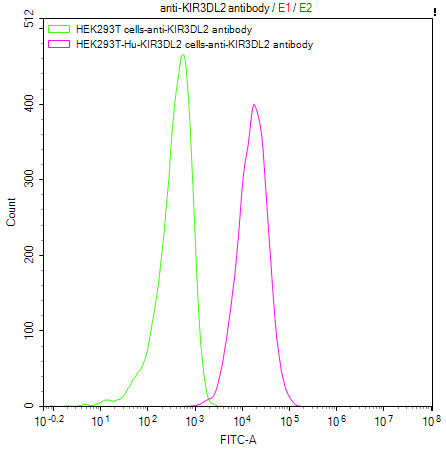
Untransfected HEK-293T cells (green line) and transfected Human KIR3DL2 HEK-293T stable cells (red line) were stained with anti-KIR3DL2 antibody(CSB-RA012365MA1HU)(2µg/1*106cells), washed and then followed by FITC conjugated anti-Human IgG Fc antibody and analyzed with flow cytometry.
Receptor on natural killer (NK) cells and T cells for MHC class I molecules. Upon binding of peptide-free HLA-F open conformer, negatively regulates NK and T cell effector functions. Acts as a receptor on astrocytes for HLA-F. Through interaction with HLA-F, may protect motor neurons from astrocyte-induced toxicity.
Gene References into Functions
We show that KIR3DL2 expression is the most sensitive diagnostic criterion of Sezary syndrome when compared with all other available biological criteria. KIR3DL2 therefore represents a valuable tool for routine use as a clinical parameter at diagnosis, for prognosis and during patient follow-upPMID:28119365
results identified significant KIR3DL2 expression in all cutaneous T-cell lymphomas subtypesPMID:29089310
Overexpression of a single MHCI molecule, HLA-F, protects human MNs from ALS astrocyte-mediated toxicity, whereas knockdown of its receptor, the killer cell immunoglobulin-like receptor KIR3DL2, on human astrocytes results in enhanced motor neurons deathPMID:26928464
KIR-3DL2 binding to HLA-B27 licenses Th17 cell differentiation in spondyloarthritis.PMID:26841353
In early axial spondyloarthritis and ankylosing spondylitis Dutch patients, no copy number changes were found for KIR3DL2.PMID:25940819
we show that the allele KIR3DL2*001 and the single nucleotide polymorphism 1190T (rs3745902) are associated with differential susceptibility to pemphigusPMID:25867094
CD158k expression was identified on cutaneous CD4+ T cells in healthy individuals and also mycosis fungoides patients.PMID:25044837
These findings provide novel insights about the molecular basis of KIR3DL2 binding to B27PMID:25582852
these data provide evidence for a possible role of KIR3DL2 in the maintenance of a high circulating malignant-cell burden by preventing activation-induced cell death.PMID:25414436
Our results indicate that KIR3DL2 can directly promote Sezary syndrome malignant cell death through the use of CpG ODN.PMID:25007046
our results show that a multistep gating of CD158k+ cells is reliable to assess tumor burden in case of Sezary syndrome.PMID:25158034
our results offer preclinical proof of concept for the clinical development of IPH4102, a humanized monoclonal antibody that targets the immune receptor KIR3DL2,to treat patients with nced cutaneous T-cell lymphomaPMID:25361998
KIR3DL2 binds to HLA-B27 dimers and free H chains more strongly than other HLA class I and promotes the expansion of T cells in ankylosing spondylitis.PMID:23440420
PLS3, Twist, KIR3DL2 and NKp46 gene expression can model efficient molecular Sezary syndrome diagnosis.PMID:23429988
most frequently expressed KIR receptor in transformed mycosis fungoidesPMID:22621189
results suggest that carriers of A allele in exon 3 of killer cell immunoglobulin-like receptor 3DL2(KIR3DL2) have a decreased susceptibility to preeclampsiaPMID:21406041
Enhanced proliferation, survival, and interleukin (IL)-17 production of KIR3DL2+ CD4 T cells stimulated with antigen-presenting cells expressing HLA-B27 homodimers suggest new therapeutic strategies in ankylosing spondylitis.PMID:21248258
Data show direct binding of KIR3DL2 to ODNs and we show that the D0 domain is involved primarily in this interaction.PMID:20147700
The A52G polymorphism in exon 3 and the frequencies of C32T in exon 9 of KIR3DL2 gene polymorphism are associated with the pathogenesis of pre-eclampsia.PMID:19953898
All genotypes seen included genes for KIR3DL2.PMID:12559621
IR3DL2/p140 engagement does not result into inhibitory (nor activatory) effects on tumor-specific cytotoxic T lymphocytes.PMID:14562047
A high level of KIR3DL2 allelic polymorphism has been identified.PMID:15304002
Receptor is a marker for the diagnosis of Sezary syndrome.PMID:16962036
Five new alleles are reported, and four previously known ones are confirmed.PMID:17661911
observation that CD4 positive, CD7 negative T-cells are mostly CD158k negative suggests that CD158k may be able to help identify and enumerate neoplastic T-cells in Sezary syndromePMID:18061949
Functional analysis of KIR3DL2-single positive natural killer (NK) cells reveals a subset that is hyporesponsive in individuals harboring cognate ligands HLA-A3/A11.PMID:18941190
Anti-p140 autoantibodies represent a major autoantibody subset in juvenile dermatomyositis.PMID:19479859
Using shotgun mass spectrometry, we found this protein differentially expressed in the dorsolateral prefrontal cortex from patients with schizophrenia.PMID:19165527
Show
More
Hide
All
Subcellular Location
Cell membrane; Single-pass type I membrane protein.