KNTPASGQPQEDLVEQKCLLKNYTHHSCDKVFCQPWQKCIEGTCACKLPYQCPKAGTPVCATNGRGYPTYCHLKSFECLHPEIKFSNNGTCTAEEKFNVSLIYGSTDTEGIVQVKLVDQDEKMFICKNSWSTVEANVACFDLGFPLGVRDIQGRFNIPVNHKINSTECLHVRCQGVETSLAECTFTKKSSKAPHGLAGVVCYTQDADFPTSQSFQCVNGKRIPQEKACDGVNDCGDQSDELCCKGCRGQAFLCKSGVCIPNQRKCNGEVDCITGEDESGCEEDKKNKIHKGLARSDQGGETEIETEETEMLTPDMDTERKRIKSLLPKLSCGVKRNTHIRRKRVVGGKPAEMGDYPWQVAIKDGDRITCGGIYIGGCWILTAAHCVRPSRYRNYQVWTSLLDWLKPNSQLAVQGVSRVVVHEKYNGATYQNDIALVEMKKHPGKKECELINSVPACVPWSPYLFQPNDRCIISGWGREKDNQKVYSLRWGEVDLIGNCSRFYPGRYYEKEMQCAGTSDGSIDACKGDSGGPLVCKDVNNVTYVWGIVSWGENCGKPEFPGVYTRVASYFDWISYYVGRPLVSQYNV
Note: The complete
sequence may include tag sequence, target protein sequence, linker sequence and extra sequence that is
translated with the protein sequence for the purpose(s) of secretion, stability, solubility, etc.
If the exact amino acid sequence of this recombinant protein is critical to your application,
please explicitly request the full and complete sequence of this protein before ordering.
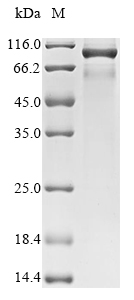
Mol. Weight
70.40000000000001
Protein Length
Full Length of Mature Protein
Tag Info
N-terminal 10xHis-tagged and C-terminal Myc-tagged
The tag type will be determined during production process. If you have specified tag type, please tell us and we will develop the specified tag preferentially.
Buffer
Tris-based buffer,50% glycerol
Storage
The shelf life is related to many factors, storage state, buffer ingredients, storage temperature and the stability of the protein itself.
Generally, the shelf life of liquid form is 6 months at -20°C/-80°C. The shelf life of lyophilized form is 12 months at -20°C/-80°C.
Shelf Life
The shelf life is related to many factors, storage state, buffer ingredients, storage temperature and the stability of the protein itself.
Generally, the shelf life of liquid form is 6 months at -20°C/-80°C. The shelf life of lyophilized form is 12 months at -20°C/-80°C.
Notes
Repeated freezing and thawing is not recommended. Store working aliquots at 4°C for up to one week.
Trypsin-like serine protease that plays an essential role in regulating the immune response by controlling all complement pathways. Inhibits these pathways by cleaving three peptide bonds in the alpha-chain of C3b and two bonds in the alpha-chain of C4b thereby inactivating these proteins. Essential cofactors for these reactions include factor H and C4BP in the fluid phase and membrane cofactor protein/CD46 and CR1 on cell surfaces. The presence of these cofactors on healthy cells allows degradation of deposited C3b by CFI in order to prevent undesired complement activation, while in apoptotic cells or microbes, the absence of such cofactors leads to C3b-mediated complement activation and subsequent opsonization.
Subcellular Location
Secreted, extracellular space.
Protein Families
Peptidase S1 family
Tissue Specificity
Expressed in the liver by hepatocytes. Also present in other cells such as monocytes, fibroblasts or keratinocytes.