Recombinant Mouse Isocitrate dehydrogenase [NADP] Cytoplasmic domain (Idh1), partial

Code: CSB-EP010989MO
Size:
20μg
20μg100μg1mg(1mg*1 or 500ug*2)
US$306
Quantity:
Express system: E.coli
Species: Mus musculus (Mouse)
Tag Info: N-terminal 6xHis-tagged
For inquiries on large quantities or another requirements
Send an Inquiry
Start an on-line Chat
Online ordering is currently available for U.S. customers only. For orders outside the U.S., please kindly submit an inquiry or start a chat with us.

Product Details

Purity
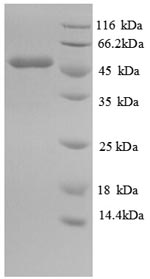
Greater than 90% as determined by SDS-PAGE.
Target Names
Idh1
Uniprot NO.
Research Area
Others
Alternative Names
Idh1; Isocitrate dehydrogenase [NADP] cytoplasmic; IDH; EC 1.1.1.42; Cytosolic NADP-isocitrate dehydrogenase; IDP; NADP(+)-specific ICDH; Oxalosuccinate decarboxylase
Species
Mus musculus (Mouse)
Source
E.coli
Expression Region
7-407aa
Target Protein Sequence
GGSVVEMQGDEMTRIIWELIKEKLILPYVELDLHSYDLGIENRDATNDQVTKDAAEAIKKYNVGVKCATITPDEKRVEEFKLKQMWKSPNGTIRNILGGTVFREAIICKNIPRLVTGWVKPIIIGRHAYGDQYRATDFVVPGPGKVEITYTPKDGTQKVTYMVHDFEEGGGVAMGMYNQDKSIEDFAHSSFQMALSKGWPLYLSTKNTILKKYDGRFKDIFQEIYDKKYKSQFEAQKICYEHRLIDDMVAQAMKSEGGFIWACKNYDGDVQSDSVAQGYGSLGMMTSVLICPDGKTVEAEAAHGTVTRHYRMYQKGQETSTNPIASIFAWSRGLAHRAKLDNNTELSFFAKALEDVCIETIEAGFMTKDLAACIKGLPNVQRSDYLNTFEFMDKLGENLKA
Note: The complete sequence may include tag sequence, target protein sequence, linker sequence and extra sequence that is translated with the protein sequence for the purpose(s) of secretion, stability, solubility, etc.
If the exact amino acid sequence of this recombinant protein is critical to your application, please explicitly request the full and complete sequence of this protein before ordering.
Mol. Weight
49.2kDa
Protein Length
Partial
Tag Info
N-terminal 6xHis-tagged
The tag type will be determined during production process. If you have specified tag type, please tell us and we will develop the specified tag preferentially.
Reconstitution
We recommend that this vial be briefly centrifuged prior to opening to bring the contents to the bottom. Please reconstitute protein in deionized sterile water to a concentration of 0.1-1.0 mg/mL.We recommend to add 5-50% of glycerol (final concentration) and aliquot for long-term storage at -20°C/-80°C. Our default final concentration of glycerol is 50%. Customers could use it as reference.
Storage Condition
The shelf life is related to many factors, storage state, buffer ingredients, storage temperature and the stability of the protein itself. Generally, the shelf life of liquid form is 6 months at -20°C/-80°C. The shelf life of lyophilized form is 12 months at -20°C/-80°C.
Shelf Life
The shelf life is related to many factors, storage state, buffer ingredients, storage temperature and the stability of the protein itself.
Generally, the shelf life of liquid form is 6 months at -20°C/-80°C. The shelf life of lyophilized form is 12 months at -20°C/-80°C.
Lead Time
Delivery time may differ from different purchasing way or location, please kindly consult your local distributors for specific delivery time.
Note: All of our proteins are default shipped with normal blue ice packs, if you request to ship with dry ice, please communicate with us in advance and extra fees will be charged.
Notes
Repeated freezing and thawing is not recommended. Store working aliquots at 4°C for up to one week.
Troubleshooting and FAQs
Datasheet & COA
Please contact us to get it.
Images
  • (Tris-Glycine gel) Discontinuous SDS-PAGE (reduced) with 5% enrichment gel and 15% separation gel.

Customer Reviews and Q&A

 Customer Reviews

Target Background

Gene References into Functions
  1. Vitamin C treatment induced an IDH1(R132H)-dependent reduction in cell proliferation. PMID:28663574
  2. IDH1 expression regulates TCA cycle in glioma and affects glioma cell growth.GDH2 promotes growth of IDH1-expressing gliomas. PMID:29097607
  3. Through the use of a conditional mutant mouse model that confers a less aggressive tumor phenotype, findings provide new insight into the effects of mutant Idh1 on a candidate cell of origin for glioma, mutant Idh1's role in disrupting the microenvironment from which gliomas arise, and mutant Idh1's effect on the course of glioma progression. PMID:28148827
  4. IDH1 mutations caused down-regulation of leukocyte chemotaxis, resulting in repression of the tumor-associated immune system. PMID:28465358
  5. Idh1(R132H) mutation in the major adult neurogenic stem cell niche causes a phenotype resembling gliomagenesis PMID:27693047
  6. Using whole RNA sequencing of bone marrow cells in iron-overloaded mice, it was observed that Idh1 and Aco1, enzymes involved in the TCA cycle, were elevated. PMID:27380194
  7. data suggest that mutant IDH1 contributes to malignancy in the T-cell lineage and may alter the metabolic profile of malignant T cells PMID:26787889
  8. The results suggest that Idh1 has a physiological function in protecting cells from oxidative stress by regulating the intracellular NADP(+)/NADPH ratio. PMID:25882048
  9. These results support the translational potential of immunotherapeutic targeting of gliomas carrying IDH1 mutations R132H. PMID:25849072
  10. MiR-181a regulates lipid metabolism via IDH1 PMID:25739786
  11. revealed a role for IDH1 in the synthesis/turnover of phospholipids in developing astrocytes and highlight the lipid alterations resulting from the loss of wild-type IDH1 activity. PMID:25218477
  12. these data show that mutant IDH or d-2HG causes persistence of chondrocytes, giving rise to rests of growth-plate cells that persist in the bone as enchondromas. PMID:25730874
  13. WA might exert its chemopreventive activity via inhibiting not only oncogenic activation, but also IDH1 inactivation. PMID:23107437
  14. Brain-specific Idh1-KI mice show brain hemorrhage accompanied by high D2HG levels but decreased ROS PMID:22925884
  15. Suggest that decreased IDPc expression renders melanocytes more vulnerable to oxidative stress, and IDPc plays an important antioxidant function in melanocytes. PMID:22264756
  16. Absence of IDH1 mutations in low-grade gliomas (LGGs) identifies a novel entity of LGGs with distinctive location, infiltrative behavior, specific molecular alterations, and dismal outcome. PMID:21080178
  17. a possible association between IDH mutations and trisomy 8 in myelodysplastic syndromes and acute myeloid leukemia. PMID:20861910
  18. IDPc would be a major NADPH producer required for fat and cholesterol synthesis. PMID:15254034
  19. The results suggest that IDPc plays an important protective role in apoptosis of HL-60 cells induced by singlet oxygen. PMID:17646934
  20. IDPc is expressed differentially along tubules in patterns that may contribute to differences in susceptibility to injury, major enzyme in cytosolic NADPH generation in kidney, downregulated with ischemia-reperfusion PMID:19106211

Show More

Hide All

Subcellular Location
Cytoplasm, cytosol.
Protein Families
Isocitrate and isopropylmalate dehydrogenases family
Database Links

UNIGENE: Mm.9925

KEGG: mmu:15926

STRING: 10090.ENSMUSP00000095316

icon of phone
Call us
301-363-4651 (Available 9 a.m. to 5 p.m. CST from Monday to Friday)
icon of address
Address
No. 269, Shendun 5th Road, Donghu Hi-Tech Development Area, Hubei Province, 430206, P.R.China
icon of social media
Join us with

Subscribe newsletter

Leave a message

* To protect against spam, please pass the CAPTCHA test below.
CAPTCHA verification
© 2007-2025 CUSABIO TECHNOLOGY LLC All rights reserved. 鄂ICP备15011166号-1
Select 0 Products