Recombinant Mouse C-X-C motif chemokine 14 (Cxcl14)

Code: CSB-RP093194m
Size:
20μg
20μg100μg1mg(1mg*1 or 500ug*2)
US$306
Quantity:
Express system: E.coli
Species: Mus musculus (Mouse)
Tag Info: N-terminal 6xHis-tagged
For inquiries on large quantities or another requirements
Send an Inquiry
Start an on-line Chat
Online ordering is currently available for U.S. customers only. For orders outside the U.S., please kindly submit an inquiry or start a chat with us.

Product Details

Purity
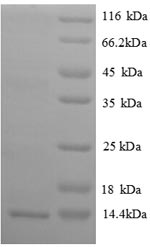
Greater than 90% as determined by SDS-PAGE.
Target Names
Cxcl14
Uniprot NO.
Research Area
Others
Alternative Names
B-cell and monocyte-activating chemokineChemokine BRAKKidney-expressed chemokine CXCMIP-2GSmall-inducible cytokine B14
Species
Mus musculus (Mouse)
Source
E.coli
Expression Region
23-99aa
Target Protein Sequence
SKCKCSRKGPKIRYSDVKKLEMKPKYPHCEEKMVIVTTKSMSRYRGQEHCLHPKLQSTKRFIKWYNAWNEKRRVYEE
Note: The complete sequence may include tag sequence, target protein sequence, linker sequence and extra sequence that is translated with the protein sequence for the purpose(s) of secretion, stability, solubility, etc.
If the exact amino acid sequence of this recombinant protein is critical to your application, please explicitly request the full and complete sequence of this protein before ordering.
Mol. Weight
13.4kDa
Protein Length
Full Length of Mature Protein
Tag Info
N-terminal 6xHis-tagged
The tag type will be determined during production process. If you have specified tag type, please tell us and we will develop the specified tag preferentially.
Reconstitution
We recommend that this vial be briefly centrifuged prior to opening to bring the contents to the bottom. Please reconstitute protein in deionized sterile water to a concentration of 0.1-1.0 mg/mL.We recommend to add 5-50% of glycerol (final concentration) and aliquot for long-term storage at -20°C/-80°C. Our default final concentration of glycerol is 50%. Customers could use it as reference.
Storage
The shelf life is related to many factors, storage state, buffer ingredients, storage temperature and the stability of the protein itself. Generally, the shelf life of liquid form is 6 months at -20°C/-80°C. The shelf life of lyophilized form is 12 months at -20°C/-80°C.
Shelf Life
The shelf life is related to many factors, storage state, buffer ingredients, storage temperature and the stability of the protein itself.
Generally, the shelf life of liquid form is 6 months at -20°C/-80°C. The shelf life of lyophilized form is 12 months at -20°C/-80°C.
Lead Time
Delivery time may differ from different purchasing way or location, please kindly consult your local distributors for specific delivery time.
Note: All of our proteins are default shipped with normal blue ice packs, if you request to ship with dry ice, please communicate with us in advance and extra fees will be charged.
Notes
Repeated freezing and thawing is not recommended. Store working aliquots at 4°C for up to one week.
Troubleshooting and FAQs
Datasheet & COA
Please contact us to get it.
Images
  • (Tris-Glycine gel) Discontinuous SDS-PAGE (reduced) with 5% enrichment gel and 15% separation gel.

Customer Reviews and Q&A

 Customer Reviews

Target Background

Function(From Uniprot)
Chemotactic for CESS B-cells and THP-1 monocytes, but not T-cells.
Gene References into Functions
  1. Platelets are a relevant source of CXCL14. Platelet-derived CXCL14 at the site of vascular lesions might play an important role in vascular repair/regeneration. PMID:28359053
  2. CXCL14 Tg mice showed a suppressed rate of carcinogenesis, decreased tumour volume, and reduced pulmonary metastasis, as well as an increased survival rate of mice following tumour cell injection. PMID:25765541
  3. CXCL14 does not seem to play a pivotal role during influenza and Escherichia coli infections of the lung. PMID:25313607
  4. CXCL14 was able to promote bone metastasis through enhancement of cancer cell tropism to the bone and/or recruitment of bone marrow cells around metastatic cancer cells. PMID:24534874
  5. In conclusion, our results suggested the important function of Cxcl14 in uNK cells and the proper level of Cxcl14 protein were required to recruit NK cells to pregnant uterus. PMID:23688424
  6. the transient expression of CXCL14 by Purkinje cells in the developing cerebellum, suggesting that it must be involved in the postnatal maturation of the cerebellum PMID:22843118
  7. CXCL14 may play an important role in central nervous system regulation of feeding behavior PMID:20428232
  8. Study identifies CXCL14 as a novel marker of tendon connective tissue. PMID:21038449
  9. Murine CXCL14 is dispensable for the homeostatic recruitment of antigen-presenting cells toward the periphery and for LC functionality. PMID:17130243
  10. CXCL14 is a critical chemoattractant of white adipose tissue macrophages and a novel regulator of glucose metabolism that functions mainly in skeletal muscle. PMID:17724031
  11. These results suggest that CXCL14 plays a causal role in high-fat diet-induced obesity. PMID:17971304
  12. Data suggest that despite the structural homology and similarity in tissue distribution of human and murine CXCL14, distinct differences point to diverse, species-specific needs for CXCL14 in epithelial immunity. PMID:18809336
  13. findings demonstrate that early overexpression of PMP22 in a mouse model of Charcot-Marie-Tooth disease type 1A results in a strong up-regulation of CXCL14 which seems to play a novel regulatory role in Schwann cell differentiation PMID:19111616
  14. CXCL14 is an important paracrine/autocrine modulator regulating trophoblast outgrowth at the maternal-fetal interface during the process of pregnancy establishment. PMID:19626669
  15. These data indicate the possibility that BRAK expression inhibits tumor cell establishment by regulating interactions between tumor stem cells and NK cells and/or suppressing formation of tumor microvessels. PMID:19887729

Show More

Hide All

Subcellular Location
Secreted.
Protein Families
Intercrine alpha (chemokine CxC) family
Tissue Specificity
Highly expressed in brain, lung, ovary, muscle and in kidney and liver parenchyma, and at lower levels in bone marrow.
Database Links
icon of phone
Call us
301-363-4651 (Available 9 a.m. to 5 p.m. CST from Monday to Friday)
icon of address
Address
No. 269, Shendun 5th Road, Donghu Hi-Tech Development Area, Hubei Province, 430206, P.R.China
icon of social media
Join us with

Subscribe newsletter

Leave a message

* To protect against spam, please pass the CAPTCHA test below.
CAPTCHA verification
© 2007-2025 CUSABIO TECHNOLOGY LLC All rights reserved. 鄂ICP备15011166号-1
Select 0 Products