Recombinant Mouse C-X-C motif chemokine 11 (Scyb11), partial

Code: CSB-RP092874m
Size:
20μg
20μg100μg1mg(1mg*1 or 500ug*2)
US$306
Quantity:
Express system: E.coli
Species: Mus musculus (Mouse)
Tag Info: N-terminal 6xHis-tagged
For inquiries on large quantities or another requirements
Send an Inquiry
Start an on-line Chat
Online ordering is currently available for U.S. customers only. For orders outside the U.S., please kindly submit an inquiry or start a chat with us.

Product Details

Purity
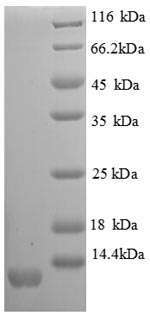
Greater than 90% as determined by SDS-PAGE.
Target Names
Cxcl11
Uniprot NO.
Research Area
Others
Alternative Names
Interferon-inducible T-cell alpha chemoattractant ;I-TACSmall-inducible cytokine B11
Species
Mus musculus (Mouse)
Source
E.coli
Expression Region
22-98aa
Target Protein Sequence
FLMFKQGRCLCIGPGMKAVKMAEIEKASVIYPSNGCDKVEVIVTMKAHKRQRCLDPRSKQARLIMQAIEKKNFLRRQ
Note: The complete sequence may include tag sequence, target protein sequence, linker sequence and extra sequence that is translated with the protein sequence for the purpose(s) of secretion, stability, solubility, etc.
If the exact amino acid sequence of this recombinant protein is critical to your application, please explicitly request the full and complete sequence of this protein before ordering.
Mol. Weight
12.9kDa
Protein Length
Partial
Tag Info
N-terminal 6xHis-tagged
The tag type will be determined during production process. If you have specified tag type, please tell us and we will develop the specified tag preferentially.
Reconstitution
We recommend that this vial be briefly centrifuged prior to opening to bring the contents to the bottom. Please reconstitute protein in deionized sterile water to a concentration of 0.1-1.0 mg/mL.We recommend to add 5-50% of glycerol (final concentration) and aliquot for long-term storage at -20°C/-80°C. Our default final concentration of glycerol is 50%. Customers could use it as reference.
Storage
The shelf life is related to many factors, storage state, buffer ingredients, storage temperature and the stability of the protein itself. Generally, the shelf life of liquid form is 6 months at -20°C/-80°C. The shelf life of lyophilized form is 12 months at -20°C/-80°C.
Shelf Life
The shelf life is related to many factors, storage state, buffer ingredients, storage temperature and the stability of the protein itself.
Generally, the shelf life of liquid form is 6 months at -20°C/-80°C. The shelf life of lyophilized form is 12 months at -20°C/-80°C.
Lead Time
Delivery time may differ from different purchasing way or location, please kindly consult your local distributors for specific delivery time.
Note: All of our proteins are default shipped with normal blue ice packs, if you request to ship with dry ice, please communicate with us in advance and extra fees will be charged.
Notes
Repeated freezing and thawing is not recommended. Store working aliquots at 4°C for up to one week.
Troubleshooting and FAQs
Datasheet & COA
Please contact us to get it.
Images
  • (Tris-Glycine gel) Discontinuous SDS-PAGE (reduced) with 5% enrichment gel and 15% separation gel.

Customer Reviews and Q&A

 Customer Reviews

Target Background

Function(From Uniprot)
Chemotactic for interleukin-activated T-cells but not unstimulated T-cells, neutrophils or monocytes. Induces calcium release in activated T-cells. Binds to CXCR3. May play an important role in CNS diseases which involve T-cell recruitment. May play a role in skin immune responses.
Gene References into Functions
  1. although the expression of CXCL9 and CXCL11 are increased after spinal nerve ligation, they may not contribute to the maintenance of neuropathic pain. PMID:29712506
  2. These findings functionally integrate K17, hnRNP K, and gene expression along with RSK and CXCR3 signaling in a keratinocyte-autonomous axis and provide a potential basis for their implication in tumorigenesis PMID:25713416
  3. very low doses of CXCL11 rapidly suppress signs of EAE in C57BL/6 mice lacking functional CXCL11. PMID:24713654
  4. Data indicate that epidermis-derived I-TAC (Cxcl11) triggers a sustained Th2-response that determines the outcome of a complex immunological process. PMID:24398292
  5. Analysis of genes within the Listr1 locus identified a frameshift mutation in the Cxcl11 gene of the C57BL/6 strain that prevents production of the mature chemokine CXCL11. PMID:24566892
  6. Cxcl10 and cxcl11 are new hair-specific transcriptional targets of ectodysplasin, and they indicates involvement of chemokines in hair development. PMID:22277947
  7. the CXCL11-heparin interaction has two different affinities for glycosaminoglycans PMID:20363748
  8. I-TAC can have an important role during virus infections and vaccinia virus has evolved ways to avoid inducing I-TAC expression. PMID:15030574
  9. I-TAC acts as an antagonist for CCR5. I-TAC inhibited the binding of macrophage-inflammatory protein-1alpha (MIP-1alpha)/CC chemokine ligand 3 (CCL3) to cells transfected with CCR5 and to monocytes. PMID:15178708
  10. Acute ethanol intoxication impairs lung expression of Cxcl11, interfering with pulmonary response to bacterial challenge. PMID:17889309
  11. homologous to human T cell attracting chemokine CXC receptor ligand 11; involved in calcium mobilization and chemotaxis PMID:11500837

Show More

Hide All

Subcellular Location
Secreted.
Protein Families
Intercrine alpha (chemokine CxC) family
Database Links

UNIGENE: Mm.131723

KEGG: mmu:56066

icon of phone
Call us
301-363-4651 (Available 9 a.m. to 5 p.m. CST from Monday to Friday)
icon of address
Address
No. 269, Shendun 5th Road, Donghu Hi-Tech Development Area, Hubei Province, 430206, P.R.China
icon of social media
Join us with

Subscribe newsletter

Leave a message

* To protect against spam, please pass the CAPTCHA test below.
CAPTCHA verification
© 2007-2025 CUSABIO TECHNOLOGY LLC All rights reserved. 鄂ICP备15011166号-1
Select 0 Products