Abbreviation
Recombinant Human TNFRSF17 protein, partial (Active)
Purity
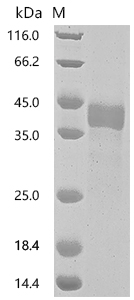
Greater than 95% as determined by SDS-PAGE.
Endotoxin
Less than 1.0 EU/ug as determined by LAL method.
Activity
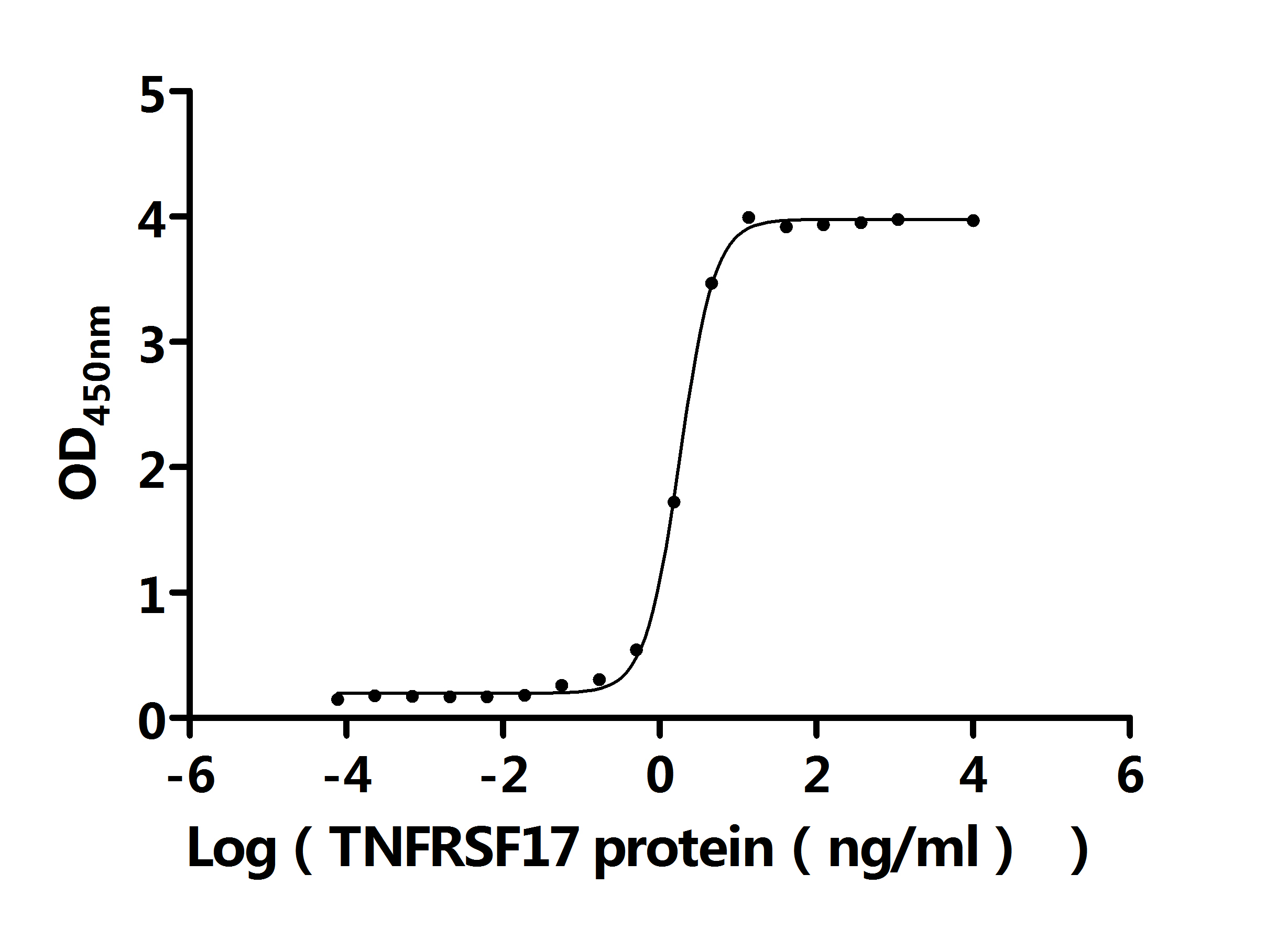
①Measured by its binding ability in a functional ELISA. Immobilized Anti-TNFRSF17 recombinant antibody (CSB-RA023974MA3HU) at 2 μg/mL can bind Human TNFRSF17 protein. The EC50 is 1.745-1.901 ng/mL.
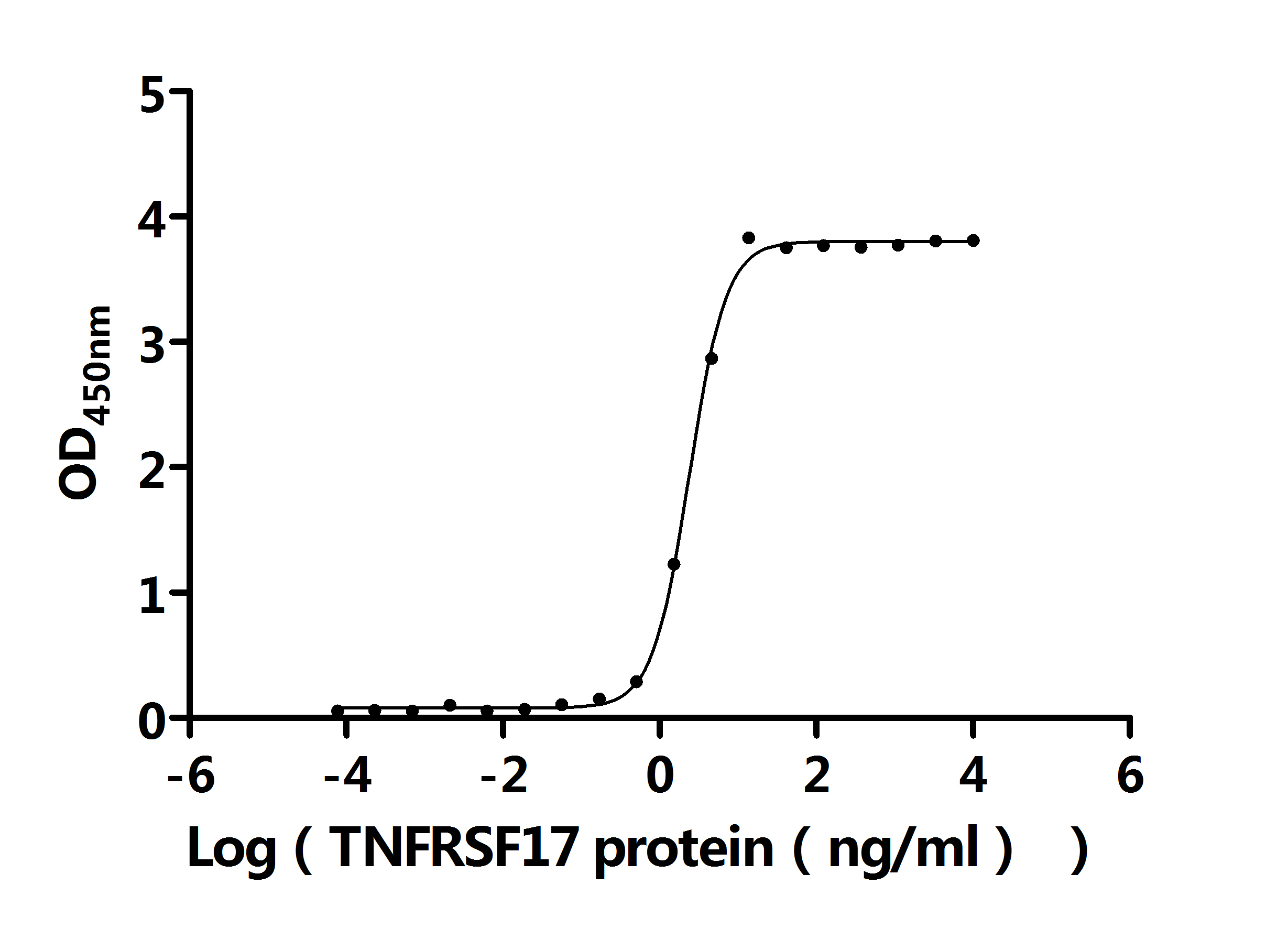
②Measured by its binding ability in a functional ELISA. Immobilized Human TNFSF13B protein (CSB-MP897523HU1-B) at 2 μg/mL can bind Human TNFRSF17 protein. The EC50 is 2.232-2.579 ng/mL.
Alternative Names
B-cell maturation protein (CD_antigen: CD269)(BCM) (BCMA)
Species
Homo sapiens (Human)
Target Protein Sequence
MLQMAGQCSQNEYFDSLLHACIPCQLRCSSNTPPLTCQRYCNASVTNSVKGTNA
Note: The complete
sequence may include tag sequence, target protein sequence, linker sequence and extra sequence that is
translated with the protein sequence for the purpose(s) of secretion, stability, solubility, etc.
If the exact amino acid sequence of this recombinant protein is critical to your application,
please explicitly request the full and complete sequence of this protein before ordering.
Tag Info
C-terminal mFc-tagged
The tag type will be determined during production process. If you have specified tag type, please tell us and we will develop the specified tag preferentially.
Form
Lyophilized powder
Note: We will preferentially ship the format that we have in stock, however, if you have any special requirement for the format, please remark your requirement when placing the order, we will prepare according to your demand.
Buffer
Lyophilized from a 0.2 μm sterile filtered PBS, 6% Trehalose, pH 7.4
Reconstitution
We recommend that this vial be briefly centrifuged prior to opening to bring the contents to the bottom. Please reconstitute protein in deionized sterile water to a concentration of 0.1-1.0 mg/mL.We recommend to add 5-50% of glycerol (final concentration) and aliquot for long-term storage at -20°C/-80°C. Our default final concentration of glycerol is 50%. Customers could use it as reference.
Storage Condition
Store at -20°C/-81°C upon receipt, aliquoting is necessary for mutiple use. Avoid repeated freeze-thaw cycles.
Lead Time
3-7 business days
Note: All of our proteins are default shipped with normal blue ice packs, if you request to ship with dry ice, please communicate with us in advance and extra fees will be charged.
Notes
Repeated freezing and thawing is not recommended. Store working aliquots at 4℃ for up to one week.
Shelf Life
The shelf life is related to many factors, storage state, storage temperature and the stability of the product itself. Generally, the shelf life of lyophilized form is 6 months at -20°C/-80°C from the date of receipt.
Datasheet & COA
Please contact us to get it.
Images
-
(Tris-Glycine gel) Discontinuous SDS-PAGE (reduced) with 5% enrichment gel and 15% separation gel.
-
Activity
Measured by its binding ability in a functional ELISA. Immobilized Anti-TNFRSF17 recombinant antibody (CSB-RA023974MA3HU) at 2 μg/ml can bind Human TNFRSF17 protein. The EC50 is 1.745-1.901 ng/mL.
-
Activity
Measured by its binding ability in a functional ELISA. Immobilized Human TNFSF13B protein (CSB-MP897523HU1-B) at 2 μg/ml can bind Human TNFRSF17 protein. The EC50 is 2.232-2.579 ng/mL.
Description
TNFRSF17 serves as a critical survival receptor on plasma cells and multiple myeloma cells, making it a validated target for CAR-T and antibody-drug conjugate therapies in hematologic malignancies. This mammalian-expressed construct spanning residues 1–54 captures the extracellular ligand-binding domain with native post-translational modifications that preserve conformational epitopes, as demonstrated by dual functional ELISA validation: the protein binds an anti-TNFRSF17 monoclonal antibody with an EC50 of 1.745–1.901 ng/mL and engages its natural ligand TNFSF13B (BAFF/APRIL) with an EC50 of 2.232–2.579 ng/mL. These quantitative binding parameters support use in therapeutic antibody epitope mapping, competitive inhibition screening for CAR-T or ADC development, and ligand-receptor interaction studies by ELISA, SPR, or BLI. The combination of >95% purity and <1.0 EU/μg endotoxin satisfies the quality criteria typical for cell-based assays and high-throughput screening campaigns in oncology drug discovery.