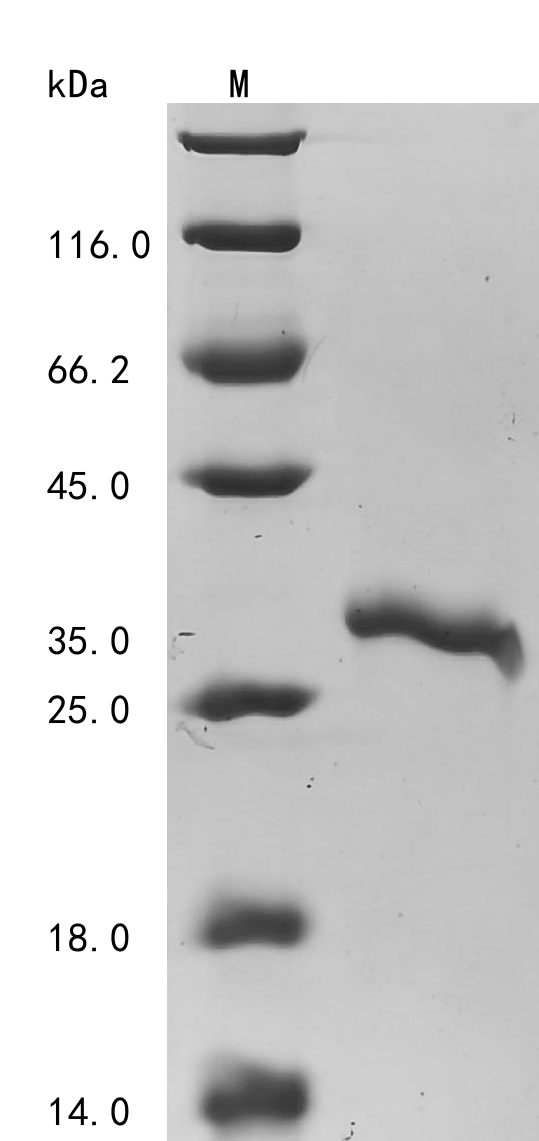
ANRGPAYGLSREVQQKIEKQYDADLEQILIQWITTQCRKDVGRPQPGRENFQNWLKDGTVLCELINALYPEGQAPVKKIQASTMAFKQMEQISQFLQAAERYGINTTDIFQTVDLWEGKNMACVQRTLMNLGGLAVARDDGLFSGDPNWFPKKSKENPRNFSDNQLQEGKNVIGLQMGTNRGASQAGMTGYGMPRQIL
Note: The complete
sequence may include tag sequence, target protein sequence, linker sequence and extra sequence that is
translated with the protein sequence for the purpose(s) of secretion, stability, solubility, etc.
If the exact amino acid sequence of this recombinant protein is critical to your application,
please explicitly request the full and complete sequence of this protein before ordering.
Mol. Weight
26.3 kDa
Protein Length
Full Length of Mature Protein
Tag Info
N-terminal 6xHis-tagged
The tag type will be determined during production process. If you have specified tag type, please tell us and we will develop the specified tag preferentially.
Buffer
Tris-based buffer,50% glycerol
Storage
The shelf life is related to many factors, storage state, buffer ingredients, storage temperature and the stability of the protein itself.
Generally, the shelf life of liquid form is 6 months at -20°C/-80°C. The shelf life of lyophilized form is 12 months at -20°C/-80°C.
Shelf Life
The shelf life is related to many factors, storage state, buffer ingredients, storage temperature and the stability of the protein itself.
Generally, the shelf life of liquid form is 6 months at -20°C/-80°C. The shelf life of lyophilized form is 12 months at -20°C/-80°C.
Lead Time
3-7 business days
Note: All of our proteins are default shipped with normal blue ice packs, if you request to ship with dry ice, please communicate with us in advance and extra fees will be charged.
Notes
Repeated freezing and thawing is not recommended. Store working aliquots at 4°C for up to one week.
Study provides important evidence that hypoxia-inducible TAGLN2 is involved in the selection of cancer cells with enhanced EMT properties to overcome the detrimental environment of cancer cells as gamma radiation.PMID:30191639
Results show that Increased expression of TAGLN2 is associated with increasing tumor grade in glioma and poor patient survival. Knockdown experiments highlighted the function of TAGLN2 in promoting glioma cell invasion, the EMT phenotype, and tumor growth.PMID:29110682
Our data support a novel mechanism in diabetes-associated PDAC by which transgelin-2 mediates proliferation of PDAC cells upon insulin stimulation.PMID:28521289
Results suggest that TAGLN2 might regulate activation and migration of B-cells, in particular, the entry of activated B-cells into the follicle.PMID:28910360
we reviewed the basic characteristics and function of Transgelin-2 and its biological role in various types of diseases in order to provide the theoretical basis for further research and new perspectives on cancer development.PMID:28639888
Our data demonstrated that TAGLN2 might be an HBx induced positive host factor involved in HBV transcription and replication and HBx related liver fibrosis and tumorigenesisPMID:27402267
Transgelin-2 plays functional roles in the progression of cervical squamous cell carcinoma. Suppression of Transgelin-2 may be a new strategy for the treatment of cervical squamous cell carcinoma.PMID:26891454
Salvianolic acid A can reverse the paclitaxel resistance and inhibit the migration and invasion abilities of human breast cancer cells by down-regulating the expression of transgelin 2.PMID:26176734
Proteomics result showed TAGLN2 as the most significant overexpression in individual bladder cancer tissues and urine specimens, and thus represents a potential biomarker for noninvasive screening for bladder cancer.PMID:26081836
TAGLN2 modulates hypoxia-induced apoptosis via caspase-8 apoptotic pathway. Taken together, our data demonstrated the roles of miR-133a in hypoxia-induced apoptotic and implicate its potential in cardiac dysfunctions therapy.PMID:25421410
Transgelin-2, a sequence homolog of transgelin, whose role in the tumor development might be contradictory to the role of transgelin.PMID:24476357
PTTG1 and TAGLN2 are highly expressed in human pancreatic cancer, and the positive expression of PTTG1 is associated with the gender of cancer patients, suggesting that it may represent a potential therapeutic target for the treatment of pancreatic cancerPMID:23527717
our data propose a novel, oncogene-tumor suppressor interplay, where oncogenic PFTK1 confers HCC cell motility through inactivating the actin-binding motile suppressing function of TAGLN2 via phosphorylation.PMID:21577206
Data indicate that TAGLN2 may have an oncogenic function and may be regulated by miR-1, a tumor suppressive miRNA in HNSCC.PMID:21378409
in pulmonary adenocarcinoma, overexpression of TAGLN was strictly localized to the tumor-induced reactive myofibroblastic stromal tissue compartment, whereas overexpression of TAGLN2 was exclusively localized to the neoplastic glandular compartmentPMID:19848416