Recombinant Human Taste receptor type 1 member 3 (TAS1R3), partial

In Stock
Code: CSB-EP752534HU
Size:
20ug
20ug100ug1mg(1mg*1 or 500ug*2)
US$388
Quantity:
Express system: E.coli
Species: Homo sapiens (Human)
Tag Info: N-terminal 10xHis-tagged and C-terminal Myc-tagged
For inquiries on large quantities or another requirements
Send an Inquiry
Start an on-line Chat
Online ordering is currently available for U.S. customers only. For orders outside the U.S., please kindly submit an inquiry or start a chat with us.

Product Details

Purity
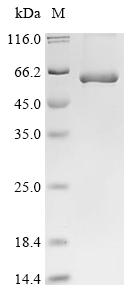
Greater than 90% as determined by SDS-PAGE.
Target Names
TAS1R3
Uniprot NO.
Research Area
Neuroscience
Species
Homo sapiens (Human)
Source
E.coli
Expression Region
21-570aa
Target Protein Sequence
APLCLSQQLRMKGDYVLGGLFPLGEAEEAGLRSRTRPSSPVCTRFSSNGLLWALAMKMAVEEINNKSDLLPGLRLGYDLFDTCSEPVVAMKPSLMFLAKAGSRDIAAYCNYTQYQPRVLAVIGPHSSELAMVTGKFFSFFLMPQVSYGASMELLSARETFPSFFRTVPSDRVQLTAAAELLQEFGWNWVAALGSDDEYGRQGLSIFSALAAARGICIAHEGLVPLPRADDSRLGKVQDVLHQVNQSSVQVVLLFASVHAAHALFNYSISSRLSPKVWVASEAWLTSDLVMGLPGMAQMGTVLGFLQRGAQLHEFPQYVKTHLALATDPAFCSALGEREQGLEEDVVGQRCPQCDCITLQNVSAGLNHHQTFSVYAAVYSVAQALHNTLQCNASGCPAQDPVKPWQLLENMYNLTFHVGGLPLRFDSSGNVDMEYDLKLWVWQGSVPRLHDVGRFNGSLRTERLKIRWHTSDNQKPVSRCSRQCQEGQVRRVKGFHSCCYDCVDCEAGSYRQNPDDIACTFCGQDEWSPERSTRCFRRRSRFLAWGEPAVL
Note: The complete sequence may include tag sequence, target protein sequence, linker sequence and extra sequence that is translated with the protein sequence for the purpose(s) of secretion, stability, solubility, etc.
If the exact amino acid sequence of this recombinant protein is critical to your application, please explicitly request the full and complete sequence of this protein before ordering.
Mol. Weight
68.4 kDa
Protein Length
Partial
Tag Info
N-terminal 10xHis-tagged and C-terminal Myc-tagged
The tag type will be determined during production process. If you have specified tag type, please tell us and we will develop the specified tag preferentially.
Form
Liquid or Lyophilized powder
Note: We will preferentially ship the format that we have in stock, however, if you have any special requirement for the format, please remark your requirement when placing the order, we will prepare according to your demand.
Buffer
If the delivery form is liquid, the default storage buffer is Tris/PBS-based buffer, 5%-50% glycerol. If the delivery form is lyophilized powder, the buffer before lyophilization is Tris/PBS-based buffer, 6% Trehalose.
Reconstitution
We recommend that this vial be briefly centrifuged prior to opening to bring the contents to the bottom. Please reconstitute protein in deionized sterile water to a concentration of 0.1-1.0 mg/mL.We recommend to add 5-50% of glycerol (final concentration) and aliquot for long-term storage at -20℃/-80℃. Our default final concentration of glycerol is 50%. Customers could use it as reference.
Storage
The shelf life is related to many factors, storage state, buffer ingredients, storage temperature and the stability of the protein itself. Generally, the shelf life of liquid form is 6 months at -20°C/-80°C. The shelf life of lyophilized form is 12 months at -20°C/-80°C.
Shelf Life
The shelf life is related to many factors, storage state, buffer ingredients, storage temperature and the stability of the protein itself.
Generally, the shelf life of liquid form is 6 months at -20°C/-80°C. The shelf life of lyophilized form is 12 months at -20°C/-80°C.
Lead Time
3-7 business days
Note: All of our proteins are default shipped with normal blue ice packs, if you request to ship with dry ice, please communicate with us in advance and extra fees will be charged.
Notes
Repeated freezing and thawing is not recommended. Store working aliquots at 4°C for up to one week.
Troubleshooting and FAQs
Datasheet & COA
Please contact us to get it.
Images
  • (Tris-Glycine gel) Discontinuous SDS-PAGE (reduced) with 5% enrichment gel and 15% separation gel.

Customer Reviews and Q&A

 Customer Reviews

Target Background

Function(From Uniprot)
Putative taste receptor. TAS1R1/TAS1R3 responds to the umami taste stimulus (the taste of monosodium glutamate). TAS1R2/TAS1R3 recognizes diverse natural and synthetic sweeteners. TAS1R3 is essential for the recognition and response to the disaccharide trehalose. Sequence differences within and between species can significantly influence the selectivity and specificity of taste responses.
Gene References into Functions
  1. Regarding "consumption of carbohydrates (% energy) and higher amount of sweet foods, respectively...no associations were found for the TAS1R3 alleles." PMID:29110749
  2. TAS1R3 gene rs307355 polymorphism found independent risk factor for dental caries experience by logistic regression & increased risk of caries. Moderate caries (4-7 caries) found to be associated w/TAS1R3 rs307355 heterozygous genotype PMID:25924601
  3. T1R3 gene expression in the tongue is suppressed by chemotherapy. PMID:26422579
  4. The transcripts of TAS1R3 and UCN2 in peripheral blood cells may be considered potential biomarkers of consumption of sugary and fatty food, respectively, to complement data of food-intake questionnaires. PMID:26168276
  5. Five amino acid residues in cysteine-rich domain of human T1R3 were involved in the response for sweet-tasting protein, thaumatin PMID:23370115
  6. T1R3 is a receptor responsible for the detection of calcium by taste. PMID:22773945
  7. Overexpressed the human N-terminal domain of T1R3 in E. coli and found that the refolded protein behaves as a dimer; showed that hT1R3-NTD is functional and capable of binding sucralose with an affinity in the millimolar range. PMID:22450161
  8. amino acid substitutions (F749S and R757C), located in the transmembrane domain of T1R3, severely impair receptor functions in vitro PMID:21422378
  9. The sweet taste receptors (alpha-gustducin and T1R3) are involved in glucose-stimulated secretion of GLP-1 and PYY. PMID:21324568
  10. Allelic polymorphism within the TAS1R3 promoter is associated with human taste sensitivity to sucrose. PMID:19559618
  11. The mechanism of interaction of the sweet protein monellin with T1R2-T1R3 receptor. PMID:12706725
  12. cysteine-rich region of T1R3 has a role in determining responses to intensely sweet proteins PMID:15299024
  13. An immunohistochemistry study to determine whether and where T1R3 may be localized in the liver and pancreas. PMID:15585941
  14. transmembrane domains of human T1R3 bind with lactisole to inhibit sweet taste PMID:15668251
  15. Although T1R2-T1R3 is known to have multiple potential ligand-binding sites to receive a wide variety of sweeteners, the present study is apparently the first to identify the ATD of hT1R3 as a new sweetener-binding region. PMID:17499612
  16. These results show that T1R2 and T1R3 receptors, in addition to their role in taste perception, may also have a role in intrahepatic cholangiocytes. PMID:17928076
  17. Expressed in the sweet/umami gustatory pathways in taste receptor cells and trigeminal neural pathways in transgenic mice. PMID:18539481
  18. The heteromeric G-protein-coupled receptor T1R2:T1R3 responds to a vast array of chemically diverse natural and artificial sweeteners. PMID:19083128
  19. Variations in perception of umami taste correlated with variations in the human TAS1R3 gene. PMID:19587085

Show More

Hide All

Subcellular Location
Cell membrane; Multi-pass membrane protein.
Protein Families
G-protein coupled receptor 3 family, TAS1R subfamily
Database Links

HGNC: 15661

UNIGENE: Hs.74375

KEGG: hsa:83756

STRING: 9606.ENSP00000344411

OMIM: 605865

icon of phone
Call us
301-363-4651 (Available 9 a.m. to 5 p.m. CST from Monday to Friday)
icon of address
Address
No. 269, Shendun 5th Road, Donghu Hi-Tech Development Area, Hubei Province, 430206, P.R.China
icon of social media
Join us with

Subscribe newsletter

Leave a message

* To protect against spam, please pass the CAPTCHA test below.
CAPTCHA verification
© 2007-2025 CUSABIO TECHNOLOGY LLC All rights reserved. 鄂ICP备15011166号-1
Select 0 Products