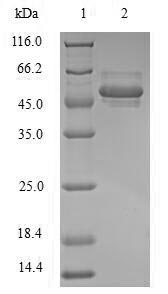
Purity
Greater than 90% as determined by SDS-PAGE.
Research Area
Epigenetics and Nuclear Signaling
Alternative Names
Octamer binding transcription factor 4; MGC22487; Oct 3; Oct 4; Oct-3; Oct-4; OCT3; Oct4; Octamer binding protein 3; Octamer binding protein 4; Octamer binding transcription factor 3; Octamer-binding protein 3; Octamer-binding protein 4; Octamer-binding transcription factor 3; OTF 3; OTF 4; OTF-3; OTF3; OTF4; PO5F1_HUMAN; POU class 5 homeobox 1; POU domain class 5 transcription factor 1; POU domain transcription factor OCT4; POU domain, class 5, transcription factor 1; POU-type homeodomain-containing DNA-binding protein; POU5F1
Species
Homo sapiens (Human)
Expression Region
1-360aa
Target Protein Sequence
MAGHLASDFAFSPPPGGGGDGPGGPEPGWVDPRTWLSFQGPPGGPGIGPGVGPGSEVWGIPPCPPPYEFCGGMAYCGPQVGVGLVPQGGLETSQPEGEAGVGVESNSDGASPEPCTVTPGAVKLEKEKLEQNPEESQDIKALQKELEQFAKLLKQKRITLGYTQADVGLTLGVLFGKVFSQTTICRFEALQLSFKNMCKLRPLLQKWVEEADNNENLQEICKAETLVQARKRKRTSIENRVRGNLENLFLQCPKPTLQQISHIAQQLGLEKDVVRVWFCNRRQKGKRSSSDYAQREDFEAAGSPFSGGPVSFPLAPGPHFGTPGYGSPHFTALYSSVPFPEGEAFPPVSVTTLGSPMHSN
Note: The complete
sequence may include tag sequence, target protein sequence, linker sequence and extra sequence that is
translated with the protein sequence for the purpose(s) of secretion, stability, solubility, etc.
If the exact amino acid sequence of this recombinant protein is critical to your application,
please explicitly request the full and complete sequence of this protein before ordering.
Protein Length
Full Length
Tag Info
N-terminal 6xHis-B2M-tagged
The tag type will be determined during production process. If you have specified tag type, please tell us and we will develop the specified tag preferentially.
Reconstitution
We recommend that this vial be briefly centrifuged prior to opening to bring the contents to the bottom. Please reconstitute protein in deionized sterile water to a concentration of 0.1-1.0 mg/mL.We recommend to add 5-50% of glycerol (final concentration) and aliquot for long-term storage at -20°C/-80°C. Our default final concentration of glycerol is 50%. Customers could use it as reference.
Storage Condition
The shelf life is related to many factors, storage state, buffer ingredients, storage temperature and the stability of the protein itself. Generally, the shelf life of liquid form is 6 months at -20°C/-80°C. The shelf life of lyophilized form is 12 months at -20°C/-80°C.
Shelf Life
The shelf life is related to many factors, storage state, buffer ingredients, storage temperature and the stability of the protein itself.
Generally, the shelf life of liquid form is 6 months at -20°C/-80°C. The shelf life of lyophilized form is 12 months at -20°C/-80°C.
Lead Time
3-7 business days
Note: All of our proteins are default shipped with normal blue ice packs, if you request to ship with dry ice, please communicate with us in advance and extra fees will be charged.
Notes
Repeated freezing and thawing is not recommended. Store working aliquots at 4°C for up to one week.
Datasheet & COA
Please contact us to get it.
Images
-
(Tris-Glycine gel) Discontinuous SDS-PAGE (reduced) with 5% enrichment gel and 15% separation gel.
Description
Like all recombinant proteins, this Recombinant Human POU5F1 protein was encoded by recombinant DNA. The recombinant DNA was introduced to a plasmid in which the gene of POU5F1 was cloned downstream of a promoter region. When the plasmid was introduced to the cells of E.coli, the E.coli’s own protein synthesis pathways would then result in the expression of the POU5F1 protein. And the next step was protein purification. The purity of this recombinant protein is 90%+ determined by SDS-PAGE.
POU Class 5 Homeobox 1 (POU5F1) is a transcription factor of the POU family that binds an octameric sequence motif to activate the expression of downstream genes. POU5F1 has been identified as one of the most important CSC markers and participates in stemness maintenance in various tumors. Published literatures have certified that increased POU5F1 was correlated with clinicopathological features and prognosis not only in LIHC, but also in bladder carcinoma, non-small cell lung carcinoma, and oral squamous cell cancer. Although many studies have been performed, the prognostic significance of POU5F1 in cancers remains controversial, and the functions of POU5F1 in the regulatory network of tumors are not fully recognized. Some studies have come to different or even totally opposite conclusions regarding the prognostic value of POU5F1 and the role of POU5F1 in tumor development. For instance, He et al. showed that elevated POU5F1 in esophageal squamous cell carcinoma symbolized poor survival outcomes. However, Ge et al. found that high expression of POU5F1 was connected with longer survival in esophageal squamous cell carcinoma. Nevertheless, POU5F1 may serve as an essential predictive factor for multiple cancers in the near future.