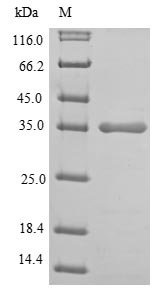
Purity
Greater than 85% as determined by SDS-PAGE.
Alternative Names
Cell proliferation-inducing gene 19 protein; GSD11; L lactate dehydrogenase B chain; L-lactate dehydrogenase A chain; Lactate dehydrogenase A; Lactate dehydrogenase B; Lactate dehydrogenase c variant 1; Lactate dehydrogenase c variant 3; Lactate dehydrogenase c variant 4; Lactate dehydrogenase C4; Lactate dehydrogenase H chain; Lactate dehydrogenase M; LDH A; LDH B; LDH H; LDH heart subunit; LDH M; LDH muscle subunit; LDH-A; LDH-M; LDH1; ldha; LDHA_HUMAN; LDHBD; LDHM; MS1111; PIG19; Proliferation inducing gene 19; Proliferation-inducing gene 19; Renal carcinoma antigen NY REN 46; Renal carcinoma antigen NY-REN-59; TRG 5; TRG5
Species
Homo sapiens (Human)
Expression Region
5-323aa
Target Protein Sequence
KDQLIYNLLKEEQTPQNKITVVGVGAVGMACAISILMKDLADELALVDVIEDKLKGEMMDLQHGSLFLRTPKIVSGKDYNVTANSKLVIITAGARQQEGESRLNLVQRNVNIFKFIIPNVVKYSPNCKLLIVSNPVDILTYVAWKISGFPKNRVIGSGCNLDSARFRYLMGERLGVHPLSCHGWVLGEHGDSSVPVWSGMNVAGVSLKTLHPDLGTDKDKEQWKEVHKQVVESAYEVIKLKGYTSWAIGLSVADLAESIMKNLRRVHPVSTMIKGLYGIKDDVFLSVPCILGQNGISDLVKVTLTSEEEARLKKSADTL
Note: The complete
sequence may include tag sequence, target protein sequence, linker sequence and extra sequence that is
translated with the protein sequence for the purpose(s) of secretion, stability, solubility, etc.
If the exact amino acid sequence of this recombinant protein is critical to your application,
please explicitly request the full and complete sequence of this protein before ordering.
Tag Info
Tag-Free
The tag type will be determined during production process. If you have specified tag type, please tell us and we will develop the specified tag preferentially.
Reconstitution
We recommend that this vial be briefly centrifuged prior to opening to bring the contents to the bottom. Please reconstitute protein in deionized sterile water to a concentration of 0.1-1.0 mg/mL.We recommend to add 5-50% of glycerol (final concentration) and aliquot for long-term storage at -20°C/-80°C. Our default final concentration of glycerol is 50%. Customers could use it as reference.
Storage Condition
The shelf life is related to many factors, storage state, buffer ingredients, storage temperature and the stability of the protein itself. Generally, the shelf life of liquid form is 6 months at -20°C/-80°C. The shelf life of lyophilized form is 12 months at -20°C/-80°C.
Shelf Life
The shelf life is related to many factors, storage state, buffer ingredients, storage temperature and the stability of the protein itself.
Generally, the shelf life of liquid form is 6 months at -20°C/-80°C. The shelf life of lyophilized form is 12 months at -20°C/-80°C.
Lead Time
3-7 business days
Note: All of our proteins are default shipped with normal blue ice packs, if you request to ship with dry ice, please communicate with us in advance and extra fees will be charged.
Notes
Repeated freezing and thawing is not recommended. Store working aliquots at 4°C for up to one week.
Datasheet & COA
Please contact us to get it.
Images
-
(Tris-Glycine gel) Discontinuous SDS-PAGE (reduced) with 5% enrichment gel and 15% separation gel.
Description
This recombinant Human LDHA protein is an E.coli expressed partial protein with Tag-Free and its purity is 85%+ determined by SDS-PAGE. With the appropriate cDNA and PCR methods, LDHA expression plasmids can be rapidly produced. which must undergo denaturation and folding cycle, can be recovered with more modest yields. Hence, using small-scale fermentations and laboratory-scale processing equipment, LDHA proteins (or subdomains thereof) can usually be produced in sufficient quantities to initiate most studies including detailed structural determinations.which must undergo denaturation and folding cycle, can be recovered with more modest yields. Hence, using small-scale fermentations and laboratory-scale processing equipment, LDHA proteins (or subdomains thereof) can usually be produced in sufficient quantities to initiate most studies including detailed structural determinations.
LDHA is a critical glycolytic enzyme that promotes aerobic glycolysis in the cells by catalyzing the interconversion of pyruvate and lactate. It contributes to the increase in glucose uptake and lactate generation in tumor cells and is important for cancer invasion and immune infiltration. High expression of LDHA has been found in a variety of malignancies such as breast cancer, liver cancer, and oral squamous cell carcinoma and has been linked to tumor volume, stage, and degree of cell differentiation as well as affected disease-free survival (DFS) and overall survival (OS). LDHA has recently been associated with lactic acid-related tumor immune infiltration and immune escape.