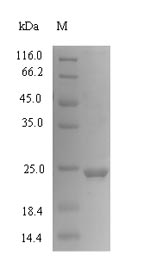
The shelf life is related to many factors, storage state, buffer ingredients, storage temperature and the stability of the protein itself. Generally, the shelf life of liquid form is 6 months at -20°C/-80°C. The shelf life of lyophilized form is 12 months at -20°C/-80°C.
Shelf Life
The shelf life is related to many factors, storage state, buffer ingredients, storage temperature and the stability of the protein itself.
Generally, the shelf life of liquid form is 6 months at -20°C/-80°C. The shelf life of lyophilized form is 12 months at -20°C/-80°C.
Notes
Repeated freezing and thawing is not recommended. Store working aliquots at 4°C for up to one week.
Has chemotactic activity for neutrophils. May play a role in inflammation and exerts its effects on endothelial cells in an autocrine fashion. In vitro, the processed forms GRO-alpha(4-73), GRO-alpha(5-73) and GRO-alpha(6-73) show a 30-fold higher chemotactic activity.
Gene References into Functions
The chemokine Gro1 induced in response to inflammation triggers senescence and arrests development of new neurons in the hippocampus and that the magnitude of this response is sex-dependent.PMID:30201019
CXCL1 displays a specific microRNA (miR) upregulated by the prototypical colon cancer onco-miR miR-105.PMID:30115896
These results show that AKIP1 is crucial in cervical cancer angiogenesis and growth by elevating the levels of the NF-kappaB-dependent chemokines CXCL1, CXCL2, and CXCL8.PMID:29520695
Adipose stromal cells recruitment to tumours, driven by CXCL1 and CXCL8, promotes prostate cancer progression.PMID:27241286
CXCL1, which is produced by breast cancer cells, can promote cancer growth and developmentPMID:29438938
miR-204 inhibits cell proliferation in gastric cancer by targeting CKS1B, CXCL1 and GPRC5A.PMID:29283424
Thrombocytosis was more prevalent in patients with inflammatory breast cancer (IBC)than in those with non-IBC and it was associated with poor prognosis. GRO and TGF-beta were associated with thrombocytosis in IBCPMID:28831670
the plasma concentrations of CXCL1 indicated the disease activity and prognosis in interstitial pneumonia with autoimmune features (IPAF). Thus, the CXCL1/CXCR2 axis appears to be involved in the progression of IPAF.PMID:27958346
CXCL1/8 secreted by adipose-derived mesenchymal stem cells could promote breast cancer angiogenesis.PMID:28514506
GROA overexpression is associated with invasion in triple negative breast cancer.PMID:28560447
The results of the transwell chemotaxis assay also supported the above results. Our data suggest that APN can promote h-JBMMSC chemotaxis by up-regulating CXCL1 and CXCL8PMID:28176455
This study highlighted CAF-secreted CXCL1 as an attractive target to reverse tumor radioresistance.PMID:28518141
we identified the microRNA miR-200a as a putative post-transcriptional regulator of CXCL1 in hepatocellular carcinomaPMID:27542259
study demonstrates that CXCL1 can transform NOFs into senescent CAFs via an autocrine mechanismPMID:29360827
Association of polymorphic markers of chemokine genes, their receptors, and CD14 gene with coronary atherosclerosisPMID:29369549
GROalpha high in the tumor microenvironment can be used as potential indicators for the progression of non-small cell lung cancerPMID:28375674
IL-8, but not the CXCL1 circuit, is critical for the regulation of thyroid cancer stem cells.PMID:27577959
this study shows that CXCL1 is expressed in epithelium of the endometrium with adenomyosis and demonstrate that VEGF is capable of inducing CXCL1 expressionPMID:27665197
Taken together, the present study indicates that IL-33 localized in the human atherosclerotic plaque increases GRO-alpha mRNA expression and protein secretion via activation of ERK1/2, JNK, and NF-kappaB in HUVECs, suggesting that IL-33 plays an important role in the pathophysiology and development of atherosclerosis.PMID:28637660
Study provides the first evidence that primary malignant cell-secreted VEGFA stimulates tumor-associated macrophages to produce CXCL1, which recruits CXCR2-positive MDSCs to form a premetastatic niche to promote liver metastases.PMID:28455419
the presence of elevated circulating levels of VEGF and CXCL1 are predictive of liver and lung metastasis, respectively of colorectal cancer.PMID:28870907
This study describe elevated levels of CXCL1 and it receptor in the Solid Component and Cyst Fluid of Human Adamantinomatous Craniopharyngioma, relative to other pediatric brain tumors and normal cerebral tissue.PMID:28859336
The expressions of CXCL1 in cancer cells and CXCR2 in stromal cells are useful prognostic factors for gastric cancer patientsPMID:28575019
CXCL1 secreted by tumor-associated lymphatic endothelial cells promotes lymph node metastasis of gastric cancer through integrin beta1/FAK/AKT signaling pathway.PMID:27832972
S100A9 and S100A12 may have a role in the pathogenesis of pneumonia: S100A9 and CXCL1 may contribute solely in mild pneumonia, and CCL5 and CXCL11 may contribute in severe pneumonia.PMID:28381820
These findings support a role for CXCL1 and IL-8 in cystic fibrosis lung disease severity and identify STAT3 as a modulating pathway.PMID:27799352
Results suggest that CXCL1 is a key molecular link between senescence of stromal fibroblasts and tumor growth.PMID:27092462
Increased IL-8 and CXCL1 transcription in T84 and THP-1 cells compared to that in wild-type EPEC.PMID:27297392
CXCL1 signaling in the tumor microenvironment is highly responsible for repeated intravesical recurrence, disease progression, and drug resistance through enhanced invasion ability. In conclusion, disrupting CXCL1 signaling to dysregulate this chemokine is a promising therapeutic approach for human UCB.PMID:27690238
Silencing of the CXCL1 gene inhibits HGC803 cell migration and invasion. The positive expression of CXCL1 is correlated with poor survival of gastric cancer patients and CXCL1 is an independent prognostic factor for gastric cancer.PMID:27748927
These results demonstrate that tumor-derived CXCL1 contributes to TANs infiltration in lung cancer which promotes tumor growth.PMID:27446967
the serum levels of the soluble factors sCD40L and CXCL1 are not associated with endometriosis and are not suitable as biomarkers for disease diagnosis.PMID:27190986
Elevated expression of GRO-alpha in cytoplasm of cancer cells (hazard ratio [HR] = 5.730, P = 0.007) and stroma (HR = 3.120, P = 0.022) were independent prognostic factors of pancreatic cancer. T classification (HR = 2.130, P = 0.023), lymphatic metastasis (HR = 4.211, P = 0.009) and TNM classification (HR = 0.481, P = 0.031) were also prognostic predictors in PC patients.PMID:27472713
The novel findings reveal the critical role of NLRP12-IL-17A-CXCL1 axis in host defense by modulating neutrophil recruitment against Klebsiella pneumoniae.PMID:26349659
increased amounts released by neutrophils from fibromyalgia patientsPMID:26341115
these findings suggest that CXCL1 plays critical roles in the growth and apoptosis of hepatocellular carcinomaPMID:26499374
BBP also stimulated the production of CXCL1/GROalpha by TADCs, which increased the angiogenesis of breast cancer in a mouse modelPMID:26397389
Intense glomerular CXCL1 expression was observed in biopsy specimens from patients with lupus nephritisPMID:25471749
hCXCL1-GAG interactions provide stringent control over regulating chemokine levels and receptor accessibility and activation, and that chemotactic gradients mediate cellular trafficking to the target site.PMID:26721883
Urine CXCL1 is a promising, non-invasive molecular marker for tumor detection and outcome prediction in patients with bladder cancer .PMID:26406865
CXCR2-CXCL1 axis is correlated with neutrophil infiltration and predicts a poor prognosis in hepatocellular carcinomaPMID:26503598
Polymorphisms in the promoter regions of the CXCL1 and CXCL2 genes contribute to increased risk of alopecia areata in the Korean populationPMID:26345899
VEGF markedly induces CXCL1 release in A549 lung epithelial cells.PMID:23665907
TGF-beta negatively regulates CXCL1 expression in CAFs through Smad2/3 binding to the promoter, and through suppression of HGF/c-Met autocrine signalingPMID:26252654
work shows parallel networks of necroptosis-induced CXCL1 and Mincle signalling that promote macrophage-induced adaptive immune suppression and thereby enable pancreatic ductal adenocarcinoma progressionPMID:27049944
High CXCL1 expression is a poor prognostic biomarker in metastatic colorectal cancer.PMID:26104296
urinary CXCL1 as a new non-invasive predictor of IgAN progressionPMID:25816025
CXCL1 expression was a negative prognostic factor.PMID:25175281
There was a significant positive correlation between CXCL-1 levels in the vitreous and the extent of the retinal detachment.PMID:25766782
CXCL1 expression was highly upregulated in patients with alcoholic hepatitis.PMID:25930080