Recombinant Human Glucosidase 2 subunit beta (PRKCSH), partial

Code: CSB-RP029254h
Size:
20ug
20ug100ug1mg(1mg*1 or 500ug*2)
US$224
Quantity:
Express system: E.coli
Species: Homo sapiens (Human)
Tag Info: N-terminal GST-tagged
For inquiries on large quantities or another requirements
Send an Inquiry
Start an on-line Chat
Online ordering is currently available for U.S. customers only. For orders outside the U.S., please kindly submit an inquiry or start a chat with us.

Product Details

Purity
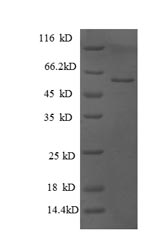
Greater than 90% as determined by SDS-PAGE.
Target Names
PRKCSH
Uniprot NO.
Research Area
Signal Transduction
Alternative Names
80K-H protein;Glucosidase II subunit betaProtein kinase C substrate 60.1 kDa protein heavy chain ;PKCSH
Species
Homo sapiens (Human)
Source
E.coli
Expression Region
15-302aa
Target Protein Sequence
VEVKRPRGVSLTNHHFYDESKPFTCLDGSATIPFDQVNDDYCDCKDGSDEPGTAACPNGSFHCTNTGYKPLYIPSNRVNDGVCDCCDGTDEYNSGVICENTCKEKGRKERESLQQMAEVTREGFRLKKILIEDWKKAREEKQKKLIELQAGKKSLEDQVEMLRTVKEEAEKPEREAKEQHQKLWEEQLAAAKAQQEQELAADAFKELDDDMDGTVSVTELQTHPELDTDGDGALSEAEAQALLSGDTQTDATSFYDRVWAAIRDKYRSEALPTDLPAPSAPDLTEPKE
Note: The complete sequence may include tag sequence, target protein sequence, linker sequence and extra sequence that is translated with the protein sequence for the purpose(s) of secretion, stability, solubility, etc.
If the exact amino acid sequence of this recombinant protein is critical to your application, please explicitly request the full and complete sequence of this protein before ordering.
Mol. Weight
59.3kDa
Protein Length
Partial
Tag Info
N-terminal GST-tagged
The tag type will be determined during production process. If you have specified tag type, please tell us and we will develop the specified tag preferentially.
Reconstitution
We recommend that this vial be briefly centrifuged prior to opening to bring the contents to the bottom. Please reconstitute protein in deionized sterile water to a concentration of 0.1-1.0 mg/mL.We recommend to add 5-50% of glycerol (final concentration) and aliquot for long-term storage at -20°C/-80°C. Our default final concentration of glycerol is 50%. Customers could use it as reference.
Storage
The shelf life is related to many factors, storage state, buffer ingredients, storage temperature and the stability of the protein itself. Generally, the shelf life of liquid form is 6 months at -20°C/-80°C. The shelf life of lyophilized form is 12 months at -20°C/-80°C.
Shelf Life
The shelf life is related to many factors, storage state, buffer ingredients, storage temperature and the stability of the protein itself.
Generally, the shelf life of liquid form is 6 months at -20°C/-80°C. The shelf life of lyophilized form is 12 months at -20°C/-80°C.
Lead Time
Delivery time may differ from different purchasing way or location, please kindly consult your local distributors for specific delivery time.
Note: All of our proteins are default shipped with normal blue ice packs, if you request to ship with dry ice, please communicate with us in advance and extra fees will be charged.
Notes
Repeated freezing and thawing is not recommended. Store working aliquots at 4°C for up to one week.
Troubleshooting and FAQs
Datasheet & COA
Please contact us to get it.
Images
  • (Tris-Glycine gel) Discontinuous SDS-PAGE (reduced) with 5% enrichment gel and 15% separation gel.

Customer Reviews and Q&A

 Customer Reviews

Target Background

Function(From Uniprot)
Regulatory subunit of glucosidase II that cleaves sequentially the 2 innermost alpha-1,3-linked glucose residues from the Glc(2)Man(9)GlcNAc(2) oligosaccharide precursor of immature glycoproteins. Required for efficient PKD1/Polycystin-1 biogenesis and trafficking to the plasma membrane of the primary cilia.
Gene References into Functions
  1. Results suggest that loss of PRKCSH and SEC63 leads to general defects in ciliogenesis, while quenching of the Wnt signaling cascade is cholangiocyte-restricted. PMID:28973524
  2. This study demonstrated that Large copy number variations on germline level are not present in patients with a clinical diagnosis of Severe Polycystic Liver Disease. PMID:26365003
  3. Polycystic liver disease is recessive at the cellular level, and loss of functional PRKCSH is an important step in cystogenesis. PMID:21856269
  4. The induction of autophagy by hepatocystin deficiency is mediated through mammalian target of rapamycin (mTOR). PMID:21681021
  5. Results provide evidence that mutations at the coding PRKCSH GAG repeat are a target of MSI and are selectively associated with the MSI-H phenotype in gastric carcinomas. PMID:21371016
  6. The common SNPs tested in DDOST, PRKCSH and LGALS3 do not seem to be associated with diabetic micro- or macrovascular complications or with type 1 diabetes in Finnish patients. PMID:20490454
  7. identified a total of 26 novel mutations in PRKCSH (n = 14) and SEC63 (n = 12), including four splice site mutations, eight insertions/ deletions, six non-sense mutations, and eight missense mutations PMID:20095989
  8. Our results suggest that PRKCSH gene is not a major genetic cause of PCLD and there may be at least another locus responsible for the disease in Taiwan. PMID:19308730
  9. PRKCSH functions as a chaperone-like molecule, which prevents endoplasmic reticulum-associated degradation of TRPP2. PMID:19801576
  10. Mutations in this protein cause isolated autosomal dominant polycystic liver disease. PMID:12529853
  11. germline mutations in PRKCSH as the probable cause of autosomal dominant polycystic liver disease PMID:12577059
  12. autosomal dominant polycystic liver disease is genetically heterogeneous PMID:15057895
  13. role of hepatocystin in carbohydrate processing and quality control of newly synthesized glycoproteins in the endoplasmic reticulum PMID:15188177
  14. results identify 80K-H as a new player involved in GLUT4 vesicle transport and identify a link between a kinase involved in the insulin signalling cascade, PKCzeta, and a known component of the GLUT4 vesicle trafficking pathway, munc18c PMID:15707389
  15. the majority of cysts from PRKCSH mutation carriers did not express hepatocystin PMID:18224332
  16. Hepatocystin is not secreted in liver cyst fluids of autosomal dominant polycystic liver disease patients, suggesting that mutant hepatocystin is either not produced or degraded intracellularly. PMID:18419150
  17. 80K-H is a novel regulator of IP3R1 activity, and it may contribute to neuronal functions. PMID:18990696
  18. These results indicate that insulin induces dynamic associations between PKCzeta, 80K-H, and munc18c and that 80K-H may act as a key signaling link between PKCzeta and munc18c in live cells. PMID:19061073

Show More

Hide All

Subcellular Location
Endoplasmic reticulum.
Database Links

HGNC: 9411

UNIGENE: Hs.610830

KEGG: hsa:5589

STRING: 9606.ENSP00000252455

OMIM: 174050

icon of phone
Call us
301-363-4651 (Available 9 a.m. to 5 p.m. CST from Monday to Friday)
icon of address
Address
No. 269, Shendun 5th Road, Donghu Hi-Tech Development Area, Hubei Province, 430206, P.R.China
icon of social media
Join us with

Subscribe newsletter

Leave a message

* To protect against spam, please pass the CAPTCHA test below.
CAPTCHA verification
© 2007-2025 CUSABIO TECHNOLOGY LLC All rights reserved. 鄂ICP备15011166号-1
Select 0 Products