Recombinant Human Fc receptor-like protein 5 (FCRL5), partial

Code: CSB-MP853494HU
Size:
20ug
20ug100ug1mg(1mg*1 or 500ug*2)
US$660
Quantity:
Express system: Mammalian cell
Species: Homo sapiens (Human)
Tag Info: C-terminal 6xHis-tagged
For inquiries on large quantities or another requirements
Send an Inquiry
Start an on-line Chat
Online ordering is currently available for U.S. customers only. For orders outside the U.S., please kindly submit an inquiry or start a chat with us.

Product Details

Abbreviation
FCRL5
Purity
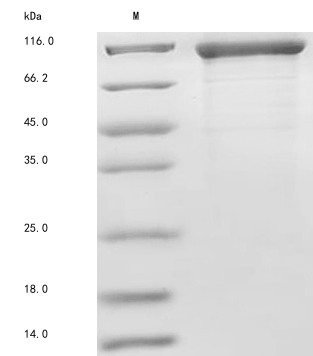
Greater than 85% as determined by SDS-PAGE.
Target Names
FCRL5
Uniprot NO.
Research Area
Immunology
Species
Homo sapiens (Human)
Source
Mammalian cell
Expression Region
16-844aa
Target Protein Sequence
QFARTPRPIIFLQPPWTTVFQGERVTLTCKGFRFYSPQKTKWYHRYLGKEILRETPDNILEVQESGEYRCQAQGSPLSSPVHLDFSSASLILQAPLSVFEGDSVVLRCRAKAEVTLNNTIYKNDNVLAFLNKRTDFHIPHACLKDNGAYRCTGYKESCCPVSSNTVKIQVQEPFTRPVLRASSFQPISGNPVTLTCETQLSLERSDVPLRFRFFRDDQTLGLGWSLSPNFQITAMWSKDSGFYWCKAATMPYSVISDSPRSWIQVQIPASHPVLTLSPEKALNFEGTKVTLHCETQEDSLRTLYRFYHEGVPLRHKSVRCERGASISFSLTTENSGNYYCTADNGLGAKPSKAVSLSVTVPVSHPVLNLSSPEDLIFEGAKVTLHCEAQRGSLPILYQFHHEGAALERRSANSAGGVAISFSLTAEHSGNYYCTADNGFGPQRSKAVSLSVTVPVSHPVLTLSSAEALTFEGATVTLHCEVQRGSPQILYQFYHEDMPLWSSSTPSVGRVSFSFSLTEGHSGNYYCTADNGFGPQRSEVVSLFVTVPVSRPILTLRVPRAQAVVGDLLELHCEAPRGSPPILYWFYHEDVTLGSSSAPSGGEASFNLSLTAEHSGNYSCEANNGLVAQHSDTISLSVIVPVSRPILTFRAPRAQAVVGDLLELHCEALRGSSPILYWFYHEDVTLGKISAPSGGGASFNLSLTTEHSGIYSCEADNGLEAQRSEMVTLKVAVPVSRPVLTLRAPGTHAAVGDLLELHCEALRGSPLILYRFFHEDVTLGNRSSPSGGASLNLSLTAEHSGNYSCEADNGLGAQRSETVTLYITGLTANR
Note: The complete sequence may include tag sequence, target protein sequence, linker sequence and extra sequence that is translated with the protein sequence for the purpose(s) of secretion, stability, solubility, etc.
If the exact amino acid sequence of this recombinant protein is critical to your application, please explicitly request the full and complete sequence of this protein before ordering.
Mol. Weight
92.9 kDa
Protein Length
Partial
Tag Info
C-terminal 6xHis-tagged
The tag type will be determined during production process. If you have specified tag type, please tell us and we will develop the specified tag preferentially.
Form
Liquid or Lyophilized powder
Note: We will preferentially ship the format that we have in stock, however, if you have any special requirement for the format, please remark your requirement when placing the order, we will prepare according to your demand.
Buffer
If the delivery form is liquid, the default storage buffer is Tris/PBS-based buffer, 5%-50% glycerol. If the delivery form is lyophilized powder, the buffer before lyophilization is Tris/PBS-based buffer, 6% Trehalose.
Reconstitution
We recommend that this vial be briefly centrifuged prior to opening to bring the contents to the bottom. Please reconstitute protein in deionized sterile water to a concentration of 0.1-1.0 mg/mL.We recommend to add 5-50% of glycerol (final concentration) and aliquot for long-term storage at -20°C/-80°C. Our default final concentration of glycerol is 50%. Customers could use it as reference.
Storage
The shelf life is related to many factors, storage state, buffer ingredients, storage temperature and the stability of the protein itself. Generally, the shelf life of liquid form is 6 months at -20°C/-80°C. The shelf life of lyophilized form is 12 months at -20°C/-80°C.
Shelf Life
The shelf life is related to many factors, storage state, buffer ingredients, storage temperature and the stability of the protein itself.
Generally, the shelf life of liquid form is 6 months at -20°C/-80°C. The shelf life of lyophilized form is 12 months at -20°C/-80°C.
Lead Time
18-28 business days
Note: All of our proteins are default shipped with normal blue ice packs, if you request to ship with dry ice, please communicate with us in advance and extra fees will be charged.
Notes
Repeated freezing and thawing is not recommended. Store working aliquots at 4°C for up to one week.
Troubleshooting and FAQs
Datasheet & COA
Please contact us to get it.
Images
  • (Tris-Glycine gel) Discontinuous SDS-PAGE (reduced) with 5% enrichment gel and 15% separation gel.

Customer Reviews and Q&A

 Customer Reviews

Target Background

Function(From Uniprot)
May be involved in B-cell development and differentiation in peripheral lymphoid organs and may be useful markers of B-cell stages. May have an immunoregulatory role in marginal zone B-cells.
Gene References into Functions
  1. based on FCRL5 binding, we can discern distinct changes in the IgG2 molecule, including the disulfide isoform structure and charge variants related to deamidation. Since both IgG2 deamidation and conversion of disulfide isoforms occur in vivo, these findings elucidate the biological FCRL5 ligand. PMID:29101848
  2. we found that FCRL5 expression is induced specifically upon BCR stimulation and dissected the molecular mechanism PMID:27065451
  3. this study revealed that the FCRL5+ tissue-like memory subset responds poorly to multiple stimuli compared with the FCRL5- subset, as reflected by reduced calcium mobilization and blunted cell proliferation PMID:27076679
  4. Data suggest that expression of FCRL5 (but not FCRL4) on surface of atypical (perhaps dysfunctional) memory B-Lymphocytes is up-regulated by exposure to Plasmodium falciparum antigens in subjects in Uganda where malaria is endemic. PMID:25993340
  5. FCRL5 is a new type of receptor that recognizes intact IgG, possibly enabling B cells to sense Ig quality. Recognition of undamaged IgG molecules by FCRL5 could allow B cells to engage recently produced Abs. PMID:23616577
  6. FcRL5 binds all immunoglobulin (Ig)G isotypes with varied efficiency. PMID:22491254
  7. Enhanced proliferation and downstream isotype expression upon FCRL5 stimulation could reflect a physiological role for FCRL5 in the expansion and development of antigen-primed B cells. PMID:22028333
  8. Three of the FCRL5 tag SNPs, rs6667109, rs3811035 and rs6692977 showed association with Graves' disease. association with FCRL5 was secondary to linkage disequilibrium with the FCRL3, rs11264798 and rs10489678 SNPs. PMID:20626413
  9. Characterization and comparison of the structure and B-cell expression pattern of the entire family of IRTA genes, which includes 5 members contiguously located on chromosome. PMID:11929751
  10. IRTA2 is expressed on the surface of human lymphoma cell lines and hairy cell leukemia cells PMID:15671532
  11. results identify FcRH5 as a novel, direct target of EBNA2 that may contribute to the development of Epstein-Barr virus-associated tumors PMID:16439682
  12. IRTA2/FcRH5 may have a role in hairy cell leukemia PMID:16681430
  13. Down-regulation of FCRL5 is associated with acute lymphoblastic leukemia. PMID:18802695
  14. Single-nucleotide polymorphism in the FCRL5 gene and HLA-B27 is associated with ankylosing spondylitis. PMID:19775371

Show More

Hide All

Subcellular Location
Cell membrane; Single-pass type I membrane protein.
Tissue Specificity
Expressed in marginal zone B-cells, immunoblasts, tonsillar germinal center centrocytes and in the intraepithelial and interfollicular regions of the tonsil. Expressed in many lymphoma cell lines and on hairy cell leukemia cells. Isoform 1, isoform 3, iso
Database Links

HGNC: 18508

UNIGENE: Hs.415950

KEGG: hsa:83416

STRING: 9606.ENSP00000354691

OMIM: 605877

icon of phone
Call us
301-363-4651 (Available 9 a.m. to 5 p.m. CST from Monday to Friday)
icon of address
Address
No. 269, Shendun 5th Road, Donghu Hi-Tech Development Area, Hubei Province, 430206, P.R.China
icon of social media
Join us with

Subscribe newsletter

Leave a message

* To protect against spam, please pass the CAPTCHA test below.
CAPTCHA verification
© 2007-2025 CUSABIO TECHNOLOGY LLC All rights reserved. 鄂ICP备15011166号-1
Select 0 Products