GILIQFEQIVAVYHSASKQKAWDHFTKAQRKNISVWCKQAEEIRNIHNDELMGIRREEEMEMSDDEIEEMTETKETEESALVSQAEALKEENDSLRWQLDAYRNEVELLKQEQGKVHREDDPNKEQQLKLLQQALQGMQQHLLKVQEEYKKKEAELEKLKDDKLQVEKMLENLKEKESCASRLCASNQDSEYPLEKTMNSSPIKSEREALLVGIISTFLHVHPFGASIEYICSYLHRLDNKICTSDVECLMGRLQHTFKQEMTGVGASLEKRWKFCGFEGLKLT
Note: The complete
sequence may include tag sequence, target protein sequence, linker sequence and extra sequence that is
translated with the protein sequence for the purpose(s) of secretion, stability, solubility, etc.
If the exact amino acid sequence of this recombinant protein is critical to your application,
please explicitly request the full and complete sequence of this protein before ordering.
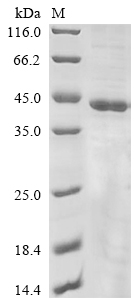
Mol. Weight
37.1 kDa
Protein Length
Partial
Tag Info
N-terminal 6xHis-tagged
The tag type will be determined during production process. If you have specified tag type, please tell us and we will develop the specified tag preferentially.
Buffer
Tris-based buffer,50% glycerol
Storage
The shelf life is related to many factors, storage state, buffer ingredients, storage temperature and the stability of the protein itself.
Generally, the shelf life of liquid form is 6 months at -20°C/-80°C. The shelf life of lyophilized form is 12 months at -20°C/-80°C.
Shelf Life
The shelf life is related to many factors, storage state, buffer ingredients, storage temperature and the stability of the protein itself.
Generally, the shelf life of liquid form is 6 months at -20°C/-80°C. The shelf life of lyophilized form is 12 months at -20°C/-80°C.
Notes
Repeated freezing and thawing is not recommended. Store working aliquots at 4°C for up to one week.
May be involved in cell growth. Probably acts as a terminal oxidase of plasma electron transport from cytosolic NAD(P)H via hydroquinones to acceptors at the cell surface. Hydroquinone oxidase activity alternates with a protein disulfide-thiol interchange/oxidoreductase activity which may control physical membrane displacements associated with vesicle budding or cell enlargement. The activities oscillate with a period length of 22 minutes and play a role in control of the ultradian cellular biological clock.
Gene References into Functions
The tumor-associated NADH oxidase (tNOX)-mediated modulation of the NAD+ concentration and SIRT1 are involved in oxaliplatin-induced apoptosis.PMID:28122359
These findings not only shed light on the molecular mechanism of the anticancer properties of capsaicin, but also the transcription regulation of tNOX expression that may potentially explain how POU3F2 is associated with tumorigenesis.PMID:27271588
The findings support a role for arNOX as a major source of oxidative damage leading to cross-linking of skin proteins.PMID:24906676
The results suggest that phosphorylation of serine-504 by PKCdelta modulates the biological function of tNOX.PMID:22659163
this result suggests that hnRNP F directs formation of the exon 4 minus variant of ENOX2.PMID:21625959
increased NADH levels resulting from ENOX2 inhibition result in decreased prosurvival sphingosine-1-phosphate and increased proapoptotic ceramide, both of which may be important to initiation of the ENOX2 inhibitor-induced apoptotic cascade.PMID:21571040
ENOX2 is a dimeric protein containing 4 coppers/dimer capable of carrying out concerted four electron transfers from NADH or ubiquinol to molecular oxygen as required to form water.PMID:20922471
arNOX activity correlates with age and reaches a maximum at about age 65 in males and 55 in females.PMID:20345278
Enhanced arNOX activity correlates with age and with oxidative changes contributing to skin aging.PMID:19734125
tNOX is both necessary and sufficient for the cellular anticancer activities attributed to both EGCg and capsaicin. *tNOX enzymePMID:15706060
results indicate that shRNA targeting of tNOX inhibits the growth of cervical cancer cells, and reduces cell migration via a decrease in the membrane association of Rac.PMID:18023414
A relationship of tNOX to unregulated growth of cancer cells was provided by data where growth of HeLa cells was inhibited by transfection with the exon 5 antisense oligonucleotidesPMID:18351130
These results indicate that tNOX is suppressed during apoptosis and demonstrate that tNOX down-regulation sensitizes cells to stress-induced growth reduction, suggesting that tNOX is required for transformed cell growth.PMID:18789934
Show
More
Hide
All
Subcellular Location
Cell membrane. Secreted, extracellular space. Note=Extracellular and plasma membrane-associated.
Protein Families
ENOX family
Tissue Specificity
Found in the sera of cancer patients with a wide variety of cancers including breast, prostate, lung and ovarian cancers, leukemias, and lymphomas. Not found in the serum of healthy volunteers or patients with disorders other than cancer. Probably shed in