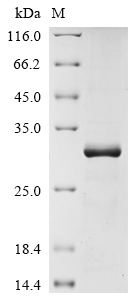
If the delivery form is liquid, the default storage buffer is Tris/PBS-based buffer, 5%-50% glycerol.
If the delivery form is lyophilized powder, the buffer before lyophilization is Tris/PBS-based buffer, 6% Trehalose.
Reconstitution
We recommend that this vial be briefly centrifuged prior to opening to bring the contents to the bottom. Please reconstitute protein in deionized sterile water to a concentration of 0.1-1.0 mg/mL.We recommend to add 5-50% of glycerol (final concentration) and aliquot for long-term storage at -20°C/-80°C. Our default final concentration of glycerol is 50%. Customers could use it as reference.
Storage
The shelf life is related to many factors, storage state, buffer ingredients, storage temperature and the stability of the protein itself.
Generally, the shelf life of liquid form is 6 months at -20°C/-80°C. The shelf life of lyophilized form is 12 months at -20°C/-80°C.
Shelf Life
The shelf life is related to many factors, storage state, buffer ingredients, storage temperature and the stability of the protein itself.
Generally, the shelf life of liquid form is 6 months at -20°C/-80°C. The shelf life of lyophilized form is 12 months at -20°C/-80°C.
Lead Time
Delivery time may differ from different purchasing way or location, please kindly consult your local distributors for specific delivery time.
Notes
Repeated freezing and thawing is not recommended. Store working aliquots at 4°C for up to one week.
Plays a major role in tight junction-specific obliteration of the intercellular space, through calcium-independent cell-adhesion activity.
Gene References into Functions
In this study, we found downregulation of miR-767-3p and upregulation of CLDN18 in lung adenocarcinoma tissue and cell lines.PMID:29169410
CDH17 and CLDN18 are useful target molecules. Their coupling can aid in the comprehensive detection and localization of gastric cancer metastases in vivo to overcome challenges associated with intratumoral heterogeneity.PMID:27580354
Bile duct adenocarcinoma cells overexpress claudin-18 via the EGFR/RAS/ERK pathway, contributing to cell proliferation and invasion.PMID:28624624
The presented data substantiate the hypothesis that claudin-18 is a central barrier-forming component of tight junctions and show that IL-13 downregulates claudin-18. These data also suggest that the loss of claudin-18 is associated with increased sensitization to aeroantigens and airway responsivenessPMID:27215490
suggest that the reduction of CLDN5, 7, and 18 expression loses the suppressive ability of interaction between PDK1 and Akt and causes sustained phosphorylation of Akt, resulting in the disordered proliferation in lung squamous carcinoma cellsPMID:27884700
Data suggest that claudin-18 suppresses the abnormal proliferation and motility of lung epithelial cells mediated by inhibition of phosphorylation of pyruvate dehydrogenase kinase isoform 1 (PDK1) and proto-oncogene protein c-akt (Akt).PMID:26919807
Human fetal lungs at 23-24 weeks gestational age, the highest-risk period for developing bronchopulmonary dysplasia, a disease of impaired alveolarization, had significantly lower CLDN18 expression relative to postnatal lungs.PMID:24787463
Evaluated expression of claudins in gastric cancer and determined their significance for patient outcome. Claudin-3 and claudin-7 were expressed in 25.4% and 29.9% of gastric cancer tissues; 51.5% of gastric cancer tissues had reduced claudin-18.PMID:24333468
High levels of CLDN18 are associated with non-small-cell lung cancer.PMID:24710653
Downregulation of miR-1303 can inhibit proliferation, migration and invasion of gastric cancer cells by targeting CLDN18.PMID:24647998
Claudin-18 positivity is a specific phenotype that is characteristic of intestinal-type Mucinous borderline tumours of the ovaryPMID:23905715
Down-regulation of claudin-18 is associated with the proliferative and invasive potential of gastric cancer.PMID:24073219
rate of CLDN18.2 positivity is high in pancreatic neoplasms whereby the expression is not limited to the primaries but is also maintained upon metastasisPMID:23900716
Claudin 10/18 are most commonly expressed in lung adenocarcinomas. Female patients and non-smokers express these claudins more commonly suggesting that they may play a part in the carcinogenesis of tobacco unrelated carcinoma.PMID:22076167
Claudin 18 (a marker for early carcinogenesis) is commonly expressed in precursor lesions of pancreatic ductal adenocarcinomas. Activation of the protein kinase C pathway might be involved in claudin 18 expression associated with carcinogenesis.PMID:21832145
Cldn18 is primarily regulated at the transcriptional level via specific protein kinase C signaling pathways and modified by DNA methylationPMID:21381080
These results suggest that CLDN18 may play an important role in biliary carcinogenesis.PMID:21607649
High claudin 18 is associated with intraductal papillary mucinous neoplasms of the pancreas.PMID:21206985
We revealed that claudin-18 expression correlates with poor survival in patients with colorectal cancer and is associated with the gastric phenotype.PMID:20846265
Loss of claudin expression may enhance the grade of malignancy of gastric cancer in vivo.PMID:17459057
We conclude that Cldn-18 is the dominant claudin in the TJ of SCE and propose that the change from a Cldn-18-deficient TJ in SqE to a Cldn-18-rich TJ in SCE contributes to the greater acid resistance of BE.PMID:17932229
Indicate that the PKC/MAPK/AP-1 dependent pathway regulates claudin-18a2 expression in gastric cells.PMID:18032479
Claudin 18 and annexin A8 are frequently highly overexpressed in infiltrating ductal adenocarcinomas.PMID:18223320
Claudin 18 staining can aid in diagnosis of gastrointestinal signet ring cell carcinoma.PMID:18580680
Increased expression of claudin-18 is associated with colitis.PMID:18831034
CLDN18.2 as a novel, highly attractive pan-cancer target for the antibody therapy of epithelial tumors.PMID:19047087
Isoform A1: Expression is restricted to the lung. Isoform A2: Expression is restricted to the stomach mucosa where it is predominantly observed in the epithelial cells of the pit region and the base of the gastric glands including exocrine and endocrine c