Recombinant Human C-C motif chemokine 7 (CCL7)

CSB-RP059654h
Size:
10μg
10μg50μg100μg200μg500μg1mg(1mg*1 or 500ug*2)
US$162
Quantity:
Express system: E.coli
Species: Homo sapiens (Human)
Tag Info: N-terminal GST-tagged
For inquiries on large quantities or another requirements
Send an Inquiry
Start an on-line Chat
Orders can only be placed from within the U.S.

Product Details

Purity
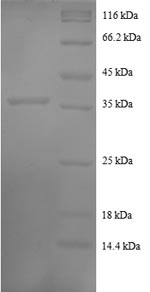
Greater than 90% as determined by SDS-PAGE.
Target Names
CCL7
Uniprot NO.
Research Area
Immunology
Alternative Names
Monocyte chemoattractant protein 3Monocyte chemotactic protein 3 ;MCP-3NC28Small-inducible cytokine A7
Species
Homo sapiens (Human)
Source
E.coli
Expression Region
24-99aa
Target Protein Sequence
QPVGINTSTTCCYRFINKKIPKQRLESYRRTTSSHCPREAVIFKTKLDKEICADPTQKWVQDFMKHLDKKTQTPKL
Mol. Weight
36.0kDa
Protein Length
Full Length of Mature Protein
Tag Info
N-terminal GST-tagged
Storage
The shelf life is related to many factors, storage state, buffer ingredients, storage temperature and the stability of the protein itself. Generally, the shelf life of liquid form is 6 months at -20°C/-80°C. The shelf life of lyophilized form is 12 months at -20°C/-80°C.
Shelf Life
The shelf life is related to many factors, storage state, buffer ingredients, storage temperature and the stability of the protein itself.
Generally, the shelf life of liquid form is 6 months at -20°C/-80°C. The shelf life of lyophilized form is 12 months at -20°C/-80°C.
Notes
Repeated freezing and thawing is not recommended. Store working aliquots at 4°C for up to one week.
Troubleshooting and FAQs
Datasheet & COA
Please contact us to get it.
Images
  • (Tris-Glycine gel) Discontinuous SDS-PAGE (reduced) with 5% enrichment gel and 15% separation gel.
Description

Customer Reviews and Q&A

 Customer Reviews

Target Background

Function
Chemotactic factor that attracts monocytes and eosinophils, but not neutrophils. Augments monocyte anti-tumor activity. Also induces the release of gelatinase B. This protein can bind heparin. Binds to CCR1, CCR2 and CCR3.
Gene References into Functions
  1. Enzyme-linked immunosorbent assay was used to detect the levels of chemokine (C-X-C motif) ligand 12, chemokine (C-X-C motif) ligand 7, hepatocyte growth factor, and fibroblast growth factor 1 in the supernatants of the laryngeal squamous cell carcinoma and control cells. PMID:28475003
  2. Periprostatic adipocytes drive prostate cancer progression in obesity via CCL7 secretion which stimulates CCR3 expressing tumor cells. PMID:26756352
  3. These results suggest that let-7d may suppress renal cell carcinoma growth, metastasis, and tumor macrophage infiltration at least partially through targeting COL3A1 and CCL7. PMID:25193015
  4. Based on nasopharyngeal CCL7 gene expression in readily available Nasopharyngeal aspirate samples , we can discriminate between severity of disease in Respiratory syncytial virus infected infants. PMID:25261323
  5. Overexpression of ISL1 in human mesnchymal stem cells promotes angiogenesis in vitro and in vivo through increasing secretion of MCP3 and other paracrine factors. PMID:24578274
  6. Our data demonstrate that the monocyte-specific chemokine CCL7 and its receptor CCR2 are expressed in tumour cells of RCC PMID:24327013
  7. Systemic IFN-gamma triggered the secretion of C-C motif ligand chemokines CCL2 and CCL7 leading to the egress of early, myeloid-committed progenitors from the bone marrow mediated by their common receptor CCR2. PMID:23762028
  8. Anticancer effect of desmethyl-lasiodiplodin is mediated, in part, by upregulation of apoptotic genes and downregulation of MCP-3. PMID:23764760
  9. Immunohistochemistry and real-time PCR analysis showed that CCL7 was expressed in normal colonic epithelium and the expression was higher in liver metastases compared to primary CRC. PMID:22614322
  10. These results suggest that overexpression of CCL21 and CCL7 is associated with tumor metastasis and serves as a prognostic factor in patients with gastric cancer. PMID:22468089
  11. MCP-3 is produced by human coronary artery smooth muscle cells and directly induces CASMC proliferation in vitro, suggesting a potential role for this chemokine in vascular pathology PMID:21536288
  12. we established, for the first time, a significant association of MCP3 variants with atopic asthma. PMID:21388664
  13. Basal monocyte migration may be facilitated by the astrocyte-derived cytokine CCL7 whose production is rapidly increased by TNF-alpha and thus likely plays a critical role in initiating neuroinvasion by SIV/HIV. PMID:21279498
  14. The expression of MCP-3 in laryngeal squamous cell carcinoma is much higher than in normal tissue. PMID:18533557
  15. IL-12 p35, ICAM-1 and MCP-3 mRNAs are expressed in primary nasal epithelial cells. PMID:19253530
  16. Cytoplasmic GR interacts with a subset of CCL7 mRNA through specific sequences and can regulate turnover rates, a novel posttranscriptional role for GR as an RNA-binding protein. PMID:21148795
  17. Monocyte chemoattractant protein-3 (MCP-3) was highly expressed in patients with chronic periodontitis, particularly in those with progressive periodontal lesions. PMID:20151806
  18. higher expression in the genital mucosa than in the blood of HIV-1-infected women from Benin PMID:19898927
  19. Elevated level of CCL7 is associated with invasion and migration of oral squamous cell carcinoma. PMID:19937793
  20. The two most abundant alleles of the CA/GA microsatellite polymorphism in the promoter-enhancer region of the MCP-3 gene, A2 and A3, are significantly associated with multiple sclerosis in the Belgian case-control study, but not in the family study. PMID:12127674
  21. overexpression of MCP-3 in early-stage systemic sclerosis suggests a novel role for this protein as a fibrotic mediator activating extracellular matrix gene expression in addition to promoting leukocyte trafficking. PMID:12847692
  22. monocyte chemotactic protein-3 uses a different mode of action from eotaxin PMID:14733956
  23. data suggest that cyclic mechanical stretch of the uterine cervix by the presenting part of the fetus during labour may augment both IL-8 and MCP-3 production in the uterine cervix via AP-1 activation. PMID:15194816
  24. These results suggest that oxLDL delivers its signal for MCP-3 expression via PPARgamma, which may be further related to the atherogenesis. PMID:15381085
  25. A non-heparin-binding mutant CCL7 inhibits chemotactic potential of synovial fluid from patients with active rheumatoid arthritis and demonstrates the glycosaminoglycan-binding requirement for chemokine-driven inflammation in vivo PMID:16002730
  26. CCR8 ligands are allotropic, binding to distinct sites within CCR8; the human immune system may have evolved to use CCL7 as a selective antagonist of viral chemokine activity at CCR8 but not those of the host ligand PMID:17023422
  27. MCP-3 is critical for monocyte mobilization and suggests new roles for monocyte chemoattractants in leukocyte homeostasis. PMID:17364026
  28. CCL7 synergizes with coproduced CXCL8 in peripheral blood monocyte migration. PMID:18469140
  29. increased plasma levels in patients with amnestic mild cognitive impairment PMID:19403065
  30. High MCP-3 is associated with macrophage/microglia infiltration in gliomas. PMID:19424580

Show More

Hide All

Subcellular Location
Secreted.
Protein Families
Intercrine beta (chemokine CC) family
Database Links

HGNC: 10634

UNIGENE: Hs.251526

KEGG: hsa:6354

STRING: 9606.ENSP00000367832

OMIM: 158106

icon of phone
Call us
301-363-4651 (Available 9 a.m. to 5 p.m. CST from Monday to Friday)

icon of address
Address
7505 Fannin St., Ste 610, Room 7 (CUBIO Innovation Center), Houston, TX 77054, USA
icon of social media
Join us with

Subscribe newsletter

Leave a message

* To protect against spam, please pass the CAPTCHA test below.
CAPTCHA verification
© 2007-2025 CUSABIO TECHNOLOGY LLC All rights reserved. 鄂ICP备15011166号-1
Select 0 Products