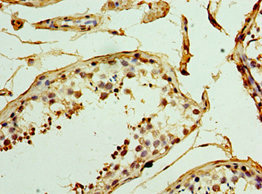
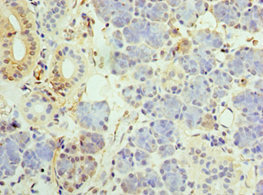
mitochondrial brown fat uncoupling protein antibody; Mitochondrial brown fat uncoupling protein 1 antibody; SLC25A7 antibody; Solute carrier family 25 member 7 antibody; Thermogenin antibody; UCP 1 antibody; UCP antibody; UCP1 antibody; UCP1_HUMAN antibody; uncoupling protein 1 (mitochondrial, proton carrier) antibody; Uncoupling protein 1 antibody
Raised in
Rabbit
Species Reactivity
Human
Immunogen
Recombinant Human Mitochondrial brown fat uncoupling protein 1 protein (1-307AA)
Immunogen Species
Homo sapiens (Human)
Conjugate
Non-conjugated
Clonality
Polyclonal
Isotype
IgG
Purification Method
Antigen Affinity Purified
Concentration
It differs from different batches. Please contact us to confirm it.
Buffer
PBS with 0.02% sodium azide, 50% glycerol, pH7.3.
Form
Liquid
Note: We will preferentially ship the format that we have in stock, however, if you have any special requirement for the format, please remark your requirement when placing the order, we will prepare according to your demand.
Upon receipt, store at -20°C or -80°C. Avoid repeated freeze.
Lead Time
Basically, we can dispatch the products out in 1-3 working days after receiving your orders. Delivery time maybe differs from different purchasing way or location, please kindly consult your local distributors for specific delivery time.
Note: All of our proteins are default shipped with normal blue ice packs, if you request to ship with dry ice, please communicate with us in advance and extra fees will be charged.
Usage
For Research Use Only. Not for use in diagnostic or therapeutic procedures.
Mitochondrial protein responsible for thermogenic respiration, a specialized capacity of brown adipose tissue and beige fat that participates in non-shivering adaptive thermogenesis to temperature and diet variations and more generally to the regulation of energy balance. Functions as a long-chain fatty acid/LCFA and proton symporter, simultaneously transporting one LCFA and one proton through the inner mitochondrial membrane. However, LCFAs remaining associated with the transporter via their hydrophobic tails, it results in an apparent transport of protons activated by LCFAs. Thereby, dissipates the mitochondrial proton gradient and converts the energy of substrate oxydation into heat instead of ATP. Regulates the production of reactive oxygen species/ROS by mitochondria.
Gene References into Functions
Results suggest that G-quadruplex structure is a potential target to regulate the expression of uncoupling protein 1 (UCP1).PMID:29796650
Cellular and genetic evidence supported the regulation of UCP1 transcription by IRX3 as a direct mechanism on the browning program of white adipocytes.PMID:28988979
Multiple regression analysis showed that age, male gender, body max index, presence of obesity, type-2-diabetes mellitus, hypertension and coronary artery disease and left ventricular ejection fraction were associated with the expression levels of UCP1, PGC1alpha and PRDM16 mRNAPMID:28824327
Results found a specific fatty acids binding site that is functionally important to the H+ transport activity of UCP1-mediated flux.PMID:28781081
MKK6 acts as a repressor of UCP1 expression, suggesting that its inhibition promotes adipose tissue browning and increases organismal energy expenditure.PMID:29021624
determined transcriptional levels of UCP1 and UCP2 in peripheral blood mononuclear cells (PBMCs) from patients with metabolic disorders: type 2 diabetes, obesity and from healthy individuals.PMID:29151065
We observed that clozapine but not six other antipsychotic drugs reprogrammed the gene expression pattern of differentiating human adipocytes ex vivo, leading to an elevated expression of the browning marker gene UCP1, more and smaller lipid droplets and more mitochondrial DNA than in the untreated white adipocytes.PMID:27898069
The GG genotype of the UCP1-3826 A/G polymorphism appears to contribute to the onset of childhood obesity in Turkish children. The GG genotype of UCP1, together with the del/del genotype of the UCP2 polymorphism, may increase the risk of obesity with synergistic effects. The ins allele of the UCP2 exon 8 del/ins polymorphism may contribute to low HDL cholesterolemia.PMID:28704105
TENM2 knockdown induces both UCP1 mRNA and protein expression upon adipogenic differentiation without affecting mitochondrial mass.PMID:28088466
The role of UCP1 gene polymorphisms A-3826G, A-1766G, Met229Leu and Ala64Thr in susceptibility to obesity or metabolic syndrome was reviewed.PMID:28100847
Haplotype-based interaction between the PPARGC1A and UCP1 genes is associated with impaired fasting glucose (IFG) or type 2 diabetes mellitus (T2DM) among the residents of Henan province, China. Individuals with the haplotype AAG (PPARGC1A gene) and CTCG (UCP1 gene) have increased susceptibility to IFG or T2DM, while those with haplotype AAG (PPARGC1A gene) and CTCA (UCP1 gene) have a lower risk of IFG or T2DM.PMID:28591028
human and rodent Brown adipose tissue have similar UCP1 function per mitochondrion.PMID:27508873
glucocorticoids increased isoprenaline-stimulated respiration and UCP-1 in human primary brown adipocytes.PMID:27411014
These results reveal different characteristics in the biological actions between WAT and BAT in obese humans. Increased levels of IL6, UCP1 and SIRT1 in the BAT were associated with metabolic parameters improvements.PMID:28073126
UCP1 dietary activation can alleviate obesity. (Review)PMID:28057582
The molecular features of UCP1 support a conventional mitochondrial carrier-like mechanism. (Review)PMID:28057583
The history of discovery of UCP1, the mitochondrial uncoupling protein of brown adipocyte, has been described. (Review)PMID:27916641
Transcriptional regulation of the UCP1 protein in obesity and normal thermogenesis has been described. (Review)PMID:27693079
The H+ transport mediated by UCP1 was shown to be electrophoretic with a linear relation to the membrane potential. (Review)PMID:27794497
In the absence of purine nucleotides, UCP1 presents a high ohmic proton conductance that does not require the presence of activating ligands, such as fatty acids or retinoids.PMID:27750036
UCP1 is a transporter for H(+) and fatty acid anions. (Review)PMID:27984203
In inguinal white adipose tissue (iWAT) of mice fed a high-fat diet (HFD), Ucp1 level decreases concomitantly with increases in Cnot7 and its interacting partner Tob.PMID:26711342
Findings suggest that polymorphisms in SIRT6/UCP1 genes may be important for increased carotid plaque burden and echodensityPMID:26332421
UCP1 -3826 A>G polymorphism is associated with weight, body fat mass, and risk of type 2 diabetes mellitus in obese individuals candidates for bariatric surgery.PMID:26458326
UCP1 and UCP3 expression is associated with lipid and carbohydrate oxidation in patients submitted to bariatric surgery.PMID:26959981
1-3826 A>G polymorphism associated with elevated lipid and apolipoprotein levels in Chinese populationPMID:25928572
this study reveals that human adipose-derived stromal/progenitor cells can be readily differentiated into beige adipocytes that, upon activation, undergo uncoupling protein 1-dependent thermogenesis.PMID:25389910
This study suggests that the SNP rs1800592 in the UCP1 gene is associated with increased risk of PDR in the Chinese type 2 diabetes mellitus population.PMID:25274455
Genotype and allele distributions of UCP1, UCP2 and UCP3 polymorphisms did not differ significantly between obese and non-obese Type 2 Diabetes Mellitus patients.[Meta-analysis]PMID:24752406
Uncoupling protein 1 binds one nucleotide per monomer and is stabilized by tightly bound cardiolipin.PMID:26038550
Meta-analysis. There was no significant association of the UCP1-3826A/G polymorphism with BMI mean differences.PMID:24804925
By the application of these findings, we demonstrate that UCP1 is functionally thermogenic in intact brite adipocytes and adrenergic UCP1 activation is largely dependent on adipose triglyceride lipase (ATGL) rather than hormone sensitive lipase (HSL).PMID:25135951
BMI and TBF were significantly different among UCPI -3826A/G and UCP3 -55C/T genotype combinations, suggesting the existence of a gene interaction between UCP1 and UCP3 in influencing obesity and adiposity in multiethnic Malaysians.PMID:25812254
MED1 is required for optimal PRDM16-induced Ucp1 expressionPMID:25644605
In obesity, in vitro differentiated beige/brite adipocytes derived from preadipocytes of human subcutaneous white adipose tissues express less UCP1.PMID:24642703
Human white adipocytes express the cold receptor TRPM8 which activation induces UCP1 expression, mitochondrial activation and heat production.PMID:24342393
UCP1 -3826A/G and ADRB3 Trp64Arg polymorphisms may have a combined effect in the modulation of overweight/obesity and HDL-C levels in type 2 diabetes mellitus (T2DM) Caucasian-Brazilian patientsPMID:24138564
The season-specific effects of UCP1 on visceral fat area were consistent with a previous finding that active brown adipose tissue was more frequently found in winter than in summer.PMID:24086366
All-trans-retinoic acid (ATRA) induces UCP1 expression in mouse adipocytes through activation of RARs, whereas expression of UCP1 in human adipocytes is not increased by exposure to ATRA.PMID:24059847
VDR directly inhibits the expression of uncoupling protein-1 (UCP1).PMID:23906633
UCP1 -3826 A/G substitution accelerates age-related decrease in BAT activity, and thereby may associate with visceral fat accumulation with age.PMID:23032405
UCP1 can exist in different functional monomeric and associated states.PMID:24196960
UCP-1 is relatively abundant in epicardial fat, and this depot possesses molecular features characteristic of those found in vitro in beige lineage adipocytes.PMID:23824424
Compares and contrasts all the known human SLC25A* genes and includes functional information.PMID:23266187
High UCP1 expression is associated with pheochromocytoma.PMID:23454374
UCP-1 single nucleotide polymorphism A-3826G is associated with the dampness-phlegm pattern in Korean stroke patients.PMID:23043591
The present study demonstrates a sex-specific effect of genetic variants in UCP1 and SIRT3 on cIMTPMID:22750084
UCP1 in HEK293 cell mitochondria is fully inhibitable and does not contribute to basal proton conductance.PMID:22676960
These data are consistent with FTO rs9939609 and UCP-1 rs6536991 common variants as contributors to obesity in the Brazilian population.PMID:23134754
This study links the GG homozygous form of UCP1 with obesity and blood pressure among females only.PMID:22764640