QPCT Antibody

Code: CSB-PA019135LA01HU
Size:
20μg
20μg50μg100μg
US$83
Quantity:
Species Reactivity: Human, Rat
Raised in: Rabbit
Application: ELISA, WB
For inquiries on large quantities or another requirements
Send an Inquiry
Start an on-line Chat
Online ordering is currently available for U.S. customers only. For orders outside the U.S., please kindly submit an inquiry or start a chat with us.

Product Details

Uniprot NO.
Target Names
QPCT
Alternative Names
5730422A13Rik antibody; EC antibody; GCT antibody; Glutaminyl cyclase antibody; Glutaminyl peptide cyclotransferase antibody; Glutaminyl tRNA cyclotransferase antibody; Glutaminyl-peptide cyclotransferase antibody; Glutaminyl-tRNA cyclotransferase antibody; Glutamyl cyclase antibody; QC antibody; qpct antibody; QPCT_HUMAN antibody; sQC antibody
Raised in
Rabbit
Species Reactivity
Human, Rat
Immunogen
Recombinant Human Glutaminyl-peptide cyclotransferase protein (29-361AA)
Immunogen Species
Homo sapiens (Human)
Conjugate
Non-conjugated
Isotype
IgG
Purification Method
>95%, Protein G purified
Concentration
It differs from different batches. Please contact us to confirm it.
Buffer
Preservative: 0.03% Proclin 300
Constituents: 50% Glycerol, 0.01M PBS, PH 7.4
Tested Applications
ELISA, WB
Recommended Dilution
ApplicationRecommended Dilution
WB1:1000-1:5000
Storage
Upon receipt, store at -20°C or -80°C. Avoid repeated freeze.
Lead Time
Basically, we can dispatch the products out in 1-3 working days after receiving your orders. Delivery time maybe differs from different purchasing way or location, please kindly consult your local distributors for specific delivery time.
Note: All of our proteins are default shipped with normal blue ice packs, if you request to ship with dry ice, please communicate with us in advance and extra fees will be charged.
Usage
For Research Use Only. Not for use in diagnostic or therapeutic procedures.
Datasheet & COA
Images
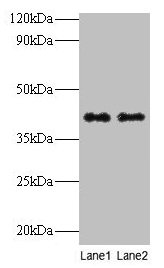
  • Western Blot
    Positive WB detected in: HepG2 whole cell lysate(30µg), COLO205 whole cell lysate(30µg), MCF7 whole cell lysate(30µg), A431 whole cell lysate(20µg), Hela whole cell lysate(30µg)
    All lanes: QPCT antibody at 1:1000
    Secondary
    Goat polyclonal to rabbit IgG at 1/40000 dilution
    Predicted band size: 41,36 kDa
    Observed band size: 41 kDa
    Exposure time: 120s
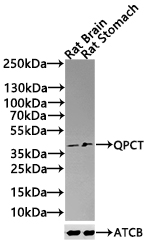
  • Western Blot
    Positive WB detected in: Rat Brain tissue lysate(30µg),Rat Stomach tissue lysate(30µg)
    All lanes: QPCT antibody at 1:1000
    Secondary
    Goat polyclonal to rabbit IgG at 1/40000 dilution
    Predicted band size: 41,36 kDa
    Observed band size: 41 kDa
    Exposure time: 120s

Customer Reviews and Q&A

 Customer Reviews

Target Background

Function(From Uniprot)
Responsible for the biosynthesis of pyroglutamyl peptides. Has a bias against acidic and tryptophan residues adjacent to the N-terminal glutaminyl residue and a lack of importance of chain length after the second residue. Also catalyzes N-terminal pyroglutamate formation. In vitro, catalyzes pyroglutamate formation of N-terminally truncated form of APP amyloid-beta peptides [Glu-3]-amyloid-beta. May be involved in the N-terminal pyroglutamate formation of several amyloid-related plaque-forming peptides.
Gene References into Functions
  1. The addition of QC activity to core diagnostic CSF biomarkers may be of specific interest in clinical cases with discordant imaging and biochemical biomarker results. PMID:28587659
  2. these findings demonstrate a significant association between common single nucleotide polymorphism within QPCT gene and schizophrenia risk in a Han Chinese population. PMID:26572640
  3. the genetic risk of QPCT gene for schizophrenia also exists in the Han Chinese population. PMID:26492838
  4. observations provide evidence for an involvement of QC in Alzheimer's disease pathogenesis and cognitive decline by QC-catalyzed pGlu-Abeta formation PMID:24164736
  5. this study demonistrated that QPCT mRNAand protein from mononuclear cells correlated with theseverity of dementia. PMID:23207485
  6. Upregulation of QPCT expression is associated with thyroid carcinomas. PMID:23183267
  7. This study presents a first comparison of two mammalian QCs (human and mouse) containing typical, conserved post-translational modifications. PMID:21671571
  8. The resilts of this studt provided histopathological evidence for QC being a prerequisite for pE-Abeta pathology in vivo and further underline the therapeutic potential of QC inhibition in Alzheimer Disease. PMID:21301857
  9. Upon binding to PBD150, a large loop movement in gQC allows the inhibitor to be tightly held in its active site primarily by hydrophobic interactions. PMID:21288892
  10. This study demonstrated that glutaminyl cyclase expression and pE-Abeta formation in subcortical brain regions( Edinger-Westphal nucleus, locus coeruleus and nucleus basalis Meynert) affected in Alzheimer's disease. PMID:20383514
  11. Human isoQC proteins displayed a broad substrate specificity and preference for hydrophobic substrates, similar to the related QC. PMID:19804409
  12. Functional expression of human glutaminyl cyclase in Pichia pastoris reveals the presence of a disulfide bond with an important role in the stabilization of active protein structure. PMID:12196024
  13. human glutaminyl cyclase is a metal-dependent transferase PMID:14522962
  14. Glutaminyl cyclase was expressed as a fully active 37 kDa enzyme with kcat/Km values of 14.3, 9.3, and 2.4 mM(-1)s(-1) for the substrates Gln-Gln, Gln-NH(2), and Gln-t-butyl ester, respectively PMID:14680951
  15. Genetic variations in QPCT are important factors affecting the bone mineral density of adult women that contribute to susceptibility for osteoporosis. PMID:15231017
  16. structure of human QC in free form and bound to a substrate and three imidazole-derived inhibitors PMID:16135565
  17. Our results suggest that QPCT may be the QTL gene at chromosome 2p for spine BMD variation in the Chinese population PMID:17687619
  18. combined steady-state enzyme kinetic and X-ray structural analyses of 11 single-mutation human QCs to investigate the roles of the H-bond network in catalysis PMID:18072935
  19. The computations outline the important role of Trp329 in helping the substrate binding process and stabilizing the cyclization transition state. PMID:18470930
  20. Golgi apparatus retention implies a "housekeeping" protein maturation machinery conducting glycosylation and pyroglutamyl formation. For these isoenzymes, apparently similar strategies evolved to retain the proteins in the Golgi complex. PMID:18486145

Show More

Hide All

Subcellular Location
Secreted.
Protein Families
Glutaminyl-peptide cyclotransferase family
Database Links

HGNC: 9753

UNIGENE: Hs.79033

KEGG: hsa:25797

STRING: 9606.ENSP00000344829

OMIM: 607065

icon of phone
Call us
301-363-4651 (Available 9 a.m. to 5 p.m. CST from Monday to Friday)

icon of address
Address
No. 269, Shendun 5th Road, Donghu Hi-Tech Development Area, Hubei Province, 430206, P.R.China
icon of social media
Join us with

Subscribe newsletter

Leave a message

* To protect against spam, please pass the CAPTCHA test below.
CAPTCHA verification
© 2007-2025 CUSABIO TECHNOLOGY LLC All rights reserved. 鄂ICP备15011166号-1
Select 0 Products