PNPLA1 Antibody

Code: CSB-PA843295LA01HU
Size:
20μg
20μg50μg100μg
US$83
Quantity:
Species Reactivity: Human, Mouse
Raised in: Rabbit
Application: ELISA, WB, IHC, IF
For inquiries on large quantities or another requirements
Send an Inquiry
Start an on-line Chat
Online ordering is currently available for U.S. customers only. For orders outside the U.S., please kindly submit an inquiry or start a chat with us.

Product Details

Uniprot NO.
Target Names
PNPLA1
Alternative Names
PNPLA1 antibody; Patatin-like phospholipase domain-containing protein 1 antibody; EC 3.1.1.- antibody
Raised in
Rabbit
Species Reactivity
Human, Mouse
Immunogen
Recombinant Human Patatin-like phospholipase domain-containing protein 1 protein (101-300AA)
Immunogen Species
Homo sapiens (Human)
Conjugate
Non-conjugated
Isotype
IgG
Purification Method
>95%, Protein G purified
Concentration
It differs from different batches. Please contact us to confirm it.
Buffer
Preservative: 0.03% Proclin 300
Constituents: 50% Glycerol, 0.01M PBS, PH 7.4
Tested Applications
ELISA, WB, IHC, IF
Recommended Dilution
ApplicationRecommended Dilution
WB1:1000-1:5000
IHC1:20-1:200
IF1:50-1:200
Storage
Upon receipt, store at -20°C or -80°C. Avoid repeated freeze.
Lead Time
Basically, we can dispatch the products out in 1-3 working days after receiving your orders. Delivery time maybe differs from different purchasing way or location, please kindly consult your local distributors for specific delivery time.
Note: All of our proteins are default shipped with normal blue ice packs, if you request to ship with dry ice, please communicate with us in advance and extra fees will be charged.
Usage
For Research Use Only. Not for use in diagnostic or therapeutic procedures.
Datasheet & COA
Images
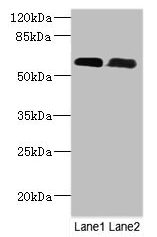
  • Western Blot
    All lanes: PNPLA1 antibody at 12μg/ml
    Lane 1: Mouse spleen tissue
    Lane 2: Mouse skeletal muscle tissue
    Secondary
    Goat polyclonal to rabbit IgG at 1/10000 dilution
    Predicted band size: 58, 48, 49 kDa
    Observed band size: 58 kDa

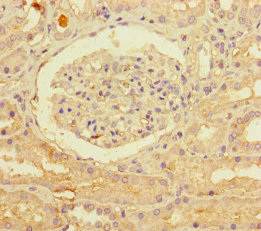
  • Immunohistochemistry of paraffin-embedded human kidney tissue using CSB-PA843295LA01HU at dilution of 1:100

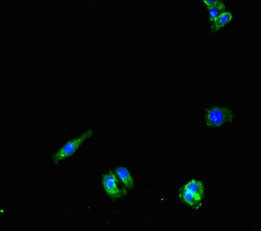
  • Immunofluorescent analysis of HepG2 cells using CSB-PA843295LA01HU at dilution of 1:100 and Alexa Fluor 488-congugated AffiniPure Goat Anti-Rabbit IgG(H+L)

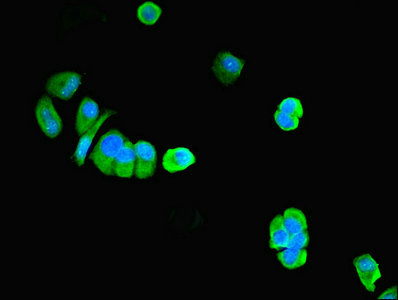
  • Immunofluorescent analysis of MCF-7 cells using CSB-PA843295LA01HU at dilution of 1:100 and Alexa Fluor 488-congugated AffiniPure Goat Anti-Rabbit IgG(H+L)

Customer Reviews and Q&A

 Customer Reviews

Target Background

Function(From Uniprot)
Omega-hydroxyceramide transacylase involved in the synthesis of omega-O-acylceramides (esterified omega-hydroxyacyl-sphingosine; EOS), which are extremely hydrophobic lipids involved in skin barrier formation. Catalyzes the last step of the synthesis of omega-O-acylceramides by transferring linoleic acid from triglycerides to an omega-hydroxyceramide. Omega-O-acylceramides, are required for the biogenesis of lipid lamellae in the stratum corneum and the formation of the cornified lipid envelope which are essential for the epidermis barrier function. These lipids also play a role in keratinocyte differentiation. May also act on omega-hydroxylated ultra-long chain fatty acids (omega-OH ULCFA) and acylglucosylceramides (GlcEOS).
Gene References into Functions
  1. We report two novel PNPLA1 mutations including one novel missense mutation c.335C > A (p.Ser112Tyr) and one novel deletion mutation c.733_735delTAC (p.Tyr245del) in Turkish autosomal recessive congenital ichthyosis patients from unrelated consanguineous families. PMID:29624231
  2. PNPLA1 catalyses the omega-O-esterification with linoleic acid to form acylceramides. PMID:28248300
  3. PNPLA1 is directly involved in acylceramide synthesis as a transacylase. PMID:28248318
  4. The PNPLA1 mutations reportedhere show PNPLA1 to be an important, if relatively rare, cause of ARCI. PMID:28403545
  5. The results show potential phenotypic variation in a small percentage of patients with PNPLA1 mutations. The variability of the clinical manifestations and the lack of typical clinical features are specific for patients with PNPLA1 mutations. PMID:28093717
  6. Data support that PNPLA1/Pnpla1 is a key player in the formation of omega-O-acylceramide, a crucial process for the epidermal permeability barrier function. PMID:28369476
  7. analysis of distinct and previously unreported mutations in the PNPLA1 gene in nine extended consanguineous families with autosomal recessive congenital ichthyosis PMID:27884779
  8. an essential role of PNPLA1 in the synthesis of omega-O-AcylCers in human and murine skin. PMID:27751867
  9. the variant identified will expand the spectrum of mutations in the PNPLA1 gene, provides more evidence for lack of genotype-phenotype correlation and clinical variability in PNPLA1 and underscores its role in causing autosomal recessive congenital ichthyosis PMID:26691440
  10. Letter: novel missense PNPLA1 variant causing autosomal recessive congenital ichthyosis in a Pakistani family. PMID:26778108
  11. Results show that PNPLA1 missense mutations observed in this European family affect the patanin-like domain PMID:24344921
  12. These results identified hPNPLA1 and a mutant in HeLa cells. PMID:24057234
  13. One missense and one nonsense mutation in the catalytic domain of human PNPLA1 were found in six individuals with autosomal recessive congenital ichthyoses from two families. PMID:22246504
  14. PNPLA1 exhibited a modest effect on obesity PMID:19390624
  15. Observational study of gene-disease association. (HuGE Navigator) PMID:19390624
  16. Observational study of gene-disease association and gene-environment interaction. (HuGE Navigator) PMID:18414634

Show More

Hide All

Subcellular Location
Cytoplasm.
Tissue Specificity
Expressed in the digestive system. Expressed in the epidermis of skin keratinocytes. Strongly expressed in the granular layer. Expressed in the upper epidermis and eccrine sweat glands of the dermis and in the region of keratin filament bundles, which is
Database Links

HGNC: 21246

UNIGENE: Hs.407002

KEGG: hsa:285848

STRING: 9606.ENSP00000378072

OMIM: 612121

icon of phone
Call us
301-363-4651 (Available 9 a.m. to 5 p.m. CST from Monday to Friday)

icon of address
Address
No. 269, Shendun 5th Road, Donghu Hi-Tech Development Area, Hubei Province, 430206, P.R.China
icon of social media
Join us with

Subscribe newsletter

Leave a message

* To protect against spam, please pass the CAPTCHA test below.
CAPTCHA verification
© 2007-2025 CUSABIO TECHNOLOGY LLC All rights reserved. 鄂ICP备15011166号-1
Select 0 Products