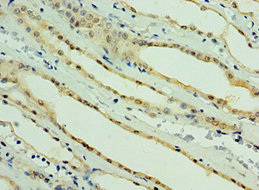
Recombinant Human Presenilins-associated rhomboid-like protein, mitochondrial protein (1-170AA)
Immunogen Species
Homo sapiens (Human)
Conjugate
Non-conjugated
Clonality
Polyclonal
Isotype
IgG
Purification Method
Antigen Affinity Purified
Concentration
It differs from different batches. Please contact us to confirm it.
Buffer
PBS with 0.02% sodium azide, 50% glycerol, pH7.3.
Form
Liquid
Note: We will preferentially ship the format that we have in stock, however, if you have any special requirement for the format, please remark your requirement when placing the order, we will prepare according to your demand.
Upon receipt, store at -20°C or -80°C. Avoid repeated freeze.
Lead Time
Basically, we can dispatch the products out in 1-3 working days after receiving your orders. Delivery time maybe differs from different purchasing way or location, please kindly consult your local distributors for specific delivery time.
Note: All of our proteins are default shipped with normal blue ice packs, if you request to ship with dry ice, please communicate with us in advance and extra fees will be charged.
Usage
For Research Use Only. Not for use in diagnostic or therapeutic procedures.
Required for the control of apoptosis during postnatal growth. Essential for proteolytic processing of an antiapoptotic form of OPA1 which prevents the release of mitochondrial cytochrome c in response to intrinsic apoptotic signals. Required for the maturation of PINK1 into its 52kDa mature form after its cleavage by mitochondrial-processing peptidase (MPP). Promotes changes in mitochondria morphology regulated by phosphorylation of P-beta domain.
Gene References into Functions
PARL preserves mitochondrial membrane homeostasis via STARD7 processing and is emerging as a critical regulator of protein localization between mitochondria and the cytosolPMID:29301859
Study confirmed that common variants in PARL and PINK1 were associated with leprosy. Furthermore, PARL and PINK1 could physically interact with each other and were involved in the highly connected network formed by reported leprosy susceptibility genes.PMID:27876828
PDK2/PARL senses defects in mitochondrial bioenergetics.PMID:28178523
Adipogenic process can be dissected into 3 stages according to the participation of PARL-PINK1-Parkin system. Findings reveal the sequential adipogenic events directed by PARL-PINK1-Parkin system, add more evidence supporting the convergence of pathogenesis leading to neurodegenerative and metabolic diseasePMID:28641777
These findings enrich the allelic spectrum of ABCC5 in PACG. We identified no tagging SNP responsible for the association of the whole region.PMID:28813580
These results reveal a pro-apoptotic function of PARL and identify PARL-mediated Smac processing and cytochrome c release facilitated by OPA1-dependent cristae remodelling as two independent pro-apoptotic pathways in mitochondria.PMID:28288130
Its mutations are a rare cause of PD and genetic variants are neither strong nor common risk factors in Parkinson disease.PMID:26778534
pathogenic PINK1 mutants which are not cleaved by PARL affect PINK1 kinase activity and the ability to induce PARK2-mediated mitophagy.PMID:26101826
Common genetic variants of the PINK1 and PARL genes are unlikely to be involved in schizophrenia.PMID:25354644
the frequency of the haplotype AAC, and AAT were significantly higher in the unaffected cases and the frequencies of haplotype GGT were significantly higher in LHON casesPMID:23973714
Rhomboid protease PARL mediates the mitochondrial membrane potential loss-induced cleavage of PGAM5.PMID:22915595
p.S77N variant, and, possibly, mutations in the PARL protein overall, are not a frequent cause of autosomal recessive early-onset Parkinson's diseasePMID:21953724
work provides unexpected insights into the structural determinants regulating Parl stability and activity in vivo, and reveals a complex cascade of proteolytic events controlling the function of the protease in the mitochondrionPMID:21415861
PARL deficiency impairs PARKIN recruitment to mitochondria.PMID:21355049
the PARL-catalyzed removal of the Pink1 signal sequence in the canonical import pathway acts as a cellular checkpoint for mitochondrial integrityPMID:21426348
Mitochondrial protease PARL cleaves PINK1 at position A103.PMID:21138942
Data show that no association between PARL gene SNPs and LHON in Chinese patients with m.11778G>A.PMID:20711738
variants of PARL are suggested to influence cell death by apoptosis which has long been believed to intrigue the neurodegeneration of LHON.PMID:20407791
Results suggest that genetic variation within PARL influences mitochondrial abundance and integrity.PMID:19862556
results indicate a different function and mechanism of Hax1 in apoptosis and re-opens the question of whether mammalian PARL, in addition to apoptosis, regulates mitochondrial stress response through Omi/HtrA2 processing.PMID:19680265
PARL might mediate a developmentally regulated mitochondria-to-nuclei signaling through regulated proteolysis of its N terminus and release of the Pbeta peptidePMID:14732705
Variation in PSARL sequence and/or expression may be an important new risk factor for type 2 diabetes and other components of the metabolic syndrome.PMID:15729572
The Leu262Val variant is unlikely to be an important contributor to insulin resistance.PMID:17019603
the PARL rs3732581 genetic variant may have a role in insulin levels, metabolic syndrome and coronary artery diseasePMID:18758826
Genetic variation of PARL may indicate earlier onset of type 2 diabetes and increased susceptibility to nephropathy and cardiovascular complications.PMID:19185381