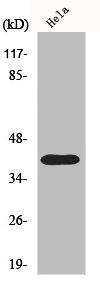
Synthesized peptide derived from the Internal region of Human P2RY8.
Immunogen Species
Homo sapiens (Human)
Conjugate
Non-conjugated
Isotype
IgG
Purification Method
The antibody was affinity-purified from rabbit antiserum by affinity-chromatography using epitope-specific immunogen.
Concentration
It differs from different batches. Please contact us to confirm it.
Buffer
Liquid in PBS containing 50% glycerol, 0.5% BSA and 0.02% sodium azide.
Tested Applications
WB, IF, ELISA
Storage
Upon receipt, store at -20°C or -80°C. Avoid repeated freeze.
Lead Time
Basically, we can dispatch the products out in 1-3 working days after receiving your orders. Delivery time maybe differs from different purchasing way or location, please kindly consult your local distributors for specific delivery time.
Usage
For Research Use Only. Not for use in diagnostic or therapeutic procedures.
Probable receptor for purines coupled to G-proteins.
Gene References into Functions
P2RY8-CRLF2 fusion is associated with childhood B-cell acute lymphoblastic leukemia.PMID:27637012
P2RY8 promotes clustering of activated B cells within follicles in a follicular dendritic cell (FDC)-dependent manner.PMID:26573295
P2RY8-CRLF2-positive clones do not have the necessary proliferative or selective advantage to evolve into a disease-relevant relapse clone.PMID:23091296
Poor prognosis for P2RY8-CRLF2 fusion but not for CRLF2 over-expression in children with intermediate risk B-cell precursor acute lymphoblastic leukemia.PMID:22484421
Study reports an extremely high incidence of relapse (71% +/- 19%) in non-high-risk precursor B-cell acute lymphoblastic leukemia patients with P2RY8-CRLF2 rearrangement.PMID:20378752
P2RY8 is expressed in leukemic cells and has an unexpected role in the pathogenesis of acute leukemiaPMID:17487742
SOX5 is upregulated by promoter swapping with the P2RY8 gene in primary splenic follicular lymphomaPMID:17554380
Show
More
Hide
All
Subcellular Location
Cell membrane; Multi-pass membrane protein.
Protein Families
G-protein coupled receptor 1 family
Tissue Specificity
Barely detectable in normal blood leukocytes. Weaker expression was seen in heart, kidney and lung. Not detected in brain.