NLRC4 Antibody

Code: CSB-PA873615ESR1HU
Size:
20μl
20μl50μl100μl
US$83
Quantity:
Species Reactivity: Human
Raised in: Rabbit
Application: ELISA, IHC
For inquiries on large quantities or another requirements
Send an Inquiry
Start an on-line Chat
Online ordering is currently available for U.S. customers only. For orders outside the U.S., please kindly submit an inquiry or start a chat with us.

Product Details

Uniprot NO.
Target Names
NLRC4
Alternative Names
and NACHT-containing protein antibody; CARD 12 antibody; CARD antibody; CARD LRR and NACHT containing protein 1 antibody; CARD LRR and NACHT containing protein antibody; CARD12 antibody; Caspase recruitment domain containing protein 12 antibody; Caspase recruitment domain family member 12 antibody; Caspase recruitment domain-containing protein 12 antibody; CLAN 1 antibody; CLAN A antibody; CLAN antibody; CLAN B antibody; CLAN C antibody; CLAN D antibody; Clan protein antibody; CLAN1 antibody; CLANA antibody; CLANB antibody; CLANC antibody; CLAND antibody; CLR 2.1 antibody; CLR2.1 antibody; ICE protease activating factor antibody; Ice protease-activating factor antibody; Ipaf antibody; LRR antibody; NLR family CARD domain containing 4 antibody; NLR family CARD domain-containing protein 4 antibody; NLRC 4 antibody; NLRC4 antibody; NLRC4_HUMAN antibody; NOD like receptor C4 antibody; Nucleotide binding oligomerization domain leucine rich repeat and CARD domain containing 4 antibody; UNQ6189/PRO20215 antibody
Raised in
Rabbit
Species Reactivity
Human
Immunogen
Recombinant Human NLR family CARD domain-containing protein 4 protein (1-250AA)
Immunogen Species
Homo sapiens (Human)
Conjugate
Non-conjugated
Isotype
IgG
Purification Method
Antigen Affinity purified
Concentration
It differs from different batches. Please contact us to confirm it.
Buffer
PBS with 0.02% sodium azide, 50% glycerol, pH7.3.
Tested Applications
ELISA, IHC
Recommended Dilution
ApplicationRecommended Dilution
IHC1:20-1:200
Storage
Upon receipt, store at -20°C or -80°C. Avoid repeated freeze.
Lead Time
Basically, we can dispatch the products out in 1-3 working days after receiving your orders. Delivery time maybe differs from different purchasing way or location, please kindly consult your local distributors for specific delivery time.
Note: All of our proteins are default shipped with normal blue ice packs, if you request to ship with dry ice, please communicate with us in advance and extra fees will be charged.
Usage
For Research Use Only. Not for use in diagnostic or therapeutic procedures.
Datasheet & COA
Images
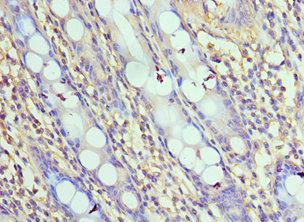
  • Immunohistochemistry of paraffin-embedded human colon tissue using CSB-PA873615ESR1HU at dilution of 1:100

Customer Reviews and Q&A

 Customer Reviews

Target Background

Function(From Uniprot)
Key component of inflammasomes that indirectly senses specific proteins from pathogenic bacteria and fungi and responds by assembling an inflammasome complex that promotes caspase-1 activation, cytokine production and macrophage pyroptosis. The NLRC4 inflammasome is activated as part of the innate immune response to a range of intracellular bacteria.
Gene References into Functions
  1. Study findings suggest that NLRC4 may be involved in the exacerbation or modification of psoriatic lesions. PMID:29797527
  2. Cryo-EM structures of ASC and NLRC4 CARD filaments reveal a unified mechanism of nucleation and activation of caspase-1 PMID:30279182
  3. obesity-associated NLRC4 inflammasome activation/ interleukin-1 signalling promotes breast cancer progression in humans and in mouse models PMID:27708283
  4. this study shows that human NAIP-NLRC4-inflammasome senses the Pseudomonas aeruginosa T3SS inner-rod protein PMID:28992059
  5. mRNA expression levels of NLRP1 and NLRC4 were not altered in chronic hepatitis B patients, suggesting that these genes are not responsible for the impaired immune responses against HBV observed in these patients. PMID:27750030
  6. The authors describe a novel mutation in NLRC4 in a large pedigree causing an NLRC4-associated, partially anakinra-responsive AID, dominated by cutaneous erythematous nodes and urticarial rash, arthralgias, and late-onset enterocolitis. PMID:27203668
  7. Results found that NLRC4 expression increased in for promoting DN progression and demonstrate NLRC4-driven IL-1beta production as critical for the progression of DN. PMID:27706238
  8. Ubiquitin-tagged NLRC4 could induce cell death and activate caspase-8 independent of Ser(533) phosphorylation. Our PMID:27974463
  9. LPS activates the MAPK pathway in macrophages, thus resulting in the upregulation of NLRC4; however, NLRC4 inhibits IL1beta and IL18 production, contributing to the anti-inflammatory response. PMID:27175981
  10. High expression of NLRP3, NLRC4, and CASP1 in background non-tumorous liver is significantly correlated with poor prognosis of patients after resection of hepatocellular carcinoma. PMID:28011505
  11. association of IL-18 levels with a single nucleotide polymorphism in the untranslated exon 2 of the inflammasome component NLRC4 PMID:26362438
  12. While both contributing to pathogen clearance, NLRP3 more than NLRC4 contributes to deleterious inflammatory responses in cystic fibrosis and correlates with defective NLRC4-dependent IL-1Ra production. PMID:26972847
  13. analysis of a subset of inflammasome receptors including NLRP3, NLRC4 and AIM2 that triggers formation of the micrometer-sized spherical supramolecular complex called the ASC speck PMID:26258904
  14. Thus, pathogenic inflammasome activity during Candida infection is negatively regulated by the IL-22/NLRC4/IL-1Ra axis. PMID:26269955
  15. cN-II co-immunoprecipitated both with wild type Ipaf and its LRR domain after transfection with corresponding expression vectors, but not with Ipaf lacking the LRR domain. PMID:25811392
  16. Elevated expression of IPAF was associated with inflammation in patients with pemphigus vulgaris disease. PMID:25342284
  17. Data indicate that NLR family CARD domain containing 4 protein (NLRC4) is a causative gene for familial cold autoinflammatory syndrome (FCAS). PMID:25385754
  18. Data show that the disease was caused by a de novo gain-of-function mutation in NLR family CARD domain containing 4 (NLRC4) encoding a p.Val341Ala substitution. PMID:25217960
  19. inflammasome (also known as NLRC4) has been demonstrated to play a role in host defense mechanisms against pathogen-associated molecules PMID:24054992
  20. This review describes the surprisingly diverse mechanisms by which NLRC4 senses bacteria and initiates innate immune responses. PMID:23215645
  21. the NAIP5-NLRC4 inflammasome is induced by direct interactions with conserved N- and C-terminal regions of flagellin PMID:23012363
  22. NLRC4 is important for host survival and bacterial clearance, as well as neutrophil-mediated inflammation in the lungs following Klebsiella pneumoniae infection. PMID:22547706
  23. Twelve single nucleotide polymorphisms within NLRP1, NLRP3, NLRC4, CARD8, CASP1, and IL1B genes were analyzed in 150 HIV-1-infected Brazilian subjects. PMID:22227487
  24. Genetic analysis of Chromobacterium violaceum infection revealed that the TTSS needle protein CprI can stimulate NLRC4 inflammasome activation in human macrophages PMID:21918512
  25. [review] role of NLRC4 inflammasome and pathways in innate immune detection of bacterial virulence factors PMID:20349122
  26. Apaf-1 protein expression did not correlate with Apaf-1 mRNA levels in human leukaemic blasts.Apaf-1 DNA promoter methylation might contribute to the inactivation of Apaf-1 expression PMID:12545166
  27. CLAN regulates several events central to host defense mechanisms against invading bacteria: modulating relative sensitivity of macrophages to lipopolysaccharide and peptidoglycan, and impacting host-pathogen interactions. PMID:15528373
  28. p53 can directly induce Ipaf gene transcription, which contributes to p53-dependent apoptosis in at least some human cells PMID:15580302
  29. Involvement of caspase 1 and its activator Ipaf upstream of mitochondrial events in apoptosis PMID:16817903
  30. hNAIP and hIpaf mediate innate intracellular defense against flagellated Legionella in human cells. PMID:18453601

Show More

Hide All

Subcellular Location
Cytoplasm. Cytoplasm, cytosol. Inflammasome.
Tissue Specificity
Isoform 2 is expressed ubiquitously, although highly expressed in lung and spleen. Isoform 1 is highly expressed in lung, followed by leukocytes especially monocytes, lymph node, colon, brain, prostate, placenta, spleen, bone marrow and fetal liver. Isofo
Database Links

HGNC: 16412

UNIGENE: Hs.574741

KEGG: hsa:58484

STRING: 9606.ENSP00000354159

OMIM: 606831

icon of phone
Call us
301-363-4651 (Available 9 a.m. to 5 p.m. CST from Monday to Friday)

icon of address
Address
No. 269, Shendun 5th Road, Donghu Hi-Tech Development Area, Hubei Province, 430206, P.R.China
icon of social media
Join us with

Subscribe newsletter

Leave a message

* To protect against spam, please pass the CAPTCHA test below.
CAPTCHA verification
© 2007-2025 CUSABIO TECHNOLOGY LLC All rights reserved. 鄂ICP备15011166号-1
Select 0 Products