It differs from different batches. Please contact us to confirm it.
Buffer
-20°C, pH7.4 PBS, 0.05% NaN3, 40% Glycerol
Tested Applications
ELISA,IHC
Storage
Upon receipt, store at -20°C or -80°C. Avoid repeated freeze.
Lead Time
Basically, we can dispatch the products out in 1-3 working days after receiving your orders. Delivery time maybe differs from different purchasing way or location, please kindly consult your local distributors for specific delivery time.
Usage
For Research Use Only. Not for use in diagnostic or therapeutic procedures.
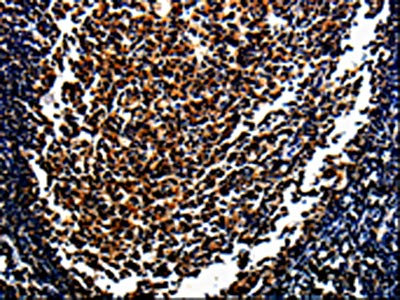
The image on the left is immunohistochemistry of paraffin-embedded Human tonsil tissue using CSB-PA179901(MAGEA4 Antibody) at dilution 1/10, on the right is treated with fusion protein. (Original magnification: ×200)
Regulates cell proliferation through the inhibition of cell cycle arrest at the G1 phase. Also negatively regulates p53-mediated apoptosis.
Gene References into Functions
MAGEA4 was positively correlated with TWIST1, and its knockdown inhibited EMT in TE3 cells.PMID:28653599
Because of the significant correlation of MAGEA4 and indices of poor prognosis, the role of this CTA may be confirmed in Esophageal squamous cell carcinoma (ESCC) aggressiveness and metastasis. Therefore, MAGEA4 may be a promising therapeutic candidate for suppressing ESCC aggressivenessPMID:30197348
Study shows that whereas MAGEA4 expression by itself may be indicative of a poor prognosis in primary lung cancer, its prognostic value depends entirely on its subcellular localization and on the p53 status. The accumulation of nuclear MAGEA4 expression without p53 expression is significantly associated with poor survival, implying that MAGEA4 inhibits apoptosis and increases tumorigenesis.PMID:29901069
MAGE-A4 depletion from MAGE-A4-expressing cancer cells destabilizes RAD18.PMID:27377895
Our results support...the potential utility of MAGEA4 as an ancillary diagnostic marker for synovial sarcomaPMID:28744588
some autoantibodies, such as anti-MAGEA4, anti-CTAG1 or anti-TP53 and their combinations could possibly contribute to the development of cancer early detection tests (not necessarily restricted to gastric cancer) when being combined with other markers.PMID:27140836
Anti-MAGEA4 exhibited the highest sensitivity for detecting early stage colorectal cancer (CRC) and advanced adenoma.PMID:26909861
High MAGE-A4 expression is associated with Lung Cancer.PMID:27793776
Results found concomitant overexpression of MAGEA4 and TWIST1 in esophageal squamous cell carcinoma (ESCC). Also, it showed a correlation between MAGEA4 and TWIST1 expression, which was found as indirect binding of TWIST1 to the E-boxes in the MAGEA4 promoter revealing transcriptional upregulation of MAGEA4 by TWIST1.PMID:27533647
Results support the potential utility of NY-ESO-1, PRAME, and MAGEA4 as targets for immunotherapy and as ancillary prognostic parameters in synovial sarcomas.PMID:27993576
CTAs (MAGE-A4, NY-ESO-1, MAGE-A10) were more likely expressed in patients with squamous cell carcinoma of the lung and when CTAs combined with CD133, they can be better prognostic factors.PMID:26191258
HLA class I loss in smokers or patients with the MAGE-A4 gene was a prognostic factors in non-small cell lung cancer .PMID:23124547
Expression of MAGE-A4 may make immunotherapeutic intervention possible in selected patients with thyroid cancer.PMID:24238058
Detection of MAGE-4 transcripts in blood may help to predict the prognosis and monitoring of the response of HCV-infected hepatocellular carcinoma patients to therapyPMID:22653756
Mage-A4 expression and serum identification is and potential therapeutic target in estrogen receptor negative breast cancer.PMID:23172894
MAGEA4 promotes growth by preventing cell cycle arrest and by inhibiting apoptosis mediated by the p53 transcriptional targets.PMID:22842486
High MAGE-4 gene expression is associated with metastases in hepatitis C virus patients complicated by hepatocellular carcinoma.PMID:21452042
MAGE-A4 is identified as a specific biomarker of esophageal squamous cell carcinoma with a possible oncogenic role contributing to tumor progression.PMID:21613820
novel HLA-A2-restricted T cell epitope derived from MAGE-4 was identifiedPMID:21815906
High MAGE-A4 gene expression is associated with head and neck squamous cell carcinomaPMID:20715104
Report immunohistochemical expression of MAGE-A4 in renal oncocytoma and chromophobe renal cell carcinoma.PMID:20591578
positive expression in patients with non-small cell lung cancer is associated with poorer overall survivalPMID:19545928
MAGE-4 protein may have a role in development of hepatocellular carcinogenesis in cirrhotic patientsPMID:11985796
MAGE-A4 expression in bladder transitional cell carcinoma.PMID:12209610
strong MAGE-A4 expression and to a lesser degree NY-ESO-1 expression is characteristic of the vast majority of uterine carcinosarcomas and a major subset of papillary serous carcinomasPMID:12209997
MAGE-A4 binds to gankyrin and suppresses its oncogenic activity.PMID:12525503
a cleaved form of MAGE-A4 binds to Miz-1 and induces apoptosisPMID:14739298
MAGE-A4(143-151) and SAGE(715-723) are HLA-A2402-restricted CTL epitopesPMID:16061876
Expression may represent potential targets for cancer immunotherapy in patients with non small cell lung carcinoma.PMID:16596224
Expressed in a large part of epithelial skin tumors with predominantly scattered immunoexpression pattern in organ-transplant recipients.PMID:17214847
Its expression is significantly associated with prognostic factors in poor outcome of the non-small cell lung cancer.PMID:18982744
Overexpression of MAGE-A4 is associated with bladder cancer.PMID:19533752
Show
More
Hide
All
Tissue Specificity
Expressed in many tumors of several types, such as melanoma, head and neck squamous cell carcinoma, lung carcinoma and breast carcinoma, but not in normal tissues except for testes and placenta.