LPAR6 Antibody

Code: CSB-PA017336OA01HU
Size:
20μl
20μl50μl100μl
US$83
Quantity:
Species Reactivity: Human
Raised in: Rabbit
Application: ELISA, WB, IHC, IF
For inquiries on large quantities or another requirements
Send an Inquiry
Start an on-line Chat
Online ordering is currently available for U.S. customers only. For orders outside the U.S., please kindly submit an inquiry or start a chat with us.

Product Details

Uniprot NO.
Target Names
LPAR6
Alternative Names
LPAR6; P2RY5; Lysophosphatidic acid receptor 6; LPA receptor 6; LPA-6; Oleoyl-L-alpha-lysophosphatidic acid receptor; P2Y purinoceptor 5; P2Y5; Purinergic receptor 5; RB intron encoded G-protein coupled receptor
Raised in
Rabbit
Species Reactivity
Human
Immunogen
Peptide sequence from Human Lysophosphatidic acid receptor 6 protein (292-313AA)
Immunogen Species
Homo sapiens (Human)
Conjugate
Non-conjugated
Isotype
IgG
Purification Method
>95%, Protein G purified
Concentration
It differs from different batches. Please contact us to confirm it.
Buffer
Preservative: 0.03% Proclin 300
Constituents: 50% Glycerol, 0.01M PBS, pH 7.4
Tested Applications
ELISA, WB, IHC, IF
Recommended Dilution
ApplicationRecommended Dilution
WB1:1000-1:5000
IHC1:200-1:500
IF1:50-1:200
Storage
Upon receipt, store at -20°C or -80°C. Avoid repeated freeze.
Lead Time
Basically, we can dispatch the products out in 1-4 working days after receiving your orders. Delivery time maybe differs from different purchasing way or location, please kindly consult your local distributors for specific delivery time.
Note: All of our proteins are default shipped with normal blue ice packs, if you request to ship with dry ice, please communicate with us in advance and extra fees will be charged.
Usage
For Research Use Only. Not for use in diagnostic or therapeutic procedures.
Datasheet & COA
Images
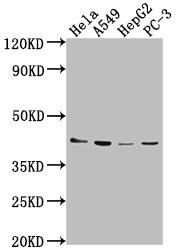
  • Western Blot
    Positive WB detected in: Hela whole cell lysate, A549 whole cell lysate, HepG2 whole cell lysate, PC-3 whole cell lysate
    All lanes: LPAR6 antibody at 1:2000
    Secondary
    Goat polyclonal to rabbit IgG at 1/50000 dilution
    Predicted band size: 40 kDa
    Observed band size: 40 kDa

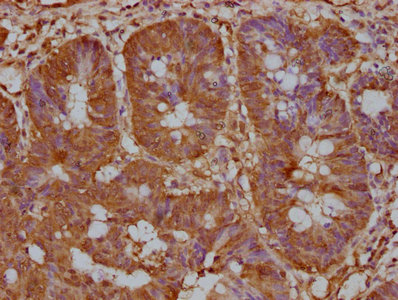
  • IHC image of CSB-PA017336OA01HU diluted at 1:200 and staining in paraffin-embedded human colon cancer performed on a Leica BondTM system. After dewaxing and hydration, antigen retrieval was mediated by high pressure in a citrate buffer (pH 6.0). Section was blocked with 10% normal goat serum 30min at RT. Then primary antibody (1% BSA) was incubated at 4°C overnight. The primary is detected by a biotinylated secondary antibody and visualized using an HRP conjugated SP system.

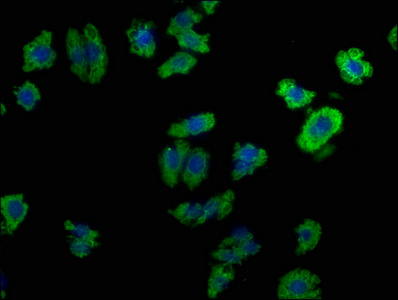
  • Immunofluorescence staining of HepG2 cells with CSB-PA017336OA01HU at 1:100, counter-stained with DAPI. The cells were fixed in 4% formaldehyde, permeabilized using 0.2% Triton X-100 and blocked in 10% normal Goat Serum. The cells were then incubated with the antibody overnight at 4°C. The secondary antibody was Alexa Fluor 488-congugated AffiniPure Goat Anti-Rabbit IgG(H+L).

Customer Reviews and Q&A

 Customer Reviews

Target Background

Function(From Uniprot)
Binds to oleoyl-L-alpha-lysophosphatidic acid (LPA). Intracellular cAMP is involved in the receptor activation. Important for the maintenance of hair growth and texture.
Gene References into Functions
  1. Novel sequence variants in the LIPH and LPAR6 genes underlies autosomal recessive woolly hair/hypotrichosis in three consanguineous Pakistani families. PMID:28425126
  2. DLD-C-F cells formed large-sized colonies, but not DLD-F-C cells, correlating with LPAR1 and LPAR6 gene expression levels. These results suggest that LPA1 and LPA6 may regulate the colony formation activity in DLD1 cells treated with anticancer drugs. PMID:29369010
  3. LPA2 mRNA levels were associated with poorer differentiation, and higher LPA6 levels were associated with microvascular invasion in HCC; both became a risk factor for recurrence after surgical treatment when combined with increased serum ATX levels PMID:27583415
  4. LPAR6 has a role in tumorigenicity of hepatocellular carcinoma PMID:25589345
  5. These results suggest that the diverse roles of LPA4, LPA5 and LPA6 are involved in the activation of tumor progression in pancreatic cancer cells. PMID:25849892
  6. Missense mutations in LPAR6 reveal abnormal phospholipid signaling pathways leading to hypotrichosis. PMID:25119526
  7. We have identified a novel deletion mutation in LPAR6, which was responsible for autosomal woolly hair syndrome with hypotrichosis in a consanguineous Chinese family. PMID:23773027
  8. study extends the spectrum of mutations in LPAR6/P2RY5 gene and underscores those mutations in LPAR6/P2RY5 and LIPH result in similar phenotypes PMID:22385360
  9. LPA2 and LPA6 receptor subtypes are predominant in both HPAECs and HMVECs PMID:23084965
  10. These findings extend the spectrum of known LPAR6 mutations and suggest a founder effect of the p.G146R mutation in the Pakistani population PMID:22531990
  11. homozygous loss of the entire LPAR6 gene in a Turkish family with hypotrichosis and woolly hair PMID:22621192
  12. Mutations identified in the present study extend the body of evidence implicating LPAR6 and LIPH genes in pathogenesis of human hereditary hair loss. PMID:21426374
  13. Autosomal recessive form of hypotrichosis simplex mapped to chromosome 13q14.11-13q21.33, and identified homozygous truncating mutations in P2RY5. PMID:18297070
  14. Disruption of P2RY5, an orphan G protein-coupled receptor, underlies autosomal recessive woolly hair. PMID:18297072
  15. In the present study, 14 of 22 families with autosomal recessive hypotrichosis show linkage to LAH3 locus on chromosome 13q14.11-q21.32. Affected individuals of all the 22 families have common clinical features. PMID:18461368
  16. Our findings show that mutations in P2RY5 display variable expressivity, underlying both hypotrichosis and woolly hair, and underscore the essential role of P2RY5 in the tissue integrity and maintenance of the hair follicle. PMID:18692127
  17. There is an involvement of P2RY5 mutations in hereditary hair diseases. PMID:18803659
  18. LIPH is a second causative gene for ARWH/hypotrichosis, giving rise to a phenotype clinically indistinguishable from P2RY5 mutations PMID:18830268
  19. gene is involved in genetics of hypotrichosis simplex and autosomal recessive wooly hair syndrome. PMID:19061667
  20. Mutations revealed in the results extend the body of evidence implicating the P2RY5 gene in the pathogenesis of human hereditary hair loss. PMID:19292720
  21. study increases the spectrum of known P2RY5 mutations and highlights the importance of this receptor in human hair growth and texture PMID:19529952
  22. Expression of turkey (Meleagris gallopavo) 6H1/p2y5 receptor in human astrocytoma cells and measurement of second mesenger levels indicate it is not a member of the P2Y receptor family. PMID:9240460

Show More

Hide All

Subcellular Location
Cell membrane; Multi-pass membrane protein.
Protein Families
G-protein coupled receptor 1 family
Tissue Specificity
Expressed ubiquitously, including in skin and hair follicle cells. Detected in both Henle's and Huxley's layers of the inner root sheath of the hair follicle and in suprabasal layers of the epidermis (at protein level). Expressed at low levels in peripher
Database Links

HGNC: 15520

UNIGENE: Hs.123464

KEGG: hsa:10161

STRING: 9606.ENSP00000344353

OMIM: 278150

icon of phone
Call us
301-363-4651 (Available 9 a.m. to 5 p.m. CST from Monday to Friday)

icon of address
Address
No. 269, Shendun 5th Road, Donghu Hi-Tech Development Area, Hubei Province, 430206, P.R.China
icon of social media
Join us with

Subscribe newsletter

Leave a message

* To protect against spam, please pass the CAPTCHA test below.
CAPTCHA verification
© 2007-2025 CUSABIO TECHNOLOGY LLC All rights reserved. 鄂ICP备15011166号-1
Select 0 Products