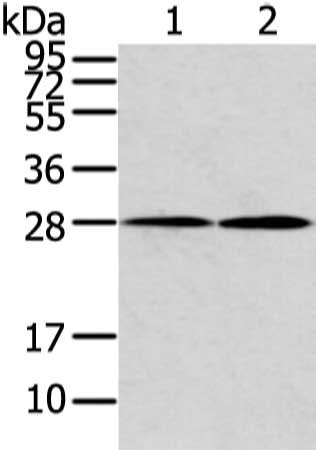
It differs from different batches. Please contact us to confirm it.
Buffer
-20°C, pH7.4 PBS, 0.05% NaN3, 40% Glycerol
Tested Applications
ELISA,WB
Storage
Upon receipt, store at -20°C or -80°C. Avoid repeated freeze.
Lead Time
Basically, we can dispatch the products out in 1-3 working days after receiving your orders. Delivery time maybe differs from different purchasing way or location, please kindly consult your local distributors for specific delivery time.
Note: All of our proteins are default shipped with normal blue ice packs, if you request to ship with dry ice, please communicate with us in advance and extra fees will be charged.
Usage
For Research Use Only. Not for use in diagnostic or therapeutic procedures.
Regulatory subunit of the calcium activated potassium KCNMA1 (maxiK) channel. Modulates the calcium sensitivity and gating kinetics of KCNMA1, thereby contributing to KCNMA1 channel diversity. Increases the apparent Ca(2+)/voltage sensitivity of the KCNMA1 channel. It also modifies KCNMA1 channel kinetics and alters its pharmacological properties. It slows down the activation and the deactivation kinetics of the channel. Acts as a negative regulator of smooth muscle contraction by enhancing the calcium sensitivity to KCNMA1. Its presence is also a requirement for internal binding of the KCNMA1 channel opener dehydrosoyasaponin I (DHS-1) triterpene glycoside and for external binding of the agonist hormone 17-beta-estradiol (E2). Increases the binding activity of charybdotoxin (CTX) toxin to KCNMA1 peptide blocker by increasing the CTX association rate and decreasing the dissociation rate.
Gene References into Functions
Expression of vascular large-conductance calcium-activated potassium channel Kcnmb1 is regulated by Nrf2 signaling.PMID:28429615
The study demonstrates that both transmembrane domains of BKbeta1 are required to provide the characteristic ion current phenotype of beta1-containing BK channels.PMID:25275635
Data show that two lysine residues that are unique to the N terminus of calcium-activated potassium channel subunit beta-1 were identified to be sufficient for voltage-sensor modulation.PMID:25825713
To determine the relationship between atherosclerosis and KCNMB1, we studied some atherogenic factors affecting vascular tone. Blood of atherosclerotic patients shows increased concentration of 7-ketocholesterol, possibly a harmful lipid to blood vessels.PMID:25576871
Bisphenol A activates BK alpha via an extracellular site and that Bisphenol A-sensitivity is increased by the beta1 subunit.PMID:24476761
In large-conductance calcium-dependent potassium channels, beta1 and beta2 subunits alter the voltage sensing domain-cytosolic domain interface.PMID:23825428
The results indicate that the beta1-subunit can form a tripartite complex with TP and MaxiKalpha, has the ability to associate with each protein independently.PMID:23255603
HIF-1alpha increases KCNMB1 expression in response to hypoxia in human pulmonary artery smooth muscle cells by binding to two hypoxia response elements located at -3,540 to -3,311 of the KCNMB1 promoterPMID:22114151
Here we found that KCNMB1 common variant Glu65Lys influences glomerular filtration rate across multiple populations of different clinical characteristics and biogeographic ancestries.PMID:20861615
downregulation of vascular BK-beta(1) expression in diabetes and in high-glucose culture conditions was associated with FOXO-3a/FBXO-dependent increase in BK-beta(1) degradation.PMID:20966391
Results reveal the first ion channel subunit as a direct target of SRF-MYOCD transactivation, providing further insight into the role of MYOCD as a master regulator of the SMC contractile phenotype.PMID:19801679
Phosphorylation-dependent functional coupling of hSlo and its hbeta 4 subunitPMID:11790768
have a reset baroreflex. Variants in the gene (KCNMB1) coding for the BK beta1 subunit are associated with baroreflex function.PMID:12011654
mesangial cells contain hbeta1, a BK accessory protein, which confers activation of BK by cGMP kinase.PMID:12670831
Beta1 subunits facilitate gating of BK channels by acting through the Ca2+, but not the Mg2+, activating mechanisms.PMID:12893878
We conclude that transient membrane current is generated by a mechanism related to the deactivation, and level of prior activation, of glioma BK channels.PMID:12962281
results reveal the molecular regions in the beta1 and beta2 subunits that determine their differential functional coupling with the pore-forming alpha-subunitPMID:16446507
identified and characterized single nucleotide polymorphisms in the exons, intron/exon junctions, upstream region and 3' untranslated regions of KCNMB1 using denaturing high-performance liquid chromatography combined with direct DNA sequencingPMID:17496725
The protective effect of KCNMB1 E65K against hypertension is restricted to blood pressure treatment with beta-blockade.PMID:18418400
African American male asthmatics carrying the KCNMB1 818T allele (10% of population) are potentially at risk for greater airway obstruction and increased asthma morbidity.PMID:18535015
The findings suggest that the KCNMB1 Glu65Lys polymorphism associates with reduced systolic and diastolic blood pressure in middle-aged men.PMID:18854753
The KCNMB1 E65K variant is associated with reduced central pulse pressure.PMID:19050450
maxi-K(+) beta1-subunit could contribute to vascular dysregulation in severe obstructive sleep apnea syndrome patients. Leukocyte beta1 expression may be independent readout of hypoxemia that could be useful as molecular marker for impending hypertension.PMID:19057512
Cell membrane stretch and cell volume sensitivity are independently regulated by KCNMB1 (BK) and KCNQ1 channels, respectively.PMID:19289549
genetic polymorphism shows sex-specific association with asthma severity in male african populationPMID:19295429
Show
More
Hide
All
Subcellular Location
Membrane; Multi-pass membrane protein.
Protein Families
KCNMB (TC 8.A.14.1) family, KCNMB1 subfamily
Tissue Specificity
Abundantly expressed in smooth muscle. Low levels of expression in most other tissues. Within the brain, relatively high levels found in hippocampus and corpus callosum.