GPR65 Antibody

Code: CSB-PA732036
Size:
50μl
50μl100μl
US$166
Quantity:
Species Reactivity: Human
Raised in: Rabbit
Application: ELISA,IHC
For inquiries on large quantities or another requirements
Send an Inquiry
Start an on-line Chat
Online ordering is currently available for U.S. customers only. For orders outside the U.S., please kindly submit an inquiry or start a chat with us.

Product Details

Uniprot NO.
Target Names
GPR65
Alternative Names
GPR65; TDAG8; Psychosine receptor; G-protein coupled receptor 65; T-cell death-associated gene 8 protein
Raised in
Rabbit
Species Reactivity
Human
Immunogen
Synthetic peptide of Human GPR65
Immunogen Species
Homo sapiens (Human)
Conjugate
Non-conjugated
Isotype
IgG
Purification Method
Antigen affinity purification
Concentration
It differs from different batches. Please contact us to confirm it.
Buffer
-20°C, pH7.4 PBS, 0.05% NaN3, 40% Glycerol
Tested Applications
ELISA,IHC
Storage
Upon receipt, store at -20°C or -80°C. Avoid repeated freeze.
Lead Time
Basically, we can dispatch the products out in 1-3 working days after receiving your orders. Delivery time maybe differs from different purchasing way or location, please kindly consult your local distributors for specific delivery time.
Note: All of our proteins are default shipped with normal blue ice packs, if you request to ship with dry ice, please communicate with us in advance and extra fees will be charged.
Usage
For Research Use Only. Not for use in diagnostic or therapeutic procedures.
Datasheet & COA
Images
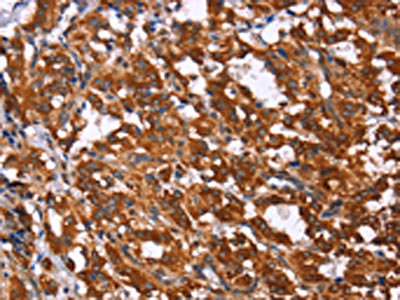
  • The image on the left is immunohistochemistry of paraffin-embedded Human thyroid cancer tissue using CSB-PA732036(GPR65 Antibody) at dilution 1/15, on the right is treated with synthetic peptide. (Original magnification: ×200)

Customer Reviews and Q&A

 Customer Reviews

Target Background

Function(From Uniprot)
Receptor for the glycosphingolipid psychosine (PSY) and several related glycosphingolipids. Plays a role in immune response by maintaining lysosome function and supporting phagocytosis-mediated intracellular bacteria clearance. May have a role in activation-induced cell death or differentiation of T-cells.
Gene References into Functions
  1. TDAG8 functions as a contextual tumor suppressor down-regulated in hematological malignancies. PMID:29017562
  2. Study results suggest greater T cell death associated gene-8 (TDAG8) expression in patients with panic disorder compared to healthy subjects, and directly link TDAG8 expression and the severity of the panic disorder symptoms PMID:28736033
  3. this study establishes a role for GPR65 in inflammatory bowel disease susceptibility and identify lysosomal dysfunction as a potentially causative element in pathogenesis PMID:27287411
  4. TDAG8 expression is decreased by more than 50%. PMID:24152439
  5. GPR65 is a regulator upstream of MMP3, which is regulated by proton-sensing G-protein-coupled receptors PMID:23707809
  6. Acidosis promotes Bcl-2 family-mediated evasion of apoptosis: involvement of acid-sensing G protein-coupled receptor Gpr65 signaling to Mek/Erk. PMID:22685289
  7. Data suggest that one physiological function of TDAG8 is negative regulation of inflammation by inhibiting production of pro-inflammatory cytokines in T-lymphocytes and macrophages. PMID:22445881
  8. These results support the hypothesis that TDAG8 enhances tumor development by promoting adaptation to the acidic environment to enhance cell survival/proliferation. PMID:20855608
  9. GPR4 and TDAG8 overexpression in human tumors plays a role in driving or maintaining tumor formation PMID:15221007
  10. TDAG8 is one of the proton-sensing GPCRs coupling to adenylyl cyclase and psychosine, and its related lysosphingolipids behave as if they were antagonists against protein-sensing receptors, including TDAG8, GPR4, and OGR1. PMID:15326175
  11. TDAG8 may play biological roles in immune response and cellular transformation under conditions accompanying tissue acidosis. PMID:15618224
  12. Expression of TDAG8 by immune cells may regulate responses in acidic microenvironments. PMID:15665078
  13. At least partly, TDGA8 mediates extracellular acidification-induced inhibition of proinflammatory cytokine production through the Gs protein/cyclic AMP-dependent protein kinase A signaling pathway in transgenic mouse macrophages. PMID:19234222

Show More

Hide All

Subcellular Location
Cell membrane; Multi-pass membrane protein.
Protein Families
G-protein coupled receptor 1 family
Tissue Specificity
Predominantly expressed in thymus, spleen, lymph nodes, small intestine, lung, placenta and peripheral blood leukocytes.
Database Links

HGNC: 4517

UNIGENE: Hs.443243

KEGG: hsa:8477

STRING: 9606.ENSP00000267549

OMIM: 604620

icon of phone
Call us
301-363-4651 (Available 9 a.m. to 5 p.m. CST from Monday to Friday)

icon of address
Address
No. 269, Shendun 5th Road, Donghu Hi-Tech Development Area, Hubei Province, 430206, P.R.China
icon of social media
Join us with

Subscribe newsletter

Leave a message

* To protect against spam, please pass the CAPTCHA test below.
CAPTCHA verification
© 2007-2025 CUSABIO TECHNOLOGY LLC All rights reserved. 鄂ICP备15011166号-1
Select 0 Products