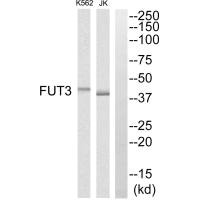
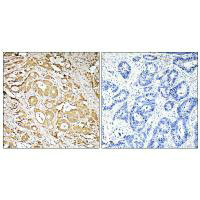
FUT3; FT3B; LE; 3-galactosyl-N-acetylglucosaminide 4-alpha-L-fucosyltransferase FUT3; Alpha-3-fucosyltransferase FUT3; Blood group Lewis alpha-4-fucosyltransferase; Lewis FT; Fucosyltransferase 3; Fucosyltransferase III; FucT-III
Raised in
Rabbit
Species Reactivity
Human
Immunogen
Synthesized peptide derived from internal of Human FUT3.
Immunogen Species
Homo sapiens (Human)
Purification Method
The antibody was affinity-purified from rabbit antiserum by affinity-chromatography using epitope-specific immunogen.
Concentration
It differs from different batches. Please contact us to confirm it.
Tested Applications
ELISA,WB,IHC
Storage
Upon receipt, store at -20°C or -80°C. Avoid repeated freeze.
Lead Time
Basically, we can dispatch the products out in 1-3 working days after receiving your orders. Delivery time maybe differs from different purchasing way or location, please kindly consult your local distributors for specific delivery time.
Usage
For Research Use Only. Not for use in diagnostic or therapeutic procedures.
Catalyzes the transfer of L-fucose, from a guanosine diphosphate-beta-L-fucose, to both the subterminal N-acetyl glucosamine (GlcNAc) of type 1 chain (beta-D-Gal-(1->3)-beta-D-GlcNAc) glycolipids and oligosaccharides via an alpha(1,4) linkage, and the subterminal glucose (Glc) or GlcNAc of type 2 chain (beta-D-Gal-(1->4)-beta-D-GlcNAc) oligosaccharides via an alpha(1,3) linkage, independently of the presence of terminal alpha-L-fucosyl-(1,2) moieties on the terminal galactose of these acceptors and participates in the blood groups Lewis determination and expression of Lewis a (Le(a)), lewis b (Le(b)), Lewis x/SSEA-1 (Le(x)) and lewis y (Le(y)) antigens. Also catalyzes the transfer of L-fucose to subterminal GlcNAc of sialyl- and disialyl-lactotetraosylceramide to produce sialyl Lewis a (sLe(a)) and disialyl Lewis a via an alpha(1,4) linkage and therefore may regulate cell surface sialyl Lewis a expression and consequently regulates adhesive properties to E-selectin, cell proliferation and migration. Catalyzes the transfer of an L-fucose to 3'-sialyl-N-acetyllactosamine by an alpha(1,3) linkage, which allows the formation of sialyl-Lewis x structure and therefore may regulate the sialyl-Lewis x surface antigen expression and consequently adhesive properties to E-selectin. Prefers type 1 chain over type 2 acceptors. Type 1 tetrasaccharide is a better acceptor than type 1 disaccharide suggesting that a beta anomeric configuration of GlcNAc in the substrate is preferred. Lewis-positive (Le(+)) individuals have an active enzyme while Lewis-negative (Le(-)) individuals have an inactive enzyme.
Gene References into Functions
High FUT3 expression is associated with breast cancer.PMID:26908442
the high expressions of BCL6 and Lewis y antigen are associated with development, high tumor burden, and worse prognosis of ovarian cancer and targeting BCL6 could be a novel therapeutic strategy for ovarian cancer treatment.PMID:28671040
the miRNA expression vector which targets the FUT3 gene can effectively inhibit the proliferation, migration and invasion abilities of KATO-III cells.PMID:27453266
Polymorphisms in FUT3 and its intestinal expression might be associated with ulcerative colitis pathogenesis.PMID:26766790
Data suggest that fucosyltransferase 3 (FUT3) gene rs28362459 and rs3745635 single nucleotide polymorphisms (SNPs) may engender the increased risk of ileocolonic and ileal Crohn's disease (CD).PMID:26663064
that the absence of alpha1,3/4-fucosyltransferase enzyme is related to breast's invasive breast carcinomaPMID:26321244
Mutations of FUT3 (rs28362459) and (rs3745635) might influence the lesion locations in CD patients.PMID:24720527
Obtained FST values reveal distinct frequencies of the FUT3 SNPs between the present sample and its representative ancestral populations.PMID:23922852
down-regulation of FUT3 and FUT5 reduces the expression of sialyl-Lewis antigens and the adhesion capacities of gastric cancer cells and allows to identify the specific alpha1-3,4 fucosyltransferases implicated in the Lewis antigens synthesisPMID:21978830
Elevated expression of Topo-I and Topo-II beta is found in Lewis(y) antigen-overexpressing ovarian cancer cells.PMID:21542140
LeY is carried by integrin alphavbeta3 and plays a critical role in attachment to cultured cells. LeY activates integrin alphavbeta3/focal adhesion kinase (FAK) signaling.PMID:20605574
At physiological levels of wall shear stress, the number of flowing cancer cells recruited to the microtube surface was dramatically reduced by FUT3 knockdownPMID:20833389
Lewis-negative genotype was associated with invasive ductal breast carcinoma but not with anatomoclinical parametersPMID:20514537
GALNT14 and FUT3/6 H-scores were significantly higher in non-small cell lung cancer cell lines sensitive to dulanermin and drozitumab versus resistant cell linesPMID:20179215
Increased expression of Lewis y antigen plays an important role in promoting cell proliferation through activating PI3K/Akt signaling pathway in ovarian carcinoma-derived RMG-I cells.PMID:20003467
PCR using sequence-specific primers DNA enables efficient genotyping of clinical samplesPMID:11668626
Sialy Lewis-X antigens play an important role liver metastases of colon carcinoma.PMID:11819805
Distribution of Lewis (FUT3)genotype and allele frequencies by ethnicity in a United States population.PMID:12424536
Cys, Gln, and Tyr residues are important for FT3wt sorting into the transport vesicles possibly due to interactions with other membrane proteinsPMID:12493760
study of the Lewis gene polymorphisms in a Caucasian Portuguese population with a high rate of H. pylori infection, and evaluation of the implications of mutant enzymes in Le(b) expression in the gastric mucosaPMID:12730721
results indicated that Mn2+ bound the enzyme and increased its affinity for the acceptorPMID:14977360
The heterologous enzyme hFUT3 was strongly expressed and fully functional in transgenic tobacco, which showed a delay in growth linked to a reduction of internode length.PMID:15331092
cloning and characterization of the promoter; strong correlation between the promoter activity and high expression of sialyl Le(a) observed in colon carcinoma cell lines seem to confirm the important regulatory role of FUT3 in synthesis of sialyl Le(a)PMID:16199102
LeX motif present in human milk can bind to dendritic cell-specific ICAM3-grabbing non-integrin (DC-SIGN), thereby preventing the capture and subsequent transfer of HIV-1 to CD4+ T lymphocytes.PMID:16239964
T3 overexpression in gastric cells depends upon promoter hypomethylation and FUT3 is responsible for overexpression of Le(a) in gastric cells, in vitroPMID:16427187
functional mutations of the FUT3 gene may be associated with an increased atherothrombotic disease prevalence, especially among abstainersPMID:17383304
increased CD15 expression is not due to de novo biosynthesis of CD15, but results predominantly from induction of alpha(2-3)-sialidase activityPMID:18953356
Expression of sLex antigen in breast cancer is not associated with breast cancer survival.PMID:18977761
These findings indicate that Lewis y antigen have the ability to enhance the proliferation and elevate the survival rates of RMG-I cells, which can promote the genesis and development of ovarian carcinomaPMID:19137814
Sequence analysis of FUT3 identified many SNPs, but most of them are in complete linkage disequilibrium with previously reported SNPs responsible for the Lewis-negative phenotype.PMID:19175549
results suggested that PKR is the primary target for HSV-1 early RNA during induction of FUT3, FUT5, and FUT6PMID:19349624
in breast cancer there was a limited humoral immune response through Lewis y/IgM/CIC levels detection which correlated with MUC1/IgM/CICPMID:19715603
Show
More
Hide
All
Subcellular Location
Golgi apparatus, Golgi stack membrane; Single-pass type II membrane protein. Note=Membrane-bound form in trans cisternae of Golgi.
Protein Families
Glycosyltransferase 10 family
Tissue Specificity
Highly expressed in stomach, colon, small intestine, lung and kidney and to a lesser extent in salivary gland, bladder, uterus and liver.