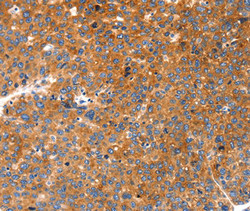
Synthetic peptide corresponding to residues near the C terminal of Human fibroblast growth factor 3
Immunogen Species
Homo sapiens (Human)
Purification Method
Antigen Affinity Purified
Concentration
It differs from different batches. Please contact us to confirm it.
Tested Applications
ELISA,IHC
Storage
Upon receipt, store at -20°C or -80°C. Avoid repeated freeze.
Lead Time
Basically, we can dispatch the products out in 1-3 working days after receiving your orders. Delivery time maybe differs from different purchasing way or location, please kindly consult your local distributors for specific delivery time.
Note: All of our proteins are default shipped with normal blue ice packs, if you request to ship with dry ice, please communicate with us in advance and extra fees will be charged.
Usage
For Research Use Only. Not for use in diagnostic or therapeutic procedures.
Plays an important role in the regulation of embryonic development, cell proliferation, and cell differentiation. Required for normal ear development.
Gene References into Functions
FGFR1 and/or FGF3 gene amplification correlated with a lower pathologic complete response in patients with HER2(+) early breast cancer treated with neoadjuvant anti-HER2 therapyPMID:28381415
fibroblast growth factor receptor 3 missense mutations were identified in 5 cases of thanatophoric dysplasiaPMID:28249712
MCF7 cells over-expressing both WNT1 and FGF3 show a 3.5-fold increase in mammosphere formation; conditioned media from these cells also promotes stem cell activity in untransfected parental MCF7 and T47D cells, as WNT1 and FGF3 are secreted factors.PMID:26421711
analysis provided evidence for gene-gene interaction between FGF3 (rs4980700) and PAX9 (rs2073242), increasing risk for isolated oral clefts (p = 0.0003). FGF3 is associated with oral clefts and may interact with PAX9.PMID:24697712
haplotypes may contribute to the tendon disease process in elite volleyball athletesPMID:24661680
FGF3 gene expression is altered in a human breast cancer progression model.PMID:25333703
Higher FGF-23 concentration was associated with LVED mass and with incident atrial fibrillation and may, in part, explain the link between chronic kidney disease and AF.PMID:24920722
A de novo 290 kb interstitial duplication of chromosome 11q13.3 including the FGF3 and FGF4 genes.PMID:24120895
tooth agenesis had increased risk of a family history of cancer. tooth agenesis was associated with positive self-reported family history of cancer and variants in FGF3.PMID:23169889
This study is the first to show a significant association between coronary calcification and elevated serum FGF 23 in children.PMID:21359960
confirm the absence of otodental syndrome in heterozygous FGF3 carriers, but report unilateral microtia in one of themPMID:21480479
Manifestations of recessive FGF3 mutations range from fully penetrant LAMM syndrome to deafness with residual inner ear structures and, by extension, with minimal syndromic features.PMID:21306635
alterations in dosage of the Fgf3 gene cause dental morphological changesPMID:20018768
labyrinth aplasia, microtia, and microdontia (LAMM) syndrome, caused by mutations in FGF3PMID:19950373
These findings suggest that the nuclear form of FGF3 inhibits cell proliferation by interfering with ribosomal biogenesis.PMID:16263090
Development of the inner ear is completely disturbed at a very early stage--or the otic vesicle is not induced at all--in all of the affected individuals who carried two mutant FGF3 allelesPMID:17236138
FGF3, FGF7, FGF10, FGF18, and FGFR1 may have roles in nonsyndromic cleft lip and palatePMID:17360555
Implication of FGF3 and FADD in human craniofacial disease.PMID:17656375
sequenced the FGF3 gene in 10 unrelated families in which probands had congenital deafness associated with various inner ear anomalies, including Michel aplasia, with or without tooth or external ear anomalies.PMID:18435799
study identified a homozygous missense mutation (c.196G-->T) in FGF3 in 21 affected individuals from a large extended family phenotypically characterized by autosomal recessive syndromic congenital sensorineural deafness, microtia and microdontiaPMID:18701883
Loss of FGFR3 signaling provides evidence that extracellular signals regulate not simply the proliferation or survival of radial glial cells, but specifically their progression to intermediate progenitor cells during neurogenesis in vivo.PMID:19923290