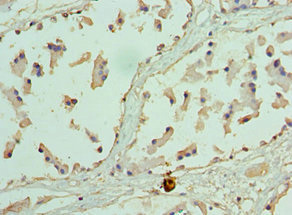
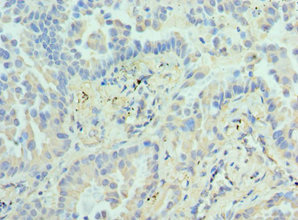
Recombinant Human Histone-lysine N-methyltransferase EZH1 protein (160-280AA)
Immunogen Species
Homo sapiens (Human)
Conjugate
Non-conjugated
Isotype
IgG
Purification Method
Antigen Affinity Purified
Concentration
It differs from different batches. Please contact us to confirm it.
Buffer
PBS with 0.02% sodium azide, 50% glycerol, pH7.3.
Tested Applications
ELISA, IHC
Recommended Dilution
Application
Recommended Dilution
IHC
1:20-1:200
Storage
Upon receipt, store at -20°C or -80°C. Avoid repeated freeze.
Lead Time
Basically, we can dispatch the products out in 1-3 working days after receiving your orders. Delivery time maybe differs from different purchasing way or location, please kindly consult your local distributors for specific delivery time.
Note: All of our proteins are default shipped with normal blue ice packs, if you request to ship with dry ice, please communicate with us in advance and extra fees will be charged.
Usage
For Research Use Only. Not for use in diagnostic or therapeutic procedures.
Polycomb group (PcG) protein. Catalytic subunit of the PRC2/EED-EZH1 complex, which methylates 'Lys-27' of histone H3, leading to transcriptional repression of the affected target gene. Able to mono-, di- and trimethylate 'Lys-27' of histone H3 to form H3K27me1, H3K27me2 and H3K27me3, respectively. Required for embryonic stem cell derivation and self-renewal, suggesting that it is involved in safeguarding embryonic stem cell identity. Compared to EZH2-containing complexes, it is less abundant in embryonic stem cells, has weak methyltransferase activity and plays a less critical role in forming H3K27me3, which is required for embryonic stem cell identity and proper differentiation.
Gene References into Functions
identification of EZH1 as a repressor of haematopoietic multipotency in the early mammalian embryoPMID:29342143
pVHL loss causes the transcriptional activation of hypoxia-inducible factor (HIF) target genes, including many genes that encode histone lysine demethylases.PMID:28701475
Data show that embryonic stem cells with deletion of EZH1 or EZH2 fail to differentiate into ectoderm lineages.PMID:28939884
Expression of the EZH2 homolog EZH1 is reduced in EZH2-deficient CML LICs, creating a scenario resembling complete loss of PRC2. EZH2 dependence of CML LICs raises prospects for improved therapy of TKI-resistant CML and/or eradication of disease by addition of EZH2 inhibitorsPMID:27630126
a hot-spot mutation in EZH1 is the second most frequent genetic alteration in autonomous thyroid adenomas; the association between EZH1 and TSHR mutations suggests a 2-hit model for the pathogenesis of these tumors, whereby constitutive activation of the cAMP pathway and EZH1 mutations cooperate to induce the hyperproliferation of thyroid cellsPMID:27500488
EZH1, SUZ12 and UXT work synergistically to regulate pathway activation in the nucleus.PMID:27127229
The authors report a novel PRC2-Ezh1 function that utilizes Ezh1beta as an adaptive stress sensor in the cytoplasm, thus allowing postmitotic cells to maintain tissue integrity in response to environmental changes.PMID:28346433
These evidences suggest that EZH2 and EZH1 are important in the counter-balancing mechanisms controlling proliferation/resting of lymphoid cells. The disruption of the balanced EZH2/EZH1 ratio may play important roles in the pathogenesis of lymphomasPMID:27311868
The related enzymatic subunits EZH1 and EZH2 undergo an expression switch during blood cell development.PMID:25578878
EZH1 maintains repressive chromatin through different mechanisms.PMID:19026781
Show
More
Hide
All
Subcellular Location
Nucleus. Note=Colocalizes with trimethylated 'Lys-27' of histone H3.
Protein Families
Class V-like SAM-binding methyltransferase superfamily, Histone-lysine methyltransferase family, EZ subfamily