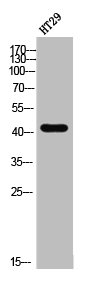
Synthesized peptide derived from the Internal region of Human EDG-3.
Immunogen Species
Homo sapiens (Human)
Conjugate
Non-conjugated
Isotype
IgG
Purification Method
The antibody was affinity-purified from rabbit antiserum by affinity-chromatography using epitope-specific immunogen.
Concentration
It differs from different batches. Please contact us to confirm it.
Buffer
Liquid in PBS containing 50% glycerol, 0.5% BSA and 0.02% sodium azide.
Tested Applications
WB, IF, ELISA
Storage
Upon receipt, store at -20°C or -80°C. Avoid repeated freeze.
Lead Time
Basically, we can dispatch the products out in 1-3 working days after receiving your orders. Delivery time maybe differs from different purchasing way or location, please kindly consult your local distributors for specific delivery time.
Usage
For Research Use Only. Not for use in diagnostic or therapeutic procedures.
Receptor for the lysosphingolipid sphingosine 1-phosphate (S1P). S1P is a bioactive lysophospholipid that elicits diverse physiological effect on most types of cells and tissues. When expressed in rat HTC4 hepatoma cells, is capable of mediating S1P-induced cell proliferation and suppression of apoptosis.
Gene References into Functions
Reactive astrocytic S1P3 signaling modulates the blood-tumor barrier in brain metastases.PMID:30006619
Authors found that elevated levels of pSphK1 were positive correlation with high expression of S1P, which in turn promoted metastasis of TNBC through S1P/S1PR3/Notch signaling pathway.PMID:29605826
Sphingosine-1-phosphate receptor 3 (S1PR3) mediates multiple aspects of the inflammatory response during sepsis.PMID:28850247
in breast cancer cells overexpression of S1P3 and its activation by S1P has pro-inflammatory and pro-metastatic potential by inducing COX-2 expression and PGE2 signaling via EP2 and EP4.PMID:27616330
High S1PR3 expression is associated with increased lung adenocarcinoma.PMID:27856637
The study shows that S1P receptor 3 (S1PR3) mRNA is overexpressed in EBV-positive NPC patient-derived xenografts and a subset of primary NPC tissues, and that knockdown of S1PR3 suppressed the activation of AKT and the S1P-induced migration of NPC cells.PMID:28240350
S1pr3 promotes leukocyte rolling by mobilization of endothelial P-selectin.PMID:25832730
Stimulation with sphingosine-1-phosphate enhances cancer stem cells via S1PR3 and subsequent Notch1 activation.PMID:25254944
TRPC1 functions as a major regulator of S1P3 and VEGFR2 expression.PMID:25971967
Data indicate that sphingosine 1-phosphate (S1P) and hepatocyte growth factor (HGF) induced transloaction of integrin beta4, S1P receptors S1PR2 and S1PR3 to endothelial cell membrane caveolin-enriched microdomains (CEMs).PMID:24851274
a novel signaling axis, i.e., ROCK-JNK-ETS-1-CD44 pathway, which plays an essential role in the S1P3-regulated chemotactic response.PMID:24064218
associations were found for 2 promoter SNPs across 2 European descent samples supporting association of alleles -1899G and -1785C with decreased risk for sepsis-associated acute respiratory distress syndrome (ARDS); alleles reduced transcription factor binding to S1PR3 promoter and S1PR3 promoter activity; associated with lower plasma S1PR3 protein in ARDS patientsPMID:23911438
Sphingosine 1-phosphate receptor 3 regulates recruitment of anti-inflammatory monocytes to microvessels during implant arteriogenesis.PMID:23918395
S1PR agonists are pro-fibrotic via S1P2R and S1P3R stimulation using Smad-independent pathways.PMID:23589284
S1P3 receptors are detected in virtually all neurons in dorsal root ganglion and mediate pain behavior.PMID:23392686
Inhibition of S1P3 receptors prevented E2-induced activation of Cdc42, supporting the important role of the S1P receptor in E2 signaling.PMID:23142484
S1PR3 is nitrated on specific tyrosine residues and released as endothelial cell microparticles during acute lung injury.PMID:22771388
Suggest that the enhanced S1P3-EGFR signaling axis may contribute to the tumorigenesis or progression of lung adenocarcinomas.PMID:22344462
S1PR3 was higher in iliac-femoral arteries compared with carotid arteries.PMID:22308044
S1P regulates MMP-9 induction and invasiveness through coupling of S1P3 and G(alphaq) in MCF10A cells, thus providing a molecular basis for the crucial role of S1P in promoting breast cell invasion.PMID:21652634
These results suggest a potential role for HDL and S1P receptors in the pathogenesis of prostate cancer.PMID:20979115
The follicular fluid-HDL-associated S1P promotes granulosa lutein cell migration via S1PR3 and RAC1 activation. This may represent a novel mechanism contributing to the development of the corpus luteum.PMID:20980685
amplification of SHC3 and EDG3 genes suggests that the two proteins co-operate and are important for ependymomas in vivo.PMID:19748727
a 9-amino acid peptide (KRX-725), derived from the second intracellular loop of S1P3 (EDG3) mimics sphingosine 1-phosphate (S1P) by triggering a Gi-dependent mitogen-activated protein kinase kinase and extracellular signal-regulated kinase signal.PMID:12763936
S1P(3) function is not subject to conventional regulation by GRK phosphorylationPMID:15894172
Expression of the sphingosine 1 phosphate receptor in primary endothelial cells is both sufficient and necessary for the expression of Akt3.PMID:16527273
Reults describe the role of mu opioid receptors and S1P3 transactivation in the attenuation of vascular permeability by methylnaltrexone.PMID:17395891
Cytosolic phospholipase A2alpha activation induced by S1P is mediated by the S1P3 receptor in lung epithelial cells.(PMID:18502815
Results suggest that S1PR3 is involved in COX2 dependent effects of high-density lipoprotein on vascular smooth muscle.PMID:18612546
Report different response patterns of several ligands at the sphingosine-1-phosphate receptor subtype 3 (S1P(3)).PMID:19309361
Show
More
Hide
All
Subcellular Location
Cell membrane; Multi-pass membrane protein.
Protein Families
G-protein coupled receptor 1 family
Tissue Specificity
Expressed in all tissues, but most abundantly in heart, placenta, kidney, and liver.