CXCR1; CMKAR1; IL8RA; C-X-C chemokine receptor type 1; CXC-R1; CXCR-1; CDw128a; High affinity interleukin-8 receptor A; IL-8R A; IL-8 receptor type 1; CD antigen CD181
Raised in
Rabbit
Species Reactivity
Human
Immunogen
Synthetic peptide of Human CXCR1
Immunogen Species
Homo sapiens (Human)
Conjugate
Non-conjugated
Isotype
IgG
Purification Method
Antigen affinity purification
Concentration
It differs from different batches. Please contact us to confirm it.
Buffer
-20°C, pH7.4 PBS, 0.05% NaN3, 40% Glycerol
Tested Applications
ELISA,WB
Storage
Upon receipt, store at -20°C or -80°C. Avoid repeated freeze.
Lead Time
Basically, we can dispatch the products out in 1-3 working days after receiving your orders. Delivery time maybe differs from different purchasing way or location, please kindly consult your local distributors for specific delivery time.
Usage
For Research Use Only. Not for use in diagnostic or therapeutic procedures.
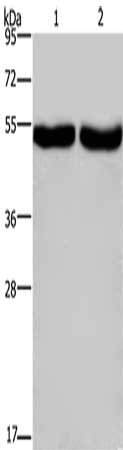
Gel: 8%SDS-PAGE, Lysate: 40 μg, Lane 1-2: Human colon cancer tissue, Human placenta tissue, Primary antibody: CSB-PA239685(CXCR1 Antibody) at dilution 1/200, Secondary antibody: Goat anti rabbit IgG at 1/8000 dilution, Exposure time: 2 minutes
Receptor to interleukin-8, which is a powerful neutrophils chemotactic factor. Binding of IL-8 to the receptor causes activation of neutrophils. This response is mediated via a G-protein that activate a phosphatidylinositol-calcium second messenger system. This receptor binds to IL-8 with a high affinity and to MGSA (GRO) with a low affinity.
Gene References into Functions
MACs from Familial hypercholesterolemia (FH)-MACs have an inflammatory phenotype that is characterized by the up-regulation of CCR3, CCR4, and CXCR1 under the control of miR-505-3p. These results suggest a chronic inflammatory condition in FH innate immunity cells that is not reverted by standard lipid-lowering treatmentPMID:29457550
Depletion of receptor accessory proteins REEP5 and REEP6 causes a decrease in CXC Chemokine Receptor 1 (CXCR1) signaling.PMID:27966653
increased production of IL-8 associated with neutrophils infiltration into the liver and decreased CXCR1/2 expression on peripheral neutrophils. CXCR1 and CXCR2 expression levels could be served as early markers to predict the severity of acute-on-chronic liver failure.PMID:27974825
Chemokine receptor CXCR1 could be used as an indicator to predict benign or malignant breast disease, and it can even predict the malignancy degree of breast cancer, as well as its invasive ability and prognosis.PMID:28454081
High expression of CXCR1 identified a subgroup of gastric cancer patients who appeared to benefit from 5-FU based adjuvant chemotherapy .PMID:27780937
CXCR1-NFkappaB pathway role in human hepatocyte proliferationPMID:27032929
Study shows that CXCR1 promoted gastric cancer cell proliferation, migration and invasion.PMID:26983663
These data provide rationale that targeting CXCR1/2 with small molecule inhibitors may enhance chemotherapeutic efficacy for the treatment of gastric cancer.PMID:26847910
The results showed that the expression of N-Ac-PGP receptors (CXCR1 and CXCR2) in CESCs was upregulated by N-Ac-PGP.PMID:26302999
These data demonstrate a biological function for mouse Cxcr1 in vivo and indicate that CXCR1-dependent neutrophil effector function is a critical innate protective mechanism of fungal clearance and host survival in systemic candidiasis.PMID:26791948
Report increased expression of CXCR1 in active pulmonary tuberculosis patients and decreased leukocyte oxidative capacity.PMID:26316141
Evaluation of GPER1, EGFR and CXCR1 mRNA/protein expression may be helpful in differential diagnosis of malignant follicular thyroid carcinoma and benign follicular thyroid adenoma.PMID:26617848
G31P blockage of CXCR1 and CXCR2 can inhibit human lung cancer cell growth and metastasisPMID:26087179
levels of CXCR1 and CXCR2 proteins were associated with the capacity of gastric cancer cell migration, while knockdown of their expression inhibited gastric cancer cell migration and invasion abilities in vitro.PMID:25022956
Findings indicate that upregulation of CXCR7 expression is associated with tumor invasion in colorectal cancer.PMID:25051350
These results, showing the inability of p17 to activate CXCR1_300_142, a receptor found to be expressed on immune cells of patients with a low progression of HIV disease, point to a crucial role of p17 in AIDS pathogenesis.PMID:25121556
These results demonstrated that the evaluation of GPER1, EGFR and CXCR1 expression in papillary thyroid carcinoma may be useful in predicting the risk of lymph node metastasisPMID:25031742
Bioluminescence resonance energy transfer and co-immunoprecipitation studies showed that secretases, PAR-2, and CXCR1 colocalize and physically interact in a novel protease/secretase-chemokine receptor network.PMID:24914212
CXCR1 and CXCR2 (rs4674258C/T, rs1008563C/T, rs6723449T/C) were analyzed for association with IL8 levels and with myocardial infarct risk.PMID:24462138
LukED recognition of CXCR1 and CXCR2 promotes the killing of monocytes and neutrophils in vitro.PMID:24139401
Dual antagonism of CXCR1 inhibits neutrophil chemotaxis in alveolar macrophages from chronic obstructive pulmonary disease patients.PMID:23912333
our results establish a new role of CXCR1 in airway smooth muscle cell migrationPMID:23904157
The CXCR1 polymorphism, rs2234671 was found to be associated with chronic HBV infection and may play a role in disease activity.PMID:23396733
HPV 16 E6 up-regulates pro-angiogenic MMP-2 and MMP-9 through inducing IL-8 expression in lung cancer cells.PMID:23349885
this study demonistrated that CX3CR1 in microglia was required for the survival of layer V neurons in mice.PMID:23525041
Findings indicate that Leu128(3.43) and Val247(6.40) are critical for G protein coupling and activation of signaling effectors, providing a valuable insight into the mechanism of CXCR1 activation.PMID:22936990
three-dimensional structure of human CXCR1 determined by NMR spectroscopyPMID:23086146
The proportions of IL-18Ralpha-expressing T lymphocytes and CD8(+) T lymphocytes were significantly higher in stable COPD patients than in nonsmokers and current smokers.PMID:22489883
The data do not support the hypothesis that bronchoepithelial expression of CXCR1 facilitates transepithelial migration of neutrophils.PMID:22076427
Data show that expression of CXCR1 and CXCR2 on neutrophils was significantly decreased in AAV patients compared to healthy controls (HC).PMID:22152684
HIV-1 matrix protein p17 promotes angiogenesis via chemokine receptors CXCR1 and CXCR2.PMID:22904195
It was shown that four SNPs in CXCR1 and three in CXCR2 strongly correlated with age-adjusted lung function in cystic fibrosis patients. SNPs comprising haplotypes CXCR1_Ha and CXCR2_Ha were in high linkage disequilibrium.PMID:22088968
The polymorphism rs2234671 in the CXCR1 gene was not associated with the susceptibility to chronic periodontitis in the studied Brazilian populationPMID:22051099
synergistic effect of CXCR1 and CXCR2 in shear-stress-induced endothelial cell migrationPMID:21989491
The N-terminal element of CXCR1 receptor, when attached to the N-terminus of the stabilized B1 domain, binds to IL-8. This binding is characterized by a small favorable enthalpy change and a larger favorable entropy change.PMID:22242662
Optimization of purification and refolding of the human chemokine receptor CXCR1 improves the stability of proteoliposomes for structure determination.PMID:22024025
association between CXCR1/CXCR2 variants and visceral leishmaniasisPMID:22171941
mRNA levels for CXCR1 and CXCR2 are increased in blood in males with obstructive CAD and decreased in patients with improved perfusion.PMID:21915051
Data demonstrate that blocking megakaryopoiesis by simultaneous inhibition of CXCR1 and CXCR2 can enhance differentiation of UCB CD133(+) cells into megakayocytic progenitors.PMID:21555225
CXCR1 and CXCR2 are important factors in mediating the migration of endothelial cells induced by shear stress, and CXCR1 fulfills a more important role.PMID:19634663
local and global dynamics of the chemokine receptor CXCR1PMID:21323370
The donor GA/AA genotypes of CXCR1 -2668G/A (rs2671222) were associated with increased risk for acute rejection even after adjusting for gender, diabetes, preemptive transplantation, immunosuppressives, relationship with the donor, and HLA mismatch.PMID:21452410
CXCR1 and CXCR2 are novel mechano-sensors mediating laminar shear stress-induced endothelial cell migration.PMID:21036625
Marked induction of CXCR1 expression on Foxp3-positive CD4 regulatory T cells by interleukin (IL)-6 followed by IL-8-mediated migration appears to be responsible for enriched migration of healthy donor mononuclear leukocytes to cultured tumor cells.PMID:21048114
The CXCR-1 receptor, but not the CXCR-2 receptor was found to be expressed in human small airway epithelial cells.PMID:20016196
CMV uses the UL146 gene product expressed in infected endothelial cells to attract neutrophils by activating their CXCR1 and CXCR2 receptors, whereby neutrophils can act as carriers of the virus to uninfected endothelial cellsPMID:20044480
Case-control analysis showed association between the common C allele (OR 2.38; 95% CI 1.23-4.57; P = 0.009) of CXCR1_rs2854386 and cutaneous leishmaniasis.PMID:20089160
When reflux was excluded, 54% of the patients had CXCR1 sequence variants. The UTI prone children expressed less CXCR1 protein than the pediatric controls (p<0.0001) and two sequence variants were shown to impair transcriptionPMID:17786197
Data demonstrate that CXCR1 and CXCR2 expression play a critical role in melanoma tumor progression and, functional blockade of CXCR1 and CXCR2 could be potentially used for future therapeutic intervention in malignant melanoma.PMID:19585580
Data show that CXCR1 is expressed in neutrophils in inflamed human stomach and gut tissues.PMID:12002274