Liquid
Note: We will preferentially ship the format that we have in stock, however, if you have any special requirement for the format, please remark your requirement when placing the order, we will prepare according to your demand.
Upon receipt, store at -20°C or -80°C. Avoid repeated freeze.
Lead Time
Basically, we can dispatch the products out in 1-3 working days after receiving your orders. Delivery time maybe differs from different purchasing way or location, please kindly consult your local distributors for specific delivery time.
Note: All of our proteins are default shipped with normal blue ice packs, if you request to ship with dry ice, please communicate with us in advance and extra fees will be charged.
Usage
For Research Use Only. Not for use in diagnostic or therapeutic procedures.
Chemotactic factor that attracts monocytes, lymphocytes, basophils and eosinophils, but not neutrophils. Signals through CCR2B and CCR3 receptors. Plays a role in the accumulation of leukocytes at both sides of allergic and non-allergic inflammation. May be involved in the recruitment of monocytes into the arterial wall during the disease process of atherosclerosis. May play a role in the monocyte attraction in tissues chronically exposed to exogenous pathogens.
Gene References into Functions
CCL13 expression is significantly upregulated in human masticatory mucosa during wound healingPMID:28005267
CCL13 levels in serum and synovial fluid may serve as a biomarker for the progression of osteoarthritis.PMID:25654294
CCL13 is an antimicrobial protein with bacteriocidal activity against E. coli.PMID:12949249
Data suggest that CCL13 binds to several chemokine receptors (CCR1, CCR2, and CCR3), allowing CCL13 to elicit different effects on target cells of immune system. CCL13 is involved in pathology of chronic inflammatory/autoimmune diseases. [REVIEW]PMID:23846739
MCP-4 and hsCRP may be the markers linking chronic inflammation in obesity and periodontal disease.PMID:23375121
E(2) has adverse effects on the pathogenesis of RA as a result of unregulated cell death, increased TNF-alpha-induced MMP-3 production, and CCL13 overproduction, subsequently resulting in the disease progression of RA.PMID:22393877
Findings suggest that the pro-atherogenic effects of CCR2 may not be restricted to interaction with MCP-1, but could also involve activation by MCP-4, being an inflammatory link between platelet and monocyte activation.PMID:20139115
Data suggest that the monocyte chemoattractant protein-4 core promoter YY-1 binding motif is functional, and modulates the transcriptional regulation of the MCP-4 gene.PMID:12805085
The study was undertaken to understand the relationship between the functional proteomics of receptor-Ck and developmental stages of human atherosclerotic aortic wall.PMID:14560935
MCP-4 may be a critical molecule that links obesity and chronic inflammation.PMID:16855189
The Th2 cytokine IL-4 preferentially stimulated MCP-4 expression.PMID:17541284
interferon-gamma with IL-1beta/TNF-alpha activates the production of CCL13 from chondrocytes in RA joints; secreted CCL13 enhances fibroblast-like synoviocyte proliferation by activating the extracellular signal-regulated MAP kinases cascadePMID:17824960
TLR2, 3, 4 and 5 ligands, but not TLR7/8 or 9 ligands, synergized with IL-4 to induce the production of MCP-4 in nasal polyp fibroblasts.PMID:17851891
CCL13 and HSPC159 mRNA expressions in PBMC are up-regulated specifically in MCNS patients during the nephrosis phase.PMID:18219197
Oncostatin M can strongly up-regulate the expression of CCL13, a chemokine recently identified in the synovial fluid of patients with rheumatoid arthritis.PMID:19565514
Show
More
Hide
All
Subcellular Location
Secreted.
Protein Families
Intercrine beta (chemokine CC) family
Tissue Specificity
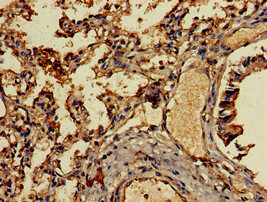
Widely expressed. Found in small intestine, thymus, colon, lung, trachea, stomach and lymph node. Low levels seen in the pulmonary artery smooth muscle cells.