APOC2 Antibody

Code: CSB-PA001932OA01HU
Size:
20μl
20μl50μl100μl
US$83
Quantity:
Species Reactivity: Human
Raised in: Rabbit
Application: ELISA, IHC
For inquiries on large quantities or another requirements
Send an Inquiry
Start an on-line Chat
Online ordering is currently available for U.S. customers only. For orders outside the U.S., please kindly submit an inquiry or start a chat with us.

Product Details

Uniprot NO.
Target Names
APOC2
Alternative Names
APC 2 antibody; APC2 antibody; Apo CII antibody; Apo-CII antibody; APOC 2 antibody; ApoC II antibody; ApoC-II antibody; APOC2 antibody; APOC2 protein antibody; APOC2_HUMAN antibody; ApoCII antibody; Apolipoprotein C II antibody; Apolipoprotein C II precursor antibody; Apolipoprotein C2 antibody; ApolipoproteinCII antibody; MGC75082 antibody; ProapoC-II antibody; Proapolipoprotein C-II antibody
Raised in
Rabbit
Species Reactivity
Human
Immunogen
Peptide sequence from Human Apolipoprotein C-II protein (20-38AA)
Immunogen Species
Homo sapiens (Human)
Conjugate
Non-conjugated
Isotype
IgG
Purification Method
>95%, Protein G purified
Concentration
It differs from different batches. Please contact us to confirm it.
Buffer
Preservative: 0.03% Proclin 300
Constituents: 50% Glycerol, 0.01M PBS, pH 7.4
Tested Applications
ELISA, IHC
Recommended Dilution
ApplicationRecommended Dilution
IHC1:500-1:1000
Storage
Upon receipt, store at -20°C or -80°C. Avoid repeated freeze.
Lead Time
Basically, we can dispatch the products out in 1-4 working days after receiving your orders. Delivery time maybe differs from different purchasing way or location, please kindly consult your local distributors for specific delivery time.
Note: All of our proteins are default shipped with normal blue ice packs, if you request to ship with dry ice, please communicate with us in advance and extra fees will be charged.
Usage
For Research Use Only. Not for use in diagnostic or therapeutic procedures.
Datasheet & COA
Images
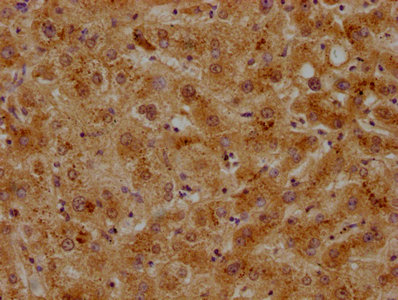
  • IHC image of CSB-PA001932OA01HU diluted at 1:500 and staining in paraffin-embedded human liver tissue performed on a Leica BondTM system. After dewaxing and hydration, antigen retrieval was mediated by high pressure in a citrate buffer (pH 6.0). Section was blocked with 10% normal goat serum 30min at RT. Then primary antibody (1% BSA) was incubated at 4°C overnight. The primary is detected by a biotinylated secondary antibody and visualized using an HRP conjugated SP system.

Customer Reviews and Q&A

 Customer Reviews

Target Background

Function(From Uniprot)
Component of chylomicrons, very low-density lipoproteins (VLDL), low-density lipoproteins (LDL), and high-density lipoproteins (HDL) in plasma. Plays an important role in lipoprotein metabolism as an activator of lipoprotein lipase. Both proapolipoprotein C-II and apolipoprotein C-II can activate lipoprotein lipase. In normolipidemic individuals, it is mainly distributed in the HDL, whereas in hypertriglyceridemic individuals, predominantly found in the VLDL and LDL.
Gene References into Functions
  1. Results from this exploratory analysis suggest that regulatory element methylation levels within the larger TOMM40-APOE-APOC2 gene region correlate with AD-related biomarkers and TOMM40 or APOE gene expression in AD. PMID:29371683
  2. Triglyceride-raising variant alleles of the APOC2 encoding apo C-II, associated with clinical Cardiovascular endpoints. PMID:28534127
  3. The results demonstrate the important role of both intra- and inter-subunit charge interactions in stabilizing apoC-II amyloid fibrils, a process that may be a key factor in determining the general ability of proteins to form amyloid fibrils. PMID:28229588
  4. The results highlight the importance of charge-pair interactions within the apoC-II fibril core PMID:26196342
  5. Conformational rearrangement of apoC-II at lipoprotein surfaces promotes interaction with LPL. PMID:26026161
  6. Large deletion in APOC2 caused by Alu-Alu homologous recombination is associated with with apolipoprotein C-II deficiency. PMID:25172036
  7. No APOC2 mutations were identified in a cohort of patients with diabetic lipemia. PMID:25131724
  8. STAT1 bound on multienhancer 2 cooperates with RXRalpha located on apoCII promoter and upregulates apoCII expression only in macrophages. PMID:22808166
  9. Mutations in GPIHBP1 are rare but the associated clinical phenotype of hypertriglyceridaemia is severe PMID:22239554
  10. These results support a predictive change in the ratio of plasma ApoCIII to ApoCII in pregnancies complicated by severe preeclampsia. PMID:21321243
  11. Substoichiometric concentrations of cyc[60-70] significantly delayed fibril formation by the fibrillogenic, linear peptides apoC-II[60-70] and apoC-II[56-76]. PMID:22244853
  12. Activation of apoC-II fibrils by submicellar lipid (NBD-lyso-12-phosphocholine) is catalytic with release of monomer- and tetramer-bound lipid accompanying fibril elongation and growth. PMID:21985034
  13. Physiological shear flow conditions and conditions experienced during apoC-II manufacturing exert significant effects on apoC-II conformation, leading to protein misfolding, aggregation, and amyloid fibril formation. PMID:21476595
  14. Includes the observation of APOC4-APOC2 read-through transcription PMID:8530039
  15. Our structural model for apoC-II fibrils suggests that apoC-II monomers fold and self-assemble to form a stable cross-beta-scaffold containing relatively unstructured connecting loops. PMID:21146539
  16. Results describe the functional role of the secondary structure in the lipoprotein lipase-binding portion of apolipoprotein CII. PMID:20042600
  17. Human apolipoprotein C-II (apoC-II) slowly forms amyloid fibers in lipid-free solutions at physiological pH and salt concentrations PMID:11751863
  18. During amyloidosis under oxidizing conditions, cysteine-containing apolipoprotein C-II (apoC-II) derivatives form fibrils more rapidly and become extensively tangled compared to wild-type apoC-II. PMID:12450397
  19. Three categories of global constraints, together with the local classical NMR constraints, define the 3D structure of the apoCII-SDS micelle complex and give important clues toward a possible mechanism for the activation of lipoprotein lipase by apoCII. PMID:12590574
  20. regions of lipoprotein lipase that are responsive to activation by apoC-II PMID:12682050
  21. Hydrolysis activated by APOC2 was faster compared with the LPL-mediated lipolysis of emulsion triolein. The binding density of APOC2 was less for small emulsion surfaces than for large ones. PMID:12782148
  22. Different levels of secreted apoC-II had little effect on LDL and HDL protein degradation by HepG2 cells. Compared to controls, cells under-expressing apoC-II showed a 160% higher capacity to selectively take up HDL-CE. PMID:15778093
  23. Results show that purified human HDL and recombinant apolipoprotein A-I lipid particles bind directly to amyloid beta and apolipoprotein C-II amyloid fibrils. PMID:16432277
  24. No relationship was found between ApoCII polymorphism and coronary disease in the Chinese Han population. PMID:16459141
  25. Decrease of LPL activity in the heart, along with the inhibitory effects of excess apolipoprotein C-II, may contribute to the hypertriglyceridemia observed in apolipoprotein c-ii transgenic mice. PMID:17018885
  26. Taken together these data demonstrate an interaction between antichymotrypsin and apolipoprotein C-II that accelerates fibrillogenesis and indicates a specific role for accessory proteins in protein aggregation. PMID:17174330
  27. These results suggested that T-->A substitution at position -190 in the apoC-II gene promoter only partly affected transcriptional activity of the apoC-II promoter, leading to decrease of apoC-II expression in quantity. PMID:17222387
  28. The ozone oxidation product of cholesterol, 3beta-hydroxy-5-oxo-5,6-secocholestan-6-al, rapidly promotes human apolipoprotein (apo) C-II amyloid fibril formation in vitro. PMID:17429947
  29. Both common and rare DNA variants of APOC2 gene were found in 10% patients with severe hypertriglyceridemia PMID:17717288
  30. Phospholipid interaction induces molecular-level polymorphism in APOC2 amyloid fibrils via alternative assembly pathways. PMID:18005990
  31. The concentration-dependent kinetics of apolipoprotein C-II amyloid fibril formation and correlated this with the final size distribution of the fibrils determined by sedimentation velocity experiments, is studied. PMID:18206908
  32. lipids promote on-pathway intermediates of apoC-II fibril assembly and the accumulation of a discrete tetrameric intermediate depends on the molecular state of the lipid PMID:18852267
  33. No significant differences were found between the acute hypertriglyceridaemic pancreatitis cases and controls with severe hypertriglyceridaemia in terms of LPL activity and mass, hepatic lipase activity, CII and CIII mass, or apo E polymorphisms. PMID:19534808

Show More

Hide All

Subcellular Location
Secreted.
Protein Families
Apolipoprotein C2 family
Tissue Specificity
Liver and intestine.
Database Links

HGNC: 609

UNIGENE: Hs.75615

KEGG: hsa:344

STRING: 9606.ENSP00000466775

OMIM: 207750

icon of phone
Call us
301-363-4651 (Available 9 a.m. to 5 p.m. CST from Monday to Friday)

icon of address
Address
No. 269, Shendun 5th Road, Donghu Hi-Tech Development Area, Hubei Province, 430206, P.R.China
icon of social media
Join us with

Subscribe newsletter

Leave a message

* To protect against spam, please pass the CAPTCHA test below.
CAPTCHA verification
© 2007-2025 CUSABIO TECHNOLOGY LLC All rights reserved. 鄂ICP备15011166号-1
Select 0 Products