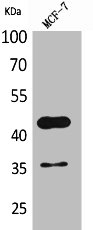
Angiopoietin like 4 antibody; Angiopoietin related protein 4 antibody; Angiopoietin-like protein 4 antibody; Angiopoietin-related protein 4 antibody; ANGL4_HUMAN antibody; ANGPT L2 antibody; ANGPT L4 antibody; ANGPTL2 antibody; Angptl4 antibody; ARP4 antibody; Fasting induced adipose factor antibody; FIAF antibody; HARP antibody; Hepatic angiopoietin related protein antibody; Hepatic fibrinogen/angiopoietin related protein antibody; Hepatic fibrinogen/angiopoietin-related protein antibody; HFARP antibody; NL2 antibody; Peroxisome proliferator-activated receptor (PPAR) gamma induced angiopoietin related protein antibody; PGAR antibody; pp1158 antibody; PPARG angiopoietin related protein antibody; PSEC0166 antibody; TGQTL antibody; UNQ171 antibody; Weakly similar to angiopoietin 1 [H.sapiens] antibody
Raised in
Rabbit
Species Reactivity
Human,Mouse,Rat
Immunogen
Synthesized peptide derived from the Internal region of Human Angptl4.
Immunogen Species
Homo sapiens (Human)
Conjugate
Non-conjugated
Isotype
IgG
Purification Method
The antibody was affinity-purified from rabbit antiserum by affinity-chromatography using epitope-specific immunogen.
Concentration
It differs from different batches. Please contact us to confirm it.
Buffer
Liquid in PBS containing 50% glycerol, 0.5% BSA and 0.02% sodium azide.
Tested Applications
WB, ELISA
Storage
Upon receipt, store at -20°C or -80°C. Avoid repeated freeze.
Lead Time
Basically, we can dispatch the products out in 1-3 working days after receiving your orders. Delivery time maybe differs from different purchasing way or location, please kindly consult your local distributors for specific delivery time.
Note: All of our proteins are default shipped with normal blue ice packs, if you request to ship with dry ice, please communicate with us in advance and extra fees will be charged.
Usage
For Research Use Only. Not for use in diagnostic or therapeutic procedures.
Mediates inactivation of the lipoprotein lipase LPL, and thereby plays a role in the regulation of triglyceride clearance from the blood serum and in lipid metabolism. May also play a role in regulating glucose homeostasis and insulin sensitivity (Probable). Inhibits proliferation, migration, and tubule formation of endothelial cells and reduces vascular leakage. Upon heterologous expression, inhibits the adhesion of endothelial cell to the extracellular matrix (ECM), and inhibits the reorganization of the actin cytoskeleton, formation of actin stress fibers and focal adhesions in endothelial cells that have adhered to ANGPTL4-containing ECM (in vitro). Depending on context, may modulate tumor-related angiogenesis.; Mediates inactivation of the lipoprotein lipase LPL, and thereby plays an important role in the regulation of triglyceride clearance from the blood serum and in lipid metabolism. Has higher activity in LPL inactivation than the uncleaved protein.
Gene References into Functions
Carriers of p.E40K, a variant that abolishes ANGPTL4 ability to inhibit lipoprotein lipase, have lower odds of T2D (odds ratio 0.89, 95% confidence interval 0.85-0.92, p = 6.3 x 10(-10)), lower fasting glucose, and greater insulin sensitivity.PMID:29899519
A relevant role of ANGPTL-4 in human obesity and its involvement in long-term body weight changes.PMID:29536615
Data indicate that the angiopoietin-like protein 4 (ANGPTL4)-mediated upregulation of tristetraprolin expression regulates the stability of chemokines in human colon epithelial cells.PMID:28287161
The data suggest that exercise-induced ANGPTL4 is secreted from the liver and driven by a glucagon-cAMP-PKA pathway in humans. These findings link the liver, insulin/glucagon, and lipid metabolism together.PMID:29031727
Study data support dual roles for ANGPTL4 in urothelial carcinoma progression, either as a tumor suppressor or oncogene, in response to microenvironmental context.PMID:29035390
ANGPTL4 levels are increased in both plasma and adipose tissues of subjects with hypertension.PMID:29490644
Low ANGPTL4 expression is associated with childhood obesity.PMID:28733963
SNP rs11672433, a high-frequency locus in the ANGPTL4 gene, does not influence the predisposition to brain arteriovenous malformation or its effect is too small to be detected in the present size sample set.PMID:29221972
Levels of ANGPTL4 in the circulation and HDLs were increased in type 2 diabetics altering lipid metabolism.PMID:28645936
High expression of ANGPTL4 is associated with drug resistance in prostate cancer.PMID:28560449
this study suggests that the presence of C allele of rs1044250 and G allele of rs2278236 in ANGPTL4 gene is associated with higher risk of moderate/severe proteinuria in renal transplant patientsPMID:27913276
These results suggested that ANGPTL4 was essential for proliferation and metastasis of lung cancer cells.PMID:27166634
The mutant tumors exhibited impaired proliferation, anoikis resistance, and migratory capability and had reduced adenylate energy charge. Further investigations also revealed that cANGPTL4 regulated the expression of Glut2PMID:28641978
Data indicate angiopoietin-like 4 (ANGPTL4) as a key player that coordinates an increase in cellular energy flux crucial for EMT via an ANGPTL4/14-3-3gamma signaling axis.PMID:28745316
The authors now show: (1) that ANGPTL4 inactivates LPL by catalyzing the unfolding of its hydrolase domain; (2) that binding to GPIHBP1 renders LPL largely refractory to this inhibition; and (3) that both the LU domain and the intrinsically disordered acidic domain of GPIHBP1 are required for this protective effect.PMID:27929370
One of the variants, rs116843064, is a damaging missense variant within the ANGPTL4 gene.PMID:27036123
reduced expression of one of the survival-associated transcripts, Angiopoietin-like 4, impairs growth of a gemcitabine-resistant pancreatic cancer cell line.PMID:27282075
Serum ANGPTL4 is elevated in coronary artery disease, but levels do not reflect severity of disease.PMID:28795637
identify ANGPTL4 as a Wnt signaling antagonist that binds to syndecans and forms a ternary complex with the Wnt co-receptor Lipoprotein receptor-related protein 6PMID:29017031
results suggest that ANGPTL4 could contribute to the development of retinal neovascularization in sickle cell patients and could therefore be a therapeutic target for the treatment of PSRPMID:28832635
Data suggest that purified FLD (C-terminal fibrinogen-like domain) of ANGPTL4 is sufficient to stimulate lipolysis in primary adipocytes; increasing circulating FLD levels in mice not only induces white adipose tissue lipolysis in vivo but also reduces diet-induced obesity without affecting LPL (lipoprotein lipase) activity; increasing systemic FLD levels induces beige conversion in white adipose tissue.PMID:28842503
enhanced expression of angiopoietin-like 4 in rheumatoid arthritis may explain the occurrence of insulin resistance, cardiovascular risk, and joint destruction [review]PMID:28004425
Neither serum nor urine Angptl4 appear to be good biomarkers in minimal change disease. Elevated urinary Angptl4 in glomerular disease appears to reflect the degree of proteinuria rather than any specific disease.PMID:28441404
results reveal that liganded GR spatiotemporally controls ANGPTL4 transcription in a chromosomal context.PMID:28056052
analyzed samples from our previously published studies on ANGPL4 levels in patients on hemodialysis and patients with diabetes type 2. These samples did not show false positive reactions. The levels of ANGPTL4 were comparable to those detected previouslyPMID:28107351
Oleic acid enhances head and neck squamous cell carcinoma metastasis through the ANGPTL4/fibronectin/Rac1/Cdc42 and ANGPTL4/fibronectin/MMP-9 signaling axes.PMID:27865799
Cyclic stretching of tendon fibroblasts stimulated the expression and release of ANGPTL4 protein.PMID:26670924
ANGPTL4 is secreted by human forearm muscle in postprandial conditions after a high-saturated fatty acid meal. Plasma ANGPTL4 concentrations were not associated with in vivo skeletal muscle LPL activity after a high-saturated fatty acid meal. Dietary fat quality affects plasma ANGPTL4, but it remains to be elucidated whether this influences short-term skeletal muscle lipid handling.PMID:27011113
angiopoietin-like 4 plays an important role in the regulation of epidermal growth factor induced cancer metastasisPMID:27797381
Beyond rare-variant genetic association study determined rare hypertriglyceridemia causal ANGPTL4 variants based on high throughput sequencing.PMID:26903168
ANGPTL4 variants are associated with, not only lower fasting triglyceride levels, but also a decreased cardiovascular risk in type 2 diabetic Tunisian patients. So, T266M and E40K polymorphism predicts cardiovascular disease risk in type 2 diabetic Tunisian population.PMID:27004807
Increased ANGPTL4 expression is associated with uveal melanoma.PMID:26761211
This study showed that the tagged SNPs and high serum levels of ANGPTL4 are associated with large artery atherosclerotic stroke and the lipid characteristics.PMID:26944173
ANGPTL4 mRNA expressions and serum levels were significantly higher in high grade breast carcinoma.PMID:26745120
Knockdown of ANGPTL4 inhibits proliferation and promotes apoptosis in cervical cancer.PMID:27053616
ANGPTL4 levels were higher in both obese and non-obese PCOS patients compared to healthy controls.PMID:26291814
circulating ANGPTL4 levels are up-regulated in COPD patients, and have correlations with pulmonary function and systematic inflammation in COPDPMID:26813452
Collectively, our findings indicate that miR-134 may regulate lipid accumulation and proinfiammatory cytokine secretion in macrophages by targeting the ANGPTL4 gene.PMID:26546816
This study is the first to show that podocyte-secreted Angptl4 is upregulated in diabetic neuropathy and can be detected in urine.PMID:25424436
Data suggest that up-regulation of plasma levels of Angptl4 (angiopoietin-like 4 protein) and LPL (lipoprotein lipase) can be used as biomarkers specific to detecting the stage of diabetic cardiovascular complications.PMID:25597500
Hepatocellular carcinoma (HCC) tissues expressed significantly lower levels of ANGPTL4 mRNA than non-tumor tissues; copy number of ANGPTL4 gene in tumor tissues was significantly lower than in non-tumor tissues of HCC patients. Higher frequency of methylation of CpG sites of ANGPTL4 promoter was detected in tumor tissues compared to non-tumor tissues.PMID:25148701
results demonstrate ANGPTL4 contributes to OSCC metastasis by stimulating cell invasion. ANGPTL4 is potential therapeutic target for preventing cancer metastasis.PMID:25060575
Carriers of E40K and other inactivating mutations in ANGPTL4 had lower levels of triglycerides and a lower risk of coronary artery disease than did noncarriers.PMID:26933753
We found that carriers of loss-of-function mutations in ANGPTL4 had triglyceride levels that were lower than those among noncarriers; these mutations were also associated with protection from coronary artery disease.PMID:26934567
ANGPTL4 might promote metastasis and might inhibit apoptosis of colorectal cancer cells by up-regulation of BMP7.PMID:26417691
A1AT binds to FA, and it is this form of A1AT that induces Angptl4 and FABP4 expression via a PPAR-dependent pathway.PMID:26363050
High serum ANGPTL4 with circulating RANKL suggests that ANGPTL4 may represent a novel marker for bone destruction in rheumatoid arthritis.PMID:25289668
results suggest targeting both ANGPTL4 and VEGF may be necessary for effective treatment or prevention of PDR and provide the foundation for studies evaluating aqueous ANGPTL4 as a biomarker to help guide individualized therapy for diabetic eye diseasePMID:26039997
plasma ANGPTL4 levels as well as ANGPTL4 variants significantly predict cardiovascular events independently of conventional cardiovascular risk factorsPMID:25463098
ANGPTL4 can both bind and inactivate lipoprotein lipase (LPL) complexed to GPIHBP1 and inactivation of LPL by ANGPTL4 greatly reduces the affinity of LPL for GPIHBP1PMID:25809481
Detected in blood plasma (at protein level). Detected in liver. Detected in white fat tissue and placenta. Expressed at high levels in the placenta, heart, liver, muscle, pancreas and lung but expressed poorly in the brain and kidney.