Liquid
Note: We will preferentially ship the format that we have in stock, however, if you have any special requirement for the format, please remark your requirement when placing the order, we will prepare according to your demand.
Upon receipt, store at -20°C or -80°C. Avoid repeated freeze.
Lead Time
Basically, we can dispatch the products out in 1-3 working days after receiving your orders. Delivery time maybe differs from different purchasing way or location, please kindly consult your local distributors for specific delivery time.
Note: All of our proteins are default shipped with normal blue ice packs, if you request to ship with dry ice, please communicate with us in advance and extra fees will be charged.
Usage
For Research Use Only. Not for use in diagnostic or therapeutic procedures.
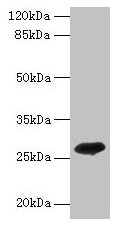
Western blot
All lanes: ADIPOQ antibody at 2µg/ml + Recombinant Adiponectin protein 0.1µg
Secondary
Goat polyclonal to rabbit IgG at 1/10000 dilution
Predicted band size: 27 kDa
Observed band size: 27 kDa
Important adipokine involved in the control of fat metabolism and insulin sensitivity, with direct anti-diabetic, anti-atherogenic and anti-inflammatory activities. Stimulates AMPK phosphorylation and activation in the liver and the skeletal muscle, enhancing glucose utilization and fatty-acid combustion. Antagonizes TNF-alpha by negatively regulating its expression in various tissues such as liver and macrophages, and also by counteracting its effects. Inhibits endothelial NF-kappa-B signaling through a cAMP-dependent pathway. May play a role in cell growth, angiogenesis and tissue remodeling by binding and sequestering various growth factors with distinct binding affinities, depending on the type of complex, LMW, MMW or HMW.
Gene References into Functions
These data suggest that energy balance around parturition may regulate plasma adiponectin but do not support roles for lipid mobilization or sustained changes in the plasma concentration of leptin, insulin, growth hormone, or fatty acids.PMID:28843695
Low level expression of adiponectin mRNA was found in all areas of bovine mammary gland tissues examined. AdipoR1 and AdipoR2 mRNAs were also detected in mammary tissues and their expression was particularly prominent in the parenchyma and cistern.PMID:25676879
Data suggest that genetic variation in promoter region of ADIPOQ (SNPs g.81966235C>T, g.81966377T>C, and g.81966364D>I) contribute to adiposity/marbling in skeletal muscle/meat (and thus meat quality) of Hanwoo beef cattle of North Korea.PMID:25817801
These data suggest differential contribution of adipose tissue depots to circulating adiponectin.PMID:24462180
Association analysis indicated that variable duplication within the ADIPOQ gene is associated with body measurements.PMID:24341634
14 polymorphisms of the ADIPOQ gene were observed in Chinese cattle; 2 polymorphisms PR_-135 A>G and PR_-68 G>C were located in the core promoter region of ADIPOQ; 3 haplotypes in the 2 polymorphic sites were detected which produce effects on ADIPOQ transcription and are associated with growth traitsPMID:24099391
reduced plasma adiponectin belongs to the subset of hormonal adaptations in EL dairy cows facilitating mammary glucose uptake via promotion of insulin resistancePMID:23077076
The physiologic status of the ovary has significant effects on the natural expression patterns of adiponectin and its receptors in follicular and luteal cells of bovine ovary.PMID:20047754
The disulfide bonds help to maintain the mature octadecameric adiponectin structure and stabilize intermediates during the assembly.PMID:19943704
Gobular adiponectin increased NO production in aortic endothlium by increasing NO synthase activity.PMID:14551684
A 5bp deletion mutation within the bovine ACRP30 gene was firstly detected and confirmed in 991 cattle .PMID:18446445
results indicate decreasing adiponectin sensitivity in adipose tissue after calving which might be involved in the reduced insulin sensitivity of adipose tissue during lactationPMID:19345551
Adiponectin gene was proved to be closely related to carcass and meat quality traits (P < 0.05), which can be used as a candidate molecular marker for production of high-grade meat in Qinchuan beef cattle.PMID:19840922