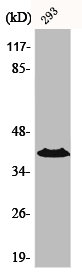
Synthesized peptide derived from the N-terminal region of Human CCRL1.
Immunogen Species
Homo sapiens (Human)
Conjugate
Non-conjugated
Isotype
IgG
Purification Method
The antibody was affinity-purified from rabbit antiserum by affinity-chromatography using epitope-specific immunogen.
Concentration
It differs from different batches. Please contact us to confirm it.
Buffer
Liquid in PBS containing 50% glycerol, 0.5% BSA and 0.02% sodium azide.
Tested Applications
WB, IF, ELISA
Storage
Upon receipt, store at -20°C or -80°C. Avoid repeated freeze.
Lead Time
Basically, we can dispatch the products out in 1-3 working days after receiving your orders. Delivery time maybe differs from different purchasing way or location, please kindly consult your local distributors for specific delivery time.
Note: All of our proteins are default shipped with normal blue ice packs, if you request to ship with dry ice, please communicate with us in advance and extra fees will be charged.
Usage
For Research Use Only. Not for use in diagnostic or therapeutic procedures.
Atypical chemokine receptor that controls chemokine levels and localization via high-affinity chemokine binding that is uncoupled from classic ligand-driven signal transduction cascades, resulting instead in chemokine sequestration, degradation, or transcytosis. Also known as interceptor (internalizing receptor) or chemokine-scavenging receptor or chemokine decoy receptor. Acts as a receptor for chemokines CCL2, CCL8, CCL13, CCL19, CCL21 and CCL25. Chemokine-binding does not activate G-protein-mediated signal transduction but instead induces beta-arrestin recruitment, leading to ligand internalization. Plays an important role in controlling the migration of immune and cancer cells that express chemokine receptors CCR7 and CCR9, by reducing the availability of CCL19, CCL21, and CCL25 through internalization. Negatively regulates CXCR3-induced chemotaxis. Regulates T-cell development in the thymus.
Gene References into Functions
Results of this study show that HEK 293 cells express an endogenous CCRL1 gene only at mRNA level. These data therefore represent the important implications for the use of HEK 293 cells as a host cell system for the study of CCX-CKR.PMID:26699909
we found that CCX-CKR expression in vitro could modulate cellular migration and invasion abilities, potentially via the regulation of other chemotactic factors/receptors.PMID:24338720
Effect of genetic variants in two chemokine decoy receptor genes, DARC and CCBP2, on metastatic potential of breast cancer.PMID:24260134
co-expression of DARC, D6, and CCX-CKR significantly associated with higher survival in gastric cancerPMID:23462454
Data suggest that co-expression of CCX-CKR and CXCR3 (chemokine receptor type 3) in T-lymphocytes results in protein multimerization and prevents CXCR3-mediated chemotaxis; this represents a novel mechanism of regulation of immune cell migration.PMID:23121557
Results suggest that chemokine binding to CCX-CKR recruits Gi proteins and beta-arrestin (beta-arr) with high affinity.PMID:23341447
Characterization of mouse CCX-CKR, a receptor for the lymphocyte-attracting chemokines TECK/mCCL25, SLC/mCCL21 and MIP-3beta/mCCL19: comparison to human CCX-CKR.PMID:11981810
Scavenges extracellular chemokines in vivo to modify responses through CCR7.PMID:16791897
Down regulation of CCX-CKR is associated with breast cancer.PMID:19383822
Show
More
Hide
All
Subcellular Location
Early endosome. Recycling endosome. Cell membrane; Multi-pass membrane protein. Note=Predominantly localizes to endocytic vesicles, and upon stimulation by the ligand is internalized via caveolae. Once internalized, the ligand dissociates from the receptor, and is targeted to degradation while the receptor is recycled back to the cell membrane.